"re-assessing deco profiles and deep stops", plus other bits..

Hi,

First off, thanks for taking the time to write such a long and detailed post. That's great :)

As you noted, I'm not against deep stops. I merely object to blanket statements such as "Deep Stops Are Good".

I might add that deco theory is of no practical concern to me at present, as I'm no longer diving twinsets, and not doing deco on my JJ (yet, and that's why "no diving twinsets" :) ). Furthermore, I'm of the school that divers spend too much time splitting hair over deco models, and not enough considering other DCS risk factors, including cold, effort, dehydration and tiredness. It is ridiculous to agonise about deep stops or GFs over drinks into the wee hours the night before going in on a wreck in cold water with a dampsuit off slack.

My interest in this is therefore largely curiosity.

With that in mind...

a/ I'm not clear if you mean "mathematically" or "in practice". Mathematically, well, I would have to disagree. The slower compartments will not have reached a "pressure" higher than the ambient partial pressure, therefore... I'll be right on board with "in practice" the total amount of gas to offgas is the same, tho.

But, if you're stopping deeper, it would follow that you'll offgas slower, so you need a longer deco time to get rid of that same amount of gas.

c/ Well, yes, but you're counting deco out of the water as part of the deco time. Longer in water deco time may mean coming out with the same amount of gas remaining in the body, if you offgased slower (deeper, for instance). It may also mean coming out with less gas in the body (e.g. if padding). And in between one may surface with less gas in the body, while also spending less time in the water.

And then there's where the gas is...

b/ and d/ Okay. Would the bubble score not increase with the diameter, too? I mean, the reflection surface would increase, right? Just wondering.
I understand that the lung is a pretty good bubble filter, provided that a) the bubbles are big enough, and b) there's not too much gas. So increased bubbling can mean more offgasing, it could even actually increase offgasing.
But only up to a point.
And that's offgasing from the blood. Doppler scores only measure moving bubbles, so in the bloodstream. And nothing about bubbles in tissues. Blood is used as a proxy. Fair enough, but is this a valid assumption?
I know JP Imbert is trying (was, anyway) to build a model that would distinguish between tissue bubbles, blood bubbles, and bubbles at the interface (crossing from tissue into blood), I need to check that again.

Still, all this would mean that the result from EAP3 is that the divers following MN78 were not offgasing much anymore after surfacing while those on the deeper profile still were. All else being equal, would it not be logical, then, to go for the shorter dive time?

Cheers,

Matthieu
 
Hi Matthieu,

Nice to talk with you on this - most others shy away from this stuff.

a/ The profiles in this test sequence was a standard shallow type one versus a slightly deeper one. The bottom segment is 20min at 60m, or in tissue terms, 20 mins of N2 being forced into tissues with 4.75 ATA behind it. That will move a lot of N2 into tissues.

Yes there will be a slight on gas of some slower tissues during the ascent, and they might add slightly to limits towards the end. That's normal on all ascents.

But, for the purpose of comparing two similar profiles, the difference in gas absorbed from each is found by applying the difference in stop depths only. So lets say profile A lags behind profile B by 5 mins through the ascent. The difference is only one or two stops at any given point, or (avg 0.5 ATA x 0.79) = 0.4 ATA. (10 % of the bottom value). At worst, we might add 10% more N2 to the tissues. But that would apply only to the slowest tissues, which are not going to be able to limit our ascent in this short test profile. The faster tissue are in off gas mode already, so maybe 5% extra? Its not a lot, and certainly would not be detectable with this test. The report is implying something like 50% change, which is not possible here.

During deco, the next tissue along that is about to limit our ascent in the next couple of stops, is already equal with ambient or slightly supersaturated and off gassing slowly, so it does not have any further gas intake. In a typical 16 cell model, on a 30 min deco, maybe cells 2 to 5 are limiting in the stops, with the rest not even close.

For single gas dives like air as used in test profiles, the only method to achieve off gas is through ascent and supersaturation. With a slightly slower ascent as with these 2 test profiles, one is essentially just slowing the off gas with little side effect from the additional depth during the ascent.

I hope that makes sense.

Matthieu: "But, if you're stopping deeper, it would follow that you'll offgas slower, so you need a longer deco time to get rid of that same amount of gas?"

Yes, and bubble models are already longer than ZHL for the first 2 hours or so (contrary to Andrew Fock's imagination).


Matthieu: "Still, all this would mean that the result from EAP3 is that the divers following MN78 were not offgasing much anymore after surfacing while those on the deeper profile still were. All else being equal, would it not be logical, then, to go for the shorter dive time?"

Maybe - the information that is missing here, is what happens in the initial ascent and first stops. The shallow stop model has an enormous supersaturation gradient initially, that likely moves a lot of gas quickly. Perhaps the off gas picture for the shallow model is a mirror image of the deeper stop one. They both have to shift the same volume of gas to the heart lung when its all finished - it just a question of when it happens.
The missing chapter in this story is measuring the gas outflow through the entire ascent. Currently we only see the end play, which is not enough information.

Microbubbles and supersaturation have been part of diving since man first breathed under water, and long before we could detect or measure them. Microbubbles are normal, and the lung has been filtering them ever since. I find this current trend of suggesting microbubbles are evil, to be rather silly. To use my coke bottle analogy again, you can open it so slowly enough that it does not bubble, but the drink will be flat when its poured out. We can make the deco long and slow enough too, but its no safer. It will not prevent a DCS injury either, that was going to happen for various reasons.

Regards
 
Hi Matthieu,

Nice to talk with you on this - most others shy away from this stuff.

a/ The profiles in this test sequence was a standard shallow type one versus a slightly deeper one. The bottom segment is 20min at 60m, or in tissue terms, 20 mins of N2 being forced into tissues with 4.75 ATA behind it. That will move a lot of N2 into tissues.

Yes there will be a slight on gas of some slower tissues during the ascent, and they might add slightly to limits towards the end. That's normal on all ascents.

But, for the purpose of comparing two similar profiles, the difference in gas absorbed from each is found by applying the difference in stop depths only. So lets say profile A lags behind profile B by 5 mins through the ascent. The difference is only one or two stops at any given point, or (avg 0.5 ATA x 0.79) = 0.4 ATA. (10 % of the bottom value). At worst, we might add 10% more N2 to the tissues. But that would apply only to the slowest tissues, which are not going to be able to limit our ascent in this short test profile. The faster tissue are in off gas mode already, so maybe 5% extra? Its not a lot, and certainly would not be detectable with this test. The report is implying something like 50% change, which is not possible here.

During deco, the next tissue along that is about to limit our ascent in the next couple of stops, is already equal with ambient or slightly supersaturated and off gassing slowly, so it does not have any further gas intake. In a typical 16 cell model, on a 30 min deco, maybe cells 2 to 5 are limiting in the stops, with the rest not even close.

For single gas dives like air as used in test profiles, the only method to achieve off gas is through ascent and supersaturation. With a slightly slower ascent as with these 2 test profiles, one is essentially just slowing the off gas with little side effect from the additional depth during the ascent.

I hope that makes sense.

Matthieu: "But, if you're stopping deeper, it would follow that you'll offgas slower, so you need a longer deco time to get rid of that same amount of gas?"

Yes, and bubble models are already longer than ZHL for the first 2 hours or so (contrary to Andrew Fock's imagination).


Matthieu: "Still, all this would mean that the result from EAP3 is that the divers following MN78 were not offgasing much anymore after surfacing while those on the deeper profile still were. All else being equal, would it not be logical, then, to go for the shorter dive time?"

Maybe - the information that is missing here, is what happens in the initial ascent and first stops. The shallow stop model has an enormous supersaturation gradient initially, that likely moves a lot of gas quickly. Perhaps the off gas picture for the shallow model is a mirror image of the deeper stop one. They both have to shift the same volume of gas to the heart lung when its all finished - it just a question of when it happens.
The missing chapter in this story is measuring the gas outflow through the entire ascent. Currently we only see the end play, which is not enough information.

Microbubbles and supersaturation have been part of diving since man first breathed under water, and long before we could detect or measure them. Microbubbles are normal, and the lung has been filtering them ever since. I find this current trend of suggesting microbubbles are evil, to be rather silly. To use my coke bottle analogy again, you can open it so slowly enough that it does not bubble, but the drink will be flat when its poured out. We can make the deco long and slow enough too, but its no safer. It will not prevent a DCS injury either, that was going to happen for various reasons.

Regards

Hi Ross, excelent explanation. I think here we are slowly arriving to the discussion from some time ago, when the object was bubble scores on some test dives that moved divers to change conservatism - ZHL-16+GF divers mostly. The question about how exact is the methodology of evaluating dives using just count of bubbles without knowing volume of those.
Everyone is talking just about those bubbles and how they are dangerous, but none wants to judge those bubbles based on their diameter and volume.
Big bubbles making troubles because they are unstable and tend to grow - creating damage,
small (micro)bubbles stable and normally not tending to grow - no damage.

I believe there should be more discussion around the dynamics of bubble growth when judging profiles. Same as more energy in trying to find a way to measure bubbles shape (diameter and volume) at the time of their count to get real picture.
 
But, for the purpose of comparing two similar profiles, the difference in gas absorbed from each is found by applying the difference in stop depths only. So lets say profile A lags behind profile B by 5 mins through the ascent. The difference is only one or two stops at any given point, or (avg 0.5 ATA x 0.79) = 0.4 ATA. (10 % of the bottom value). At worst, we might add 10% more N2 to the tissues. But that would apply only to the slowest tissues, which are not going to be able to limit our ascent in this short test profile. The faster tissue are in off gas mode already, so maybe 5% extra? Its not a lot, and certainly would not be detectable with this test. The report is implying something like 50% change, which is not possible here.

.....

We can make the deco long and slow enough too, but its no safer. It will not prevent a DCS injury either, that was going to happen for various reasons.
I draw from the discussion of the S-curve profiles, such saturation ranges.
Which was used to calculate the decompression in a single step to the surface. Of course, this oxygen decompression.
As shown in the calculation of the control tissue is 7.

1 P1 = 9.5 + (25.66-9.5) (0.5 ^ (10/5) = 13.54 m
2 P2 = 9.5 + (28.65-9.5) (0.5 ^ (10/8)) = 17.55 m
3 P3 = 9.5 + (29.82-9.5) (0.5 ^ (10/12, 5)) = 21.17 m
4 P4 = 9.5 + (28.99-9.5) (0.5 ^ (10/18, 5)) = 22.90 m
5 P5 = 9.5 + (26.68-9.5) (0.5 ^ (10/27)) = 22.79 m
6 P6 = 9.5 + (23.77-9.5) (0.5 ^ (10/38,3)) = 21.40 m
7 P7 = 9.5 + (20.67-9.5) (0.5 ^ (10/54,3)) = 19.33 m
8 P8 = + 9.5 (17.79 -9.5) (0.5 ^ (10/77)) = 17.07 m
9 P9 = 9.5 + (15.31-9.5) (0.5 ^ (10/109)) = 14.95 m
P10 = 10 + 9.5 (13.62-9.5) (0.5 ^ (10/146)) = 13.43 m
P11 = 11 + 9.5 (12.42-9.5) (0.5 ^ (10/187)) = 12.31 m

Again, a nice moment.

6 P6 21.40 (0.5 ^ (t/38, 3)) = 15.75 m t = 16.93 min
7 P7 19.33 (0.5 ^ (t/54,3)) = 14.85 m t = 20.654
8 P8 17.07 (0.5 ^ (t/77)) = 14.3 m t = 19.66

Will put increased saturation of 10% for free compartments, that can control the end of the decompression, after using a long deep stops.

Recalculates a range of controls and what decompression time.

6 P6 23.54 (0.5 ^ (t/38, 3)) = 15.75 m t = 22.28 min
7 P7 21.26 7 (0.5 ^ (t/54,3)) = 14.85 m t = 28.19
8 P8 18.78 (0.5 ^ (t/77)) = 14.3 m t = 30.26
9 P9 16.45 (0.5 ^ (t/109)) = 13.68 m t = 28.996

We see that the decompression controls oxygen decompression another range tissue 8, time increased from 20.654 min to 30.26 min.
This change in free tissue saturation of 10%, given the change in oxygen decompression time.
Yes, this approximate calculation.

Clearly shows that intuition leads to errors thick and lethal.
Just calculate, it is not difficult.


Is the performance of decompression according to the old method, extended bottom time or more depth, used for shallower decompression, is less safe?

greet rc
 
Last edited:
Hi Ross,

But, for the purpose of comparing two similar profiles, the difference in gas absorbed from each is found by applying the difference in stop depths only. So lets say profile A lags behind profile B by 5 mins through the ascent. The difference is only one or two stops at any given point, or (avg 0.5 ATA x 0.79) = 0.4 ATA. (10 % of the bottom value). At worst, we might add 10% more N2 to the tissues. But that would apply only to the slowest tissues, which are not going to be able to limit our ascent in this short test profile. The faster tissue are in off gas mode already, so maybe 5% extra? Its not a lot, and certainly would not be detectable with this test. The report is implying something like 50% change, which is not possible here.

During deco, the next tissue along that is about to limit our ascent in the next couple of stops, is already equal with ambient or slightly supersaturated and off gassing slowly, so it does not have any further gas intake. In a typical 16 cell model, on a 30 min deco, maybe cells 2 to 5 are limiting in the stops, with the rest not even close.

Okay, fair enough, I'm impressed.

I plugged in the EAP3 profile in my planner. For pure Buhlmann 16B (comp 0 is 5 mins, what's with the 2 options here, anyway?), descent 20m/min, ascent 10m/min, I get this for the second dive:

Ascending to 18.0, ceil=8.353474015143377m, controlling=1
Staying 1.0min. During stop: Offgasing: 0-5 ; Ongasing: 6-15
Ascending to 15.0, ceil=7.589006505818443m, controlling=2
Staying 1.0min. During stop: Offgasing: 0-6 ; Ongasing: 7-15
Ascending to 12.0, ceil=7.186480437371328m, controlling=3
Staying 1.0min. During stop: Offgasing: 0-7 ; Ongasing: 8-15
Ascending to 9.0, ceil=6.726197112848348m, controlling=3
Staying 2.0min. During stop: Offgasing: 0-8 ; Ongasing: 9-15
Ascending to 6.0, ceil=5.803969374036315m, controlling=3
Staying 5.0min. During stop: Offgasing: 0-10 ; Ongasing: 11-15
Ascending to 3.0, ceil=4.0458517084353085m, controlling=4
Staying 13.0min. During stop: Offgasing: 0-13 ; Ongasing: 14,15
Ascending to 0.0, ceil=1.7443454140296843m, controlling=5

So (do take this with salt, BTW, I hacked up this thing so much I wouldn't trust it to give me the time of day ;) ):

Pure Buhlmann says you should expect bubbling (offgasing) when getting out, because the ascent from 3 to 0 broke the ceiling.

The only controlling compartments are 1 to 5, the first compartment that suffers ongassing from the deeper stops is 6. So extra ongassing is irrelevant, like you said.

If we want to make dive 2 Bulhmann-safe, the stop at 3 needs to be 33 mins (20 mins extra, 43 mins total stop time).

Keeping dive 1 as is, if we do dive 2 the Buhlmann way, we get 4@9, 12@6, 27@3 (42 mins). Much longer than their profile, no practical difference with the above.

If we do both dive the Bulhmann way, dive 1 is now 1@9, 4@6, 8@3 (1 minute less than their profile), and dive 2 becomes 4@9, 11@6, 27@3 (and again).

So basically, no matter which way I look at it, pure Buhlmann says you should stay longer in the water (and 50m air is the sort of thing that I think has been pretty well tested by The Man), and their changes to the profile don't affect the time in the water, so why not do them, just in case ( :) )?

Yes, and bubble models are already longer than ZHL for the first 2 hours or so (contrary to Andrew Fock's imagination).

I do recall Andrew Fock showing a generated profile that showed over 100% gradient coming out, and I remember thinking the software was GAP, so RGBM. I don't know what profile that was, tho.

Maybe - the information that is missing here, is what happens in the initial ascent and first stops. The shallow stop model has an enormous supersaturation gradient initially, that likely moves a lot of gas quickly. Perhaps the off gas picture for the shallow model is a mirror image of the deeper stop one. They both have to shift the same volume of gas to the heart lung when its all finished - it just a question of when it happens.
The missing chapter in this story is measuring the gas outflow through the entire ascent. Currently we only see the end play, which is not enough information.

Right. So basically, it's a matter of perpective. From a bubble POV, a shallower profile that gets you out quicker and with less gas remaining means, suggests, that crazy bubbling occurred before, and is that safe? From a Haldanian POV, we "know" the body can take it, so deeper stops are an inefficient way to do deco. Except, actually, that the above suggests that you can do deeper stops without changing the total time in the water, at least for that profile.

I'd like to know more about this MN78 :)

Cheers,

Matthieu
 
Hello (and I guess to Ross in particular),

In respect of this tangled discussion of "deep stops" here are two indisputable facts:

First: Around the early to mid 2000s it became an article of faith for the vast majority of technical divers that a "deep stop" approach to decompression was superior to anything else.

Second: Since that time the weight of available evidence challenges rather than supports the above view.

To expand on this, in the first relevant paper (Undersea Biomed Res 1976;3:121), Tom Neuman found reduced venous bubble formation following deep air dives in which a single deep stop was imposed, in comparison to dives without the deep stop. This was followed by a paper (Undersea Hyperbaric Med 2004;21:233) by Marroni et al which showed a similar result for shallow air dives. Neither of these studies involved "deep stop profiles" containing a sequential series of deeper stops as we might follow if using VPM or a gradient factor algorithm with a low value for GF-low. Subsequently, Blatteau et al 2005 (Aviat Space Environ Med 2005;67:490) showed that a deep stop decompression profile produced more venous bubbles than a more traditional profile after decompression from a deep air dive. Shellart et al (Aviat Space Environ Med 2008;79:488) conducted a study with some similarities to the Marroni study cited above, but found the opposite result to Marroni (that is, dives with the deep stop produced more bubbles). Finally, in 2009 the US Navy Experimental Diving Unit presented the results of their deep stop study at the Decompression and Deep Stop workshop. The reference is as follows:

Gerth WA, Doolette DJ, Gault KA. Deep stops and their efficacy in decompression: U.S. Navy research. In: Bennett PB, Wienke BR, Mitchell SJ, editors. Decompression and the deep stop. Undersea and Hyperbaric Medical Society Workshop; 2008 Jun 24b-25; Salt Lake City (UT). Durham (NC): Undersea and Hyperbaric Medical Society; 2009. p. 165-85

This work has subsequently been published as an NEDU Technical report:

Doolette DJ, Gerth WA, Gault KA. Redistribution of decompression stop time from shallow to deep stops increases incidence of decompression sickness in air decompression dives. Technical Report. Panama City (FL): Navy Experimental Diving Unit; 2011 Jul. Report No.: 11-06. 53 p

This study is set apart from all others in that it used clinically diagnosed DCS in human subjects as an outcome measure. The divers completed wet dives to 170'; for 30 minutes during which time they performed a standardised level of work, and then decompressed according to prescriptions from a Haldanian-style USN algorithm or a USN bubble model (which specified deeper stops). There was a significantly greater incidence of DCS following the deep stop profile.

This is the study that Ross has attempted to discredit in this thread. I think he needs to be very cautious because there is a substantial risk he is wrong. As a group (technical divers), we (including me) were attracted to deep stop decompression largely because of theoretical attraction, and perhaps some supportive anecdote. However, as a group at the cutting edge of a field in which so much of what we do is experimental, we must never develop entrenched views on issues which are not illuminated by good evidence, and we need to stay alert to developments in that evidence base. My point is that the emerging evidence has cast significant doubt on the efficacy of deep stop approaches to improve safety in decompression. In his extensive (and frequently flawed) critique of this evidence Ross fails to acknowledge the fact that there is effectively NO evidence that supports the deep stop approach he defends. The most relevant evidence we have suggests the opposite, but I do agree that we cannot yet draw definitive conclusions (which is the consensus that the Deep Stops workshop came to). This is a long way from the certainty of benefit that technical divers have perceived over the years.

That is really the essence of what I want to say but if people can be bothered reading on, I will address some aspects of Ross's commentary on the USN and other studies.

Maybe now its time to expose some of the details behinds these.

The Navy test - did NOT use any deep stops! If you take away the paper's Title and conclusions, and take a good look at the study for yourself, you might come to a different conclusion.

* No deep stops used in the test -at all - none! They instead tried to simulate them by working its tissue model backwards. They took their BVM model (navy use only - not deep by our standards) and reversed into a shallow profile shape that would simulate the same tissue effects of the slightly deeper profile. All this artificial fiddling was done to get the profile to finish at the same time as the base control test model (VVAL18). They instead should have let the BVM make its own profile naturally and accept the different finish times, but they didn't. So this is why the test profile ended up with an unnatural multilevel profile (and why the test went of the rails). They had a multilevel shallow profile - not a deep profile, and no deep stops to be seen anywhere.

Ross, this is misleading. The truth is that both the deep stop profiles used in the USN study and those generated by VPM (especially the early iterations) have in common a tendency to reduce supersaturation in fast compartments at the expense of increased supersaturation in slow compartments when compared to shallow stops schedules. The fact that the deep stop schedule used here does not look exactly like a VPM profile is not the point. The point (that the current evidence is indicating) is that we must confront the possibility that this redistribution of emphasis in decompression is quite possibly not a good idea. I do not want to say more about this right now, except that I am as interested as everyone else in the truth, and more relevant material will be published in the near future.

* Next - and this is the kicker; the test was stopped because the base line control model (VVAL18) - was about to drop out the bottom of the test limits and invalidate the entire project. That's why it stopped - not because of the BVM model. The artificially simulated BVM profile was right down the middle of the test parameters (3 to 7%) exactly where it was calibrated to be. The test was stopped because the base line calibration data from its VVAL18 - the basis of many other navy testing projects - was about to invalidate this project by dropping below 3%. I'll say it again - this test stopped because the VVAL 18 control model datum, was 5 dives short of mandatory invalidation of the entire project!

Ross, this is wrong. The slide (with the blue background) you posted shows one approach to determining the duration of an experimental comparison (known as a sequential analysis). When results from either group crosses one of the pre-determined boundaries you analyze the results. Crossing the boundary does not invalidate the study. I suspect the reason they stopped was that the difference in DCS incidence between the groups had reached statistical significance and it would have been unethical to continue a trial with human DCS as the outcome measure when the research question had been answered.

A note on Navy testing risk rate: it is done with exaggeration (cold / exercise) to force DCS, so they can better measure it. That's why you get unrealistic risk numbers like 5% out of navy data - the risk numbers need to be normalized back to real world values.

Why? If there is an advantage for deep stops it would be all the better demonstrated under such circumstances.

So why did the navy label it deep, when there was none? Why did the navy spin the load of BS about the reasons for cancelling this test? I understand they had to save face and this this project from failure, but the spin is not justified, and neither are the papers conclusions.

Ross, some of the world's leading decompression scientists were involved in this study, and my personal advice would be that you be less aggressive and certain in your dismissive commentary because you might end up with egg on your face in the fullness of time.

And this from a later post:

More microbubbles does NOT mean higher risk! Research in this area has failed to find any correlation between microbubble volumes and DCS risk! Despite the obvious desire to link DCS to Spencer count, no researcher has ever been able to connect this.

This is wrong Ross. This matter is discussed extensively in Ron Nishi's chapter in Bennett and Elliott 5th edition. I am travelling so do not have access to the text, but there is a table that summarizes a fairly extensive dataset correlating the relationship between Doppler-detected venous bubbles and risk. While it is true that bubble counts are a non-specific indicator of risk of clinical DCS, it is wrong to say more bubbles does not mean higher risk. High bubble counts do carry a higher risk than low bubble counts, but not everyone with high bubble counts suffers DCS.

I wish to reiterate that I am neither pro- nor anti- deep stops. I am merely trying to be objective in appraising the relevant evidence on the matter, and at this stage it would be unwise to stipulate a certain view either way. The weight of currently available evidence certainly mandates revisiting our previous perception that deep stops were unquestionably the correct approach.

Simon M
 
Last edited:
Adjusting GF Lo ?

I think it was Mark who, several pages ago asked about using a higher GF Lo setting such as 75 or thereabouts. Has anybody tried this? Is this practical or is it less safe than say a more accepted GF Lo such as 30 that most computers default to? Theoretically, this seems like a reasonable proposal. What would be the downside of this?
 
Hello (and I guess to Ross in particular),

In respect of this tangled discussion of "deep stops" here are two indisputable facts:

First: Around the early to mid 2000s it became an article of faith for the vast majority of technical divers that a "deep stop" approach to decompression was superior to anything else.

Second: Since that time the weight of available evidence challenges rather than supports the above view.

To expand on this, in the first relevant paper (Undersea Biomed Res 1976;3:121), Tom Neuman found reduced venous bubble formation following deep air dives in which a single deep stop was imposed, in comparison to dives without the deep stop. This was followed by a paper (Undersea Hyperbaric Med 2004;21:233) by Marroni et al which showed a similar result for shallow air dives. Neither of these studies involved “deep stop profiles” containing a sequential series of deeper stops as we might follow if using VPM or a gradient factor algorithm with a low value for GF-low. Subsequently, Blatteau et al 2005 (Aviat Space Environ Med 2005;67:490) showed that a deep stop decompression profile produced more venous bubbles than a more traditional profile after decompression from a deep air dive. Shellart et al (Aviat Space Environ Med 2008;79:488) conducted a study with some similarities to the Marroni study cited above, and found the opposite result (that is, dives with the deep stop produced more bubbles). Finally, in 2009 the US Navy Experimental Diving Unit presented the results of their deep stop study at the Decompression and Deep Stop workshop. The reference is as follows:

Gerth WA, Doolette DJ, Gault KA. Deep stops and their efficacy in decompression: U.S. Navy research. In: Bennett PB, Wienke BR, Mitchell SJ, editors. Decompression and the deep stop. Undersea and Hyperbaric Medical Society Workshop; 2008 Jun 24b-25; Salt Lake City (UT). Durham (NC): Undersea and Hyperbaric Medical Society; 2009. p. 165-85

This work has subsequently been published as an NEDU Technical report:

Doolette DJ, Gerth WA, Gault KA. Redistribution of decompression stop time from shallow to deep stops increases incidence of decompression sickness in air decompression dives. Technical Report. Panama City (FL): Navy Experimental Diving Unit; 2011 Jul. Report No.: 11-06. 53 p

This study is set apart from all others in that it used clinically diagnosed DCS in human subjects as an outcome measure. The divers completed wet dives to 170’ for 30 minutes during which time they performed a standardised level of work, and then decompressed according to prescriptions from a Haldanian-style USN algorithm or a USN bubble model (which specified deeper stops). There was a significantly greater incidence of DCS following the deep stop profile.

This is the study that Ross has attempted to discredit in this thread. I think he needs to be very cautious because I think there is a substantial risk he is wrong. As a group (technical divers), we (including me) were attracted to deep stop decompression largely because of theoretical attraction, and perhaps some supportive anecdote. However, as a group at the cutting edge of a field in which so much of what we do is experimental, we must never develop entrenched views on issues which are not illuminated by good evidence, and we need to stay alert to developments in that evidence base. My point is that the emerging evidence has cast significant doubt on the efficacy of deep stop approaches to improve safety in decompression. In his extensive (and frequently flawed) critique of this evidence Ross fails to acknowledge the fact that there is effectively NO evidence that supports the deep stop approach he defends. The most relevant evidence we have suggests the opposite, but I do agree that we cannot yet draw definitive conclusions (which is the consensus that the Deep Stops workshop came to). This is a long way from the certainty of benefit that technical divers have perceived over the years.

That is really the essence of what I want to say but if people can be bothered reading on, I will address some aspects of Ross's commentary on the USN and other studies.


Ross, this is misleading. The truth is that both the deep stop profiles used in the USN study and those generated by VPM (especially the early iterations) have in common a tendency to reduce supersaturation in fast compartments at the expense of increased supersaturation in slow compartments when compared to shallow stops schedules. The fact that the deep stop schedule used here does not look exactly like a VPM profile is not the point. The point (that the current evidence is indicating) is that we must confront the possibility that this redistribution of emphasis in decompression is quite possibly not a good idea. I do not want to say more about this right now, except that I am as interested as everyone else in the truth, and more relevant material will be published in the near future.


Ross, this is wrong. The slide (with the blue background) you posted shows one approach to determining the duration of an experimental comparison (known as a sequential analysis). When results from either group crosses one of the pre-determined boundaries you analyze the results. Crossing the boundary does not invalidate the study. I suspect the reason they stopped was that the difference in DCS incidence between the groups had reached statistical significance and it would have been unethical to continue a trial with human DCS as the outcome measure when the research question had been answered.


Why? If there is an advantage for deep stops it would be all the better demonstrated under such circumstances.


Ross, some of the world’s leading decompression scientists were involved in this study, and my personal advice would be that you be less aggressive and certain in your dismissive commentary because you might end up with egg on your face in the fullness of time.

And this from a later post:


This is wrong Ross. This matter is discussed extensively in Ron Nishi’s chapter in Bennett and Elliott 5th edition. I am travelling so do not have access to the text, but there is a table that summarizes a fairly extensive dataset correlating the relationship between Doppler-detected venous bubbles and risk. While it is true that bubble counts are a non-specific indicator of risk of clinical DCS, it is wrong to say more bubbles does not mean higher risk. High bubble counts do carry a higher risk than low bubble counts, but not everyone with high bubble counts suffers DCS.

I wish to reiterate that I am neither pro- nor anti- deep stops. I am merely trying to be objective in appraising the relevant evidence on the matter, and at this stage it would be unwise to stipulate a certain view either way. The weight of currently available evidence certainly mandates revisiting our previous perception that deep stops were unquestionably the correct approach.

Simon M

Very interesting and thank you very much for posting. All these tests where done on Air. Is it possible that there might have been better results from deep stops if helium based mixes where used? Helium off gasses faster and a deco profiles might benefit more from deep stops using helium than when using air? Have any deep stop tests been done using helium based breathing gases ?
 
Hi Simon,

We should meet some day, instead of these disagreements on the web.


The US Navy test spent 3 hours (180mins) getting from 15m up the surface. That's not deep stops - not by anyone's standards. I say again - there are no deep stops in this navy test profiles. The navy was testing a navy idea for navy use, with navy models. It was NOT using any deep stop system consistent with any model like VPM, RGBM, RD, GF, Pyle, or anything else similar in use today (or older). It's plain obvious to anyone who cares to take a look.

That also was the basis of many objections by your peers in the follow up discussion at your UHMS conference in 2008. No one was in agreement. No one in the training industry has since embraced this study either.

But Andrew is on a on world tour, trying to sell this lemon to the public. Why is that?

I suggest you take a look at the earlier presentation of the study by Wayne at the DAN conference 2008 (link in the post above), as its a more technical version than your UHMS one was. He explains some of the reasons behind the choices for this strange test parameters. Yes, it was cancelled due to the impending failure of the control.


****


The French test is more interesting, and almost representative of tech world diving. But they poisoned the test sequence when 25% of the divers had prior DCS cases (one severe). This is all documented in the study paper. More on the bubble count below.


****

Bubble sizes and counting:

Quoting from your "UHMS Decompression and Deep Stops Workshop proceedings 2008" ISBN 0-930406-24-9

Bubble Detection and DCS Relevance by Neal Pollock.

  • page 215 p2: " A recent study of 1,726 air dives and 1,508 heliox dives showed extremely poor positive predictive value for Spencer Grade III-IV intravascular bubbles."
  • Page 218 p4: "Intravascular bubble grades are generally not correlated with the severity of DCS."
  • Page 223: Conclusions: "VGE are not a direct measure of decompression sickness, but ultrasonic bubble monitoring can provide a useful measure of decompression stress."
Its a great presentation as Neal summarizes many of the prior studies in this field.


I will rephrase my earlier statement:

More microbubbles does NOT mean higher risk! Research in this area has failed to find correlation between microbubble volumes and DCS risk! Despite the obvious desire to link DCS risk to Spencer count, that simple relationship is not there.

****

It pretty clear that the whole microbubble in VGE and it relevance to risk, is not understood. But we have various test papers jumping to a conclusion that the higher count proves their papers theory - when it suits the author.

Different profiles have different off gas characteristics - why is that a surprise to anyone?

I wish you guys would get it right and come up with some good work in this area. I really do. This has been dragging on for a decade now.


I did not invent the deep stop, and I have not made any unrealistic claims about them. I leave that for others to decide for themselves. I was just lucky enough to be invited to help in the VPM project and getting it out in software.

The dive industry has adopted deep stops into diving the world over. Training organizations include them too. Every tech dive computer has them included in the model it uses. The man tested original models from the 90's have been left behind, or abandoned, or modified to become deep stops systems themselves. Deep stops profiles are ubiquitous and more successful than there predecessors. There is a mountain of anecdotal data to be seen everywhere. None of it has been formally tested.

VPM-B is 10 years old this month, and its still used in its original specifications. It's dived by thousands everyday, and used in all types of profiles. Thousands more use similar models and methods, all with deep stops.

It seems odd that a Dr would spend his time using flawed data, trying to scare us back to the 1990's.

Rossh
 
Last edited:
Hi Simon,

Again conclusions just on boubble number count and not volume of boubles - dimensions of boubbles.

I belive there (in boubble dimensions and not just boubble number) is the reason why some divers with same boubble scores sufer DCS and some does not. I realy hope someone will start a study on boubble dimension tracking and not just number count. Does actual methods detect difference between microboubbles and bigger microboubbles?

NEDU study was made on completely different profile than we technical divers dive.
This was extensively discused on TDS when the results of NEDU resurch were published.

I hope someday someone makes a study on real profiles we do.

Regards,

Igor P

Sent from my GT-I5800 using Tapatalk 2
 
Last edited:
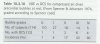
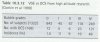
Here are the bubble count vs DCS data from Ron Nishi's chapter in Bennett and Elliott.One table describes data from air dives and the other from altitude exposures.

There is a clear dose response, though the relationship is non-specific (high bubble counts are not invariably associated with DCS). Nevertheless, Ross's categorical statement about the absence of such a relationship is incorrect.

Nishi 1.jpg

Nishi 2.jpg
 
Last edited:
Here are the bubble count vs DCS data from Ron Nishi's chapter in Bennett and Elliott.One table describes data from air dives and the other from altitude dives.

There is a clear dose response, though the relationship is non-specific (high bubble counts are not invariably associated with DCS). Nevertheless, Ross's categorical statement about the absence of such a relationship is incorrect.

View attachment 2751

View attachment 2752

Simon, Perhaps I came on too strong originally.

Maybe we are going at this from the wrong angle. That test data you show here is for individuals, who were pushed into DCS, through deco failure. The bubbles are inclusive to the DCS event.

But what were are discussing above, is comparison of two successful ascents - without any DCS. The problem assumption is "because the bubble count is higher, therefore its a precursor to DCS". But that is not true. More bubbles do not indicate a pending DCS event.

To quote another line from Dr. Neal Pollock: "The most critical limitation of bubble data is the uncertainty regarding the role intervascular bubbles play in the development of DCS."

Rossh
 
Hi Simon,

We should meet some day, instead of these disagreements on the web.

Ross,

Yes definitely, and please understand there is nothing personal in this. However, you are making some fairly strong statements "on the web" on matters that may relate directly to dive safety and I do not agree with all of them. Under those circumstances you can expect some debate.


The US Navy test spent 3 hours (180mins) getting from 15m up the surface. That's not deep stops - not by anyone's standards. I say again - there are no deep stops in this navy test profiles. The navy was testing a navy idea for navy use, with navy models. It was NOT using any deep stop system consistent with any model like VPM, RGBM, RD, GF, Pyle, or anything else similar in use today (or older). It's plain obvious to anyone who cares to take a look.

You are ignoring / obfuscating the crucial point I made about redistribution of decompression time in my ealier post. Most of the models / approaches you name (including VPM) reduce supersaturation of fast tissues while increasing supersaturation of slow tissues. (Doolette et al Navy Experimental Diving Unit; 2011 Jul. Report No.: 11-06. 53 p.). It is to some extent irrelevant that the profiles of the USN or Blatteau studies are not exactly like VPM. What these studies MAY be telling us is that this approach to decompression MAY not be a good thing.

That also was the basis of many objections by your peers in the follow up discussion at your UHMS conference in 2008. No one was in agreement. No one in the training industry has since embraced this study either.

I don't know which UHMS Deep Stops workshop you attended Ross, but I convened one and edited the proceedings and my recollection is very different to yours. The Gerth and Blatteau papers were very well received by everyone except known proponents of deep stops (my co-convenors Peter Bennett and Bruce Wienke). The level of concern about the safety of deep stop approaches to decompression was sufficient among the participants that they came to a consensus statement warning the diving community that there was no basis for claiming that deep stop approaches were better (or worse). This outcome is clearly documented in the proceedings and the fact that it occurred does not support your claim quoted above.

But Andrew is on a on world tour, trying to sell this lemon to the public. Why is that?

Andrew is not on a world tour, and he is not trying to sell anything. He is giving an objective appraisal of the available evidence (as I am). In contrast, you are selling the benefits of an approach to decompression based almost entirely on theoretical attraction alone, and with essentially NO data that identifies it as superior.

I suggest you take a look at the earlier presentation of the study by Wayne at the DAN conference 2008 (link in the post above), as its a more technical version than your UHMS one was. He explains some of the reasons behind the choices for this strange test parameters. Yes, it was cancelled due to the impending failure of the control.

NO it was not, but yes, let's take a look at the earlier presentation as you say. At the bottom of this post I have pasted the paragraph from the DAN 2008 workshop that describes why the study was terminated. It says nothing about "impending failure of the control".It is in complete agreement with what I said in my earlier post. You have no right to make statements that are clearly wrong about an important study like this.

The French test is more interesting, and almost representative of tech world diving. But they poisoned the test sequence when 25% of the divers had prior DCS cases (one severe). This is all documented in the study paper. More on the bubble count below.

Why would this "poison the sequence" so long as the prior DCS cases participated equally in all the profiles tested?

Bubble sizes and counting:

Quoting from your "UHMS Decompression and Deep Stops Workshop proceedings 2008" ISBN 0-930406-24-9

Bubble Detection and DCS Relevance by Neal Pollock.

  • page 215 p2: " A recent study of 1,726 air dives and 1,508 heliox dives showed extremely poor positive predictive value for Spencer Grade III-IV intravascular bubbles."
  • Page 218 p4: "Intravascular bubble grades are generally not correlated with the severity of DCS."
  • Page 223: Conclusions: "VGE are not a direct measure of decompression sickness, but ultrasonic bubble monitoring can provide a useful measure of decompression stress."
Its a great presentation as Neal summarizes many of the prior studies in this field.

You are misinterpreting what Neal is saying. I don't disagree with any of the above statements but they simply articulate what I have already said: that high bubble grades do not accurately predict the occurrence of DCS. This is very different to your categorical statement that there was no link between bubbles and risk of DCS. I have presented the data that you claimed did not exist in the two tables in my earlier post. Their meaning is self apparent.

I will rephrase my earlier statement:

More microbubbles does NOT mean higher risk! Research in this area has failed to find correlation between microbubble volumes and DCS risk! Despite the obvious desire to link DCS risk to Spencer count, that simple relationship is not there.

The statement is still clearly wrong. See the tables I presented in my earlier post.

It pretty clear that the whole microbubble in VGE and it relevance to risk, is not understood. But we have various test papers jumping to a conclusion that the higher count proves their papers theory - when it suits the author.

I think the Blatteau paper is fairly honest about what it means or does not mean. The conclusion in the abstract is the most accurate one. It reads: "The addition of deep stops requires careful consideration. Two of our EAPs made no difference and one produced increased bubbling". Hardly jumping to conclusions.

Deep stops profiles are ubiquitous and more successful than there predecessors.

And this is the point. There is not a shred of evidence to support this statement. Most of the available evidence (with whatever imperfections it has) points in the other direction.

There is a mountain of anecdotal data to be seen everywhere.

Where exactly? Lots of divers have been injured, and some have died after following VPM or RGBM. How do you know whether your approach is optimal?

None of it has been formally tested.

See the USN study and Blatteau.

It seems odd that a Dr would spend his time using flawed data, trying to scare us back to the 1990's.

This is uncalled for. I am not trying to scare anyone back to anywhere. Quite frankly Ross, it is you who should consider a little introspection. You are challenging the best evidence we have in actively promoting a particular approach to an activity with significant hazards. Moreover, aspects of your commentary are demonstrably inaccurate (as I have documented above). I am merely pointing out that we cannot be as sure about this as you would have us believe.

Simon M
 

Attachments

  • Gerth paragraph.jpg
    Gerth paragraph.jpg
    123 KB · Views: 82
Last edited:
.
Boy, you guys are really hanging onto this turkey and not letting go.


170ft_30_air_NEDU_1v1.png


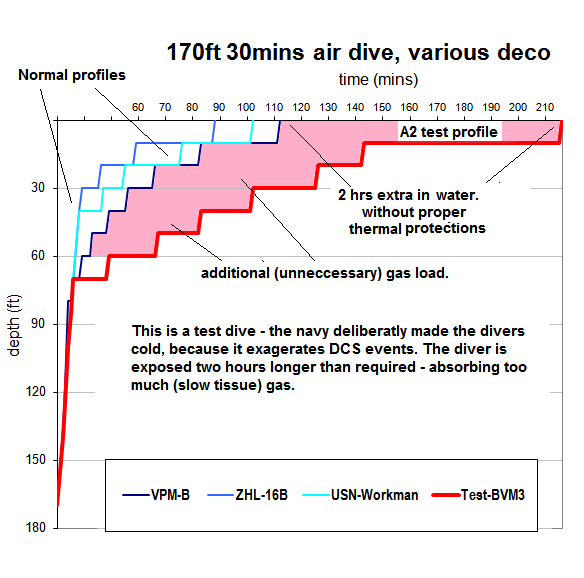
Shown to the left are three profiles of interest.

ZHL16-B
USN / Workman (2003)
VPM-B

Here you can see the difference between two conventional Haldane profiles, and a bubble profile. At this wide time scale, they are not too far apart. You can see that the bubble model starts deeper, and ends later than the other two. Any shallow stop off gassing required for the bubble model is essentially delayed a little compared first two.


The big red line is this test profile. It adds two extra hours, and during that time, will likely saturate a good number of the tissues. This is not the same as a bubble style profile - no matter how much fancy math the navy throws at this - you can't make it the same as the bubble model profile conditions.

The DCS events occur for two reasons.

1/ The diver is two hours extra colder - remember these guys have no wetsuit. The navy deliberately makes them cold to force DCS and exaggerate the effects. Recently there was a detailed study that showed how cold like this affects deco negatively, confirming the navy's practice here.

2/ This diver has saturated many of his tissues, and requires a lot of deco to clear. The profile has trapped him by staying too long. Again, the conditions are not the same as a bubble profile.


You are ignoring / obfuscating the crucial point I made about redistribution of decompression time in my ealier post. Most of the models / approaches you name (including VPM) reduce supersaturation of fast tissues while increasing supersaturation of slow tissues. (Doolette et al Navy Experimental Diving Unit; 2011 Jul. Report No.: 11-06. 53 p.). It is to some extent irrelevant that the profiles of the USN or Blatteau studies are not exactly like VPM. What these studies MAY be telling us is that this approach to decompression MAY not be a good thing.


If you worked in modeling, you can see all this in motion. You can stop them half way up and see how one thing affects another. Your point here about extra on gassing is not valid for this range of depth and deco profiles. Very little extra time is added to the slower tissues from the deeper stops. If this is the basis of the whole objection, then your making an objection over nothing.

There are three examples of this with math in the posts above. For these modest dive depths, the longer ascent time comes from the approaching limiting cells were "on hold", while were doing the deeper stops. The approaching stops and cells are at ambient while we stop deeper (not on gassing), and only go supersaturated as we ascend. The slower cells at the end of the profile, as so far away from the limits for this range of dive profile, that we essentially arrive at the shallows, before than can gas up enough to effect the ascent.

What's the difference in time? Well you can see it between the first two standard profiles and the VPM-B one, in the graph above.

-------

For the conditions your suggesting: extra deco time added due to the occurrence of the deep stop - you need a really deep profile (90m+) and the matching deco to get significant extra compounded time in the latter segments. Its all proportional to the deco amount. In order to add enough gas to the shallow segments you need to be stopping much deeper. A quick look though our 82,000 dive data base, and you can see how the shallow segments begin to roll over flat as the dive gets deeper. That is your on gassing effect in action. You can see this effect in every deco model.

****

I'm going to skip over the rest of your reply, as its mostly a tit for tat argument now.

I realize that Dr.'s have an etiquette to uphold, with regards to others published papers. But I don't and I can call BS at any time.:banana1:

rossh
 
.
I'm going to skip over the rest of your reply, as its mostly a tit for tat argument now.

I suppose it suits you to trivialise the points I have made by calling it "tit for tat". But in this "tit for tat" I have demonstrated that you misrepresented the facts about bubbles and risk and of DCS, and about sequential analysis of comparative trials. It is also where I point out that the published consensus view of the diving scientific community is that you have no evidence to support your claim of superior efficacy of the decompression methods that you aggressively promote. I think that is a crucial point.

As to the debate about redistribution of decompression time between deep and shallow stops, I can go no further with that without encroaching on other people's unpublished work. Hopefully we will not have to wait long for it.

Finally, since these debates can give a false impression of total polarisation, I would like to restate my position that I am not saying that deep stop decompression methods are bad or that they don't work. What I am saying is that the best evidence currently available does not support Ross's contention that these methods are demonstrably superior. That view has the backing of the diving science community as expressed in the consensus statements published in the UHMS Deep Stops workshop proceedings.

Simon M
 
.
Boy, you guys are really hanging onto this turkey and not letting go.


170ft_30_air_NEDU_1v1.png


Shown to the left are three profiles of interest.

ZHL16-B
USN / Workman (2003)
VPM-B

Here you can see the difference between two conventional Haldane profiles, and a bubble profile. At this wide time scale, they are not too far apart. You can see that the bubble model starts deeper, and ends later than the other two. Any shallow stop off gassing required for the bubble model is essentially delayed a little compared first two.


The big red line is this test profile. It adds two extra hours, and during that time, will likely saturate a good number of the tissues. This is not the same as a bubble style profile - no matter how much fancy math the navy throws at this - you can't make it the same as the bubble model profile conditions.

The DCS events occur for two reasons.

1/ The diver is two hours extra colder - remember these guys have no wetsuit. The navy deliberately makes them cold to force DCS and exaggerate the effects. Recently there was a detailed study that showed how cold like this affects deco negatively, confirming the navy's practice here.

2/ This diver has saturated many of his tissues, and requires a lot of deco to clear. The profile has trapped him by staying too long. Again, the conditions are not the same as a bubble profile.


If you worked in modeling, you can see all this in motion. You can stop them half way up and see how one thing affects another. Your point here about extra on gassing is not valid for this range of depth and deco profiles. Very little extra time is added to the slower tissues from the deeper stops. If this is the basis of the whole objection, then your making an objection over nothing.

There are three examples of this with math in the posts above. For these modest dive depths, the longer ascent time comes from the approaching limiting cells were "on hold", while were doing the deeper stops. The approaching stops and cells are at ambient while we stop deeper (not on gassing), and only go supersaturated as we ascend. The slower cells at the end of the profile, as so far away from the limits for this range of dive profile, that we essentially arrive at the shallows, before than can gas up enough to effect the ascent.

What's the difference in time? Well you can see it between the first two standard profiles and the VPM-B one, in the graph above.

-------

For the conditions your suggesting: extra deco time added due to the occurrence of the deep stop - you need a really deep profile (90m+) and the matching deco to get significant extra compounded time in the latter segments. Its all proportional to the deco amount. In order to add enough gas to the shallow segments you need to be stopping much deeper. A quick look though our 82,000 dive data base, and you can see how the shallow segments begin to roll over flat as the dive gets deeper. That is your on gassing effect in action. You can see this effect in every deco model.

****

I'm going to skip over the rest of your reply, as its mostly a tit for tat argument now.

I realize that Dr.'s have an etiquette to uphold, with regards to others published papers. But I don't and I can call BS at any time.:banana1:

rossh
The BVM3 profile in graph is multilevel dive if you are looking from sport diving dive planning prospective. So as such should be compared to normaly calculated sport dive profile.

This way it should be checked if it would compromise ceilings.
Need to surch the actual profile and try to make comparision.

The seccond thing is the misleading boubble count that should indicate bigger possibility of DCS ocurence. Seems everyone agree it is not accurate indicator of DCS ocurence - mean it can not tell for sure DCS will happen.
So another indicator should be invented - more accurate.

Sent from my GT-I5800 using Tapatalk 2
 
Finally, since these debates can give a false impression of total polarisation, I would like to restate my position that I am not saying that deep stop decompression methods are bad or that they don't work. What I am saying is that the best evidence currently available does not support Ross's contention that these methods are demonstrably superior. That view has the backing of the diving science community as expressed in the consensus statements published in the UHMS Deep Stops workshop proceedings.

Simon M

Simon, the deep stop decompression methods are not all just methods, bouble models are models and not methods, they do not modifie or use some imaginary aproach, but calculate its parameters and based on them geave stops, which coincidentaly are barely/in some way similar to deep stop theoryes. I think we should case the discusion on deep stops as they are not some aditional sort of stops but in bubble models normal required stops.

I wrote lot of times until now, I realy hope someone will someday make some resurch on real sport diving profiles (profiles we do in our diving) and publish it's results.

If it is true what some friends told me, there was a study run in Split (Croatia) that some of my friends took part, but I haven't jet seen any publication about. I am still waiting to see the results if I ever will get. In that study there were used CCR divers same as OC divers doing deep dives planned with V-planner (so it was interpreted to me Ross, do not know more).

Igor P
 
At worst, we might add 10% more N2 to the tissues. But that would apply only to the slowest tissues, which are not going to be able to limit our ascent in this short test profile. The faster tissue are in off gas mode already, so maybe 5% extra? Its not a lot, and certainly would not be detectable with this test. The report is implying something like 50% change, which is not possible here.

6 P6 21.40 (0.5 ^ (t/38, 3)) = 15.75 m t = 16.93 min
7 P7 19.33 (0.5 ^ (t/54,3)) = 14.85 m t = 20.654
8 P8 17.07 (0.5 ^ (t/77)) = 14.3 m t = 19.66

Will put increased saturation of 10% for free compartments, that can control the end of the decompression, after using a long deep stops.

Recalculates a range of controls and what decompression time.

6 P6 23.54 (0.5 ^ (t/38, 3)) = 15.75 m t = 22.28 min
7 P7 21.26 7 (0.5 ^ (t/54,3)) = 14.85 m t = 28.19
8 P8 18.78 (0.5 ^ (t/77)) = 14.3 m t = 30.26
9 P9 16.45 (0.5 ^ (t/109)) = 13.68 m t = 28.996

We see that the decompression controls oxygen decompression another range tissue 8, time increased from 20.654 min to 30.26 min.
This change in free tissue saturation of 10%, given the change in oxygen decompression time.
Yes, this approximate calculation.

Clearly shows that intuition leads to errors thick and lethal.
Just calculate, it is not difficult.

Ross did not you answer.

greet rc
 
Some discusion was on TDS here, read at least where I.G Saturation coments the study: The Deco Stop

If you utter the view, which can be easily calculated and the result is contrary to the view.
It falls to comment or withdraw from wrong view.

Showed that the change in free tissue saturation of 10% gives you extra time by about 50% at the shallow stops, for speeding up calculations applied oxygen decompression.

greet rc
 
Back
Top