My DCS Hit

Status
Not open for further replies.
Hello Jeff,

The one thing that the formal evaluations of deeper vs shallower stop approaches have taught us to date is that there is nothing magical about the bubble model approach of protecting fast tissues from supersaturation early in an ascent that could be expected to facilitate "longer bottom times, less deco". Every time these approaches have been carefully compared in human experiments the result is more DCS and / or more bubbles and / or more inflammatory activation in the deeper stop approaches. The face validity of these results is enhanced by ISS evaluations like the ones posted by UWSojourner here which show greater supersaturation levels in the deeper stop approaches.

Your obvious scepticism about all this is (quite understandably) based on your own good outcomes when using VPM. I don't dispute these outcomes for one picosecond. Nor would I recommend you change if VPM is working for you. But for perspective, it is important you understand that humans are not all equal in respect of vulnerability to DCS. Some are bubblers and some are not. In my life as a diving physician I have seen divers who have been doing outrageous things (off the scale of any deco algorithm we use) for many years with no problems. My point is that your successful use of VPM says little about it as a source of truth for the wider community. That is why we do proper studies, and I have mentioned the results of those performed to date above.

It is entirely plausible that your diving would be even safer (that is, you would be further away from the edge of risk) if you used an approach with less emphasis on deep stops. To illustrate this (entirely hypothetically), lets say you have done 3000 dives, and your risk using VPM is 1 case in 4000 dives. It would therefore not be surprising that you have not had a case of DCS yet. But another approach might have a risk of 1 case in 6000 dives. The alternative would therefore be safer. This is just hypothetical and not intended to reflect reality in any objective sense. But the best evidence we currently have is that bubble models have no particular qualities that facilitate "longer bottom times, less deco" and I wanted to discuss how the fact that you appear to have reaped such a benefit so far may be an attribution error, and that it is your physiology rather than the model that is working for you at the moment.

Simon M
Simon, you and others keep bringing up deep stops, we don't see them. Our dives are 200-350ft , runtimes 2.5 plus. We don't see these mystical deep stops. Sometimes we see them on the computers, but by the time we get there, that they are gone. The number of times were ever had to do any actual deep stop,I can count on one hand with 5 fingers left. Our stops at the deepest start at 100ft. I don't consider that a deep stop. As I stated above, perhaps all this banter on deep stops is only applicable to extreme dives, and for most divers not even relevant.

Now the 400ft dive we're planning, had some deep stops, and we will adhere to those. Logically it makes sense to slow bubble formation.

I make no claim that vpm is for everyone,I just bristle at all these deep stop debate, as from our perspective, it's not even applicable and seems more academic than practical. We just don't see them.
 
Simon, you and others keep bringing up deep stops, we don't see them. Our dives are 200-350ft , runtimes 2.5 plus. We don't see these mystical deep stops. Sometimes we see them on the computers, but by the time we get there, that they are gone..
Sorry Jeff but when you multilevel dive (as indicated by rjack) and due to that "automatically" are doing deep "stops" and you claim you do not see deeps stop and therefore the debate is wrong, then this thinking is flawed.
It is similar to a rec diver that is racking up several minutes of stop time at max depth on his computer, then continues the dive shallower and by the time he gets to his safety stop the computer is within NDL again claiming after the dive he did a NDL dive which he did not..
If by the time you get there stops that had been shown on your computer are gone as you state it means that you have done those stops and in fact likely even exceeded those stops.. in relation to the discussion at hand that means that you are (given all available knowledge up to date) very likely even increasing the DCS risk in comparison to actually surfacing directly as prescribed by VPM when those stops "sometimes are seen on the computers"
 
Simon, you and others keep bringing up deep stops, we don't see them. Our dives are 200-350ft , runtimes 2.5 plus. We don't see these mystical deep stops. Sometimes we see them on the computers, but by the time we get there, that they are gone. The number of times were ever had to do any actual deep stop,I can count on one hand with 5 fingers left. Our stops at the deepest start at 100ft. I don't consider that a deep stop. As I stated above, perhaps all this banter on deep stops is only applicable to extreme dives, and for most divers not even relevant.

Now the 400ft dive we're planning, had some deep stops, and we will adhere to those. Logically it makes sense to slow bubble formation.

I make no claim that vpm is for everyone,I just bristle at all these deep stop debate, as from our perspective, it's not even applicable and seems more academic than practical. We just don't see them.
I think the simplest way forward for all would be if you could post a planned dive profile for a dive you did and then the actual dive log. Then everyone could see what you mean.
 
An ascent rate marginally lower than the computer expects is enough to clear those stops. Not saying you do, but most divers I know struggle to keep their ascent speed up.
 
An ascent rate marginally lower than the computer expects is enough to clear those stops. Not saying you do, but most divers I know struggle to keep their ascent speed up.
surely not with GF computers.. maybe the very first gets eliminated and you end up 3m shallower, but no significant changes.
Maybe different actually diving VPM with a computer, but what does it actually mean? It means you DID in fact already do those stops..

Lastly most of the folks I know that used VPM did it with precut tables not live computers and they def ended up with DEEP first stops..
 
surely not with GF computers.. maybe the very first gets eliminated and you end up 3m shallower, but no significant changes.
Maybe different actually diving VPM with a computer, but what does it actually mean? It means you DID in fact already do those stops..

Lastly most of the folks I know that used VPM did it with precut tables not live computers and they def ended up with DEEP first stops..

i used to run hard tables ,
and to get back to first deep stop on time , id pad first stop or leave bottom a few mins be4 my planed bottom time , so for the most part i was using not the table in my hand
padding the deep stop may have put more risk in to the dive , leaving bottom a few mins less than planned lowered the risk some what , 80 90m stuff
no bends ,(well none that put me in a pot ) 2 that i fixed my self , so luck was with me maybe , not vpm
ddplan gf s or bend and mend proplan or zplan with pyle stops on or off depending on depth,

then deco on the fly with vf£ and pushing the dope on the rope ,
 
Last edited:
Jeff just post some screen shots from your shearwater of a couple of your dives. My personal definition of what a deep stop actually "is" is colored by my past OC training and perspective, For most of my dives I have max depths in the 180-220ft range and with 30min BTs I get first stops on buhlmann in the 80-120ft range. The slower I come up (multi-leveling) the more likely these clear and my first "real" stop ends up staying put around 60-70ft. Its actually somewhat difficult for me, and I suspect most of us, to ascend fast enough to arrive at the shearwater prescribed first stop before it clears on me. I usually dive GF 40/80. The shorter the time at depth the more buhlmann and VPM agree too.

Vs Trying doing a 3hr 32% OC dive at an average of 90ft and VPM and Buhlmann start to diverge more & more.
 
we watch our comps very diligently, I think the deepest stop I've ever seen indicated was 130. And gone by the time we get there.

But yea Richard, my experience matches yours with respect to stops. Most of the time we're stopping starting at 70ft.

Even a 130ft stop, I dont really consider a deep stop.

But basically yea, deeper and longer is where VPM and Buhlmann diverge.
 
we watch our comps very diligently, I think the deepest stop I've ever seen indicated was 130. And gone by the time we get there.
This is odd. must be tied to the relatively aggressive VPM settin (2/3).. on my 100m+ (330'+) dives with 2-3 hr RT I see my first stops at 50mish(160'is) with a GFlo of 40 or even 50..
VPM (from planning on PC) should more demand a stop comparable to GFlo 10-25 range which then again should be deeper like mid to low 50s (180'ish)
...
130' is a deep stop.. a VPM or GF profile that gives you a 130' stop would with a pure Bühlmann let you likely get up to the range of 70'.. so starting at roughly double the depth is deep.. But yes it is not a depth one would place a Pyle stop those would be deeper..
 
My personal move away from deep stops was based upon several years of personal testing during Innerspace by the Dan Docs performing a multi year trans thoracic echo cardiogram bubble test on me. As I eventually moved from an 15/85 GF with Pyle Stops, to what eventually became 40/70 GF, my bubble scores decreased significantly. For me personally, this was a real eye opener and was all of the personal proof I needed. We can argue all we want about whether bubbles in the heart are a perfect indicator of DCS stress or not, but they can't be good for you! :) I am further comforted by the fact that the most current, widely recognized consensus within the decompression scientific community points towards the direction in which I have moved.
Hello Randy,

With your study, were there any particular milestones in how you changed things which could indicate the relative importance of having removed the Pyle stop, to raising GF Low versus lowering GF high to the substantial reduction in your bubble scores.

It is results on one diver for a particular set of dives so can't be extrapolated to be representative of all divers, but it would still be interesting information to know.

Did any other divers achieve similar results from changing their model parameters?

I assume the test results will be in the DAN database so should provide some quality data for decompression model evaluation purposes.

Thanks,
Tony
 
Did any other divers achieve similar results from changing their model parameters?

Six years ago I went to a talk by Andrew Fock in which he presented the results of the NEDU and a French study, and explained that deeps stops may not be all that they were cracked up to be.

This seemed reasonable enough, so I figured I'd increase my low GF by 10 every year and see.

This was an easy enough decision because I had little deco behind me, all on OC at 30/80, and none on rebreather, so I had no personal experience of "deco that works for me". I did however, because of all the online talk, sort of expect that this would end up in the chamber.

I've now been diving 80/80 for two years, and nothing ever happened. Just this last Monday, I did a 114m, 4h6min dive, starting my final ascent from 6m at 85, actually, because I was getting very cold, and nothing happened. I did get tested for bubbles once, in 2016, diving 70/80, and there was nothing to see - that was a 50m 2h-ish dive.

Cheers,

Matthieu
 
Hello Randy,

With your study, were there any particular milestones in how you changed things which could indicate the relative importance of having removed the Pyle stop, to raising GF Low versus lowering GF high to the substantial reduction in your bubble scores.

It is results on one diver for a particular set of dives so can't be extrapolated to be representative of all divers, but it would still be interesting information to know.

Did any other divers achieve similar results from changing their model parameters?

I assume the test results will be in the DAN database so should provide some quality data for decompression model evaluation purposes.

Thanks,
Tony

Hi Tony,

I participated in the study along with both of my boys. The bubble scores were graded on a 1-5 scale, so for example after having completed a particular 100 meter Trimix dive, using a 15/18 GF with Pyle stops, I may have received a bubble score of 4+ or a 4 etc. After 2 or 3 such high scores, I switched to a 30/80 with no Pyle stops and saw the bubble score decline slightly. I then moved to a 30/70 and saw further declines and ultimately moved to a 40/70 where I am currently diving. Throughout this process, I personally saw my bubble scores go from 4+ to 2 when completing these 100 meter dives. One of my boys went from 5s to mid 2s with the same process. Now, as you have already stated, this will not necessarily be the case for every individual. These are just our personal experiences. For me, it was an eye opener and I loved having the opportunity to participate in the study.
 
Hi Tony,

I participated in the study along with both of my boys. The bubble scores were graded on a 1-5 scale, so for example after having completed a particular 100 meter Trimix dive, using a 15/18 GF with Pyle stops, I may have received a bubble score of 4+ or a 4 etc. After 2 or 3 such high scores, I switched to a 30/80 with no Pyle stops and saw the bubble score decline slightly. I then moved to a 30/70 and saw further declines and ultimately moved to a 40/70 where I am currently diving. Throughout this process, I personally saw my bubble scores go from 4+ to 2 when completing these 100 meter dives. One of my boys went from 5s to mid 2s with the same process. Now, as you have already stated, this will not necessarily be the case for every individual. These are just our personal experiences. For me, it was an eye opener and I loved having the opportunity to participate in the study.

Let me guess. You removed a few minutes of deeper stops, and replaced it with 10 plus minutes of extra (high O2) shallow stops. So which part lowered the VGE score? The longer shallow time made the biggest change

Not convinced? Try this. On the next dive, add two minutes to the bottom time, and do all the shallow extra time. The 2 extra mins on the bottom just replicated any deeper stop effect. What do you think the result might be??

The solution to your issue was longer shallow time, while the deeper stops have little direct effect. All that fuss over deeper stops is worth a two or three minute change in bottom time, and that small change can nullified and eliminate the whole argument against deeper stops.

.
 
Last edited:
Six years ago I went to a talk by Andrew Fock in which he presented the results of the NEDU and a French study, and explained that deeps stops may not be all that they were cracked up to be.

This seemed reasonable enough, so I figured I'd increase my low GF by 10 every year and see.

This was an easy enough decision because I had little deco behind me, all on OC at 30/80, and none on rebreather, so I had no personal experience of "deco that works for me". I did however, because of all the online talk, sort of expect that this would end up in the chamber.

I've now been diving 80/80 for two years, and nothing ever happened. Just this last Monday, I did a 114m, 4h6min dive, starting my final ascent from 6m at 85, actually, because I was getting very cold, and nothing happened. I did get tested for bubbles once, in 2016, diving 70/80, and there was nothing to see - that was a 50m 2h-ish dive.

Cheers,

Matthieu

Can we come back to reality please.

On these deep dives like Don's example, VPM-B, and similar plans with deep GF numbers work. While the 60/70 and higher GF numbers failed / will fail. The reason is simple - ZHL and GF is too far off scale at these extreme depths, and gives dive plans that contain far too much direct ascent distance. They have exceed the basic human abilities.

So while you lot are busy convincing yourself of phony reasons to prop up the anti-deep stop arguments, please spare a thought for the next person who goes this deep. Should they follow the examples of real dive profiles that worked, or failed ones and your theoretical posturing notions?

.
 
Six years ago I went to a talk by Andrew Fock in which he presented the results of the NEDU and a French study, and explained that deeps stops may not be all that they were cracked up to be.

This seemed reasonable enough, so I figured I'd increase my low GF by 10 every year and see.

This was an easy enough decision because I had little deco behind me, all on OC at 30/80, and none on rebreather, so I had no personal experience of "deco that works for me". I did however, because of all the online talk, sort of expect that this would end up in the chamber.

I've now been diving 80/80 for two years, and nothing ever happened. Just this last Monday, I did a 114m, 4h6min dive, starting my final ascent from 6m at 85, actually, because I was getting very cold, and nothing happened. I did get tested for bubbles once, in 2016, diving 70/80, and there was nothing to see - that was a 50m 2h-ish dive.

Cheers,

Matthieu

Mathieu do you track your ascent rate at all and do you pad anything on the ascent or change setpoint?
 
On these deep dives like Don's example, VPM-B, and similar plans with deep GF numbers work ... 60/70 and higher GF numbers will fail ... GF is too far off scale at these extreme depths.

Even with low GFs, VPM-B is not like GF at these depths.

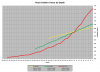
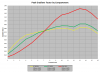
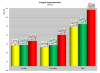
For example, consider the following data from a 615ft bounce dive, Tx5/80, and 30fpm ascent above 440ft (i.e. approximately Don's dive, but with slower ascent). Here's how GF60/84, GF30/93, and VPM-B+3 compare -- all profiles have same run time.
  1. VPM-B surfaces at a GF > 130. Adding +40 to your surfacing GF is a good idea because ???????GF_byDepth.png
  2. VPM-B exceeds a GF of 100 in compartments 9 thru 16; VPM-B exceeds a GF of 119 in cmpts 11 thru 15. In an era where decompression scientists are recommending things like GF40/70 as a baseline, these GF levels have to be concerning -- especially since research has clearly indicated bubble-model- style deep stops are not the elixir once claimed.GF_byCmpt.png
  3. Total supersaturation exposure for VPM-B+3 is 44% higher than GF60/84 and 34% higher than GF30/93. The difference between the two GF profiles is only 7%.ISS_Total.png

Any fair assessment of these profiles would conclude that it's VPM-B+3 that "is too far off scale at these extreme depths".
 
Last edited:
Even with low GFs, VPM-B is not like GF at these depths.

For example, consider the following data from a 615ft bounce dive, Tx5/80, and 30fpm ascent above 440ft (i.e. approximately Don's dive, but with slower ascent). Here's how GF60/84, GF30/93, and VPM-B+3 compare -- all profiles have same run time.
  1. VPM-B surfaces at a GF > 130. Adding +40 to your surfacing GF is a good idea because ???????View attachment 10073
  2. VPM-B exceeds a GF of 100 in compartments 9 thru 16; VPM-B exceeds a GF of 119 in cmpts 11 thru 15. In an era where decompression scientists are recommending things like GF40/70 as a baseline, these GF levels have to be concerning -- especially since research has clearly indicated bubble-model- style deep stops are not the elixir once claimed.View attachment 10074
  3. Total supersaturation exposure for VPM-B+3 is 44% higher than GF60/84 and 34% higher than GF30/93. The difference between the two GF profiles is only 7%.View attachment 10075

Any fair assessment of these profiles would conclude that it's VPM-B+3 that "is too far off scale at these extreme depths".


All of which is theoretical nonsense....

You still have not told us who pays you to come here are peddle your propaganda.

I remind you again VPM-B has been to these depths and beyond...very successfully. Obviously VPM-B works, and your JUNK science graphs are mere noise.

Interesting how your entire arguments against VPM-B is nothing but abstract. No actual science to go on. In the real world, dive plans like VPM-B, or GF equivalent are essential to success at these depths.

Or have you forgotten, your "new, more efficient" deco method, as tested here in Don's dive, and as promoted by Simon Mitchell.. it FAILED, and put the guy in a wheel chair, and 3 months of injury.


The really sad thing is some one is going to get conned by your pretend science and fake reasons... and try this dive using your junk science, and get themselves really injured.... Don't you people have a conscience?

.
 
Last edited:
Mathieu do you track your ascent rate at all and do you pad anything on the ascent or change setpoint?

Hi Jon,

I usually do around 10m/min. On that specific 114m dive, I did 12m/min.

I like to switch to 1.5 setpoint for the ascent and dial back to 1.3 between 15 and 9m, but I don't always do it. The idea is to limit ongasing in the slow compartments and tissues while doing stops to offgas the fast ones.

The only "padding" I do is during the final ascent from 6 (or 4.5, depending on surface conditions): I do 1m/min.

Cheers,

Matthieu
 
Last edited:
Hello UWS,

Thank you for your analysis on the three dive profiles. I preface the following comments with the caveat that I am not seeking to promote or advance either approach (bubble versus dissolved tissue) at the expense of the other.

Your analysis in seeking to compare what are perceived to be three equivalent dives (two different GFs and one VPM) may not be a correct equivalence because equal run time is the wrong measure of decompression risk equivalence for the two models. The outcome of your analysis (higher levels of supersaturation with VPM as compared to GF models for the same run time) is merely a necessary and expected outcome of comparing two decompression risk models requiring different quantum of decompression stops for dives of the same working depth.

Put another way for the deep bounce dive profile analyzed, if I was to say that a bubble model would result in a shorter dive run-time; no one should be surprised if that is an inherent differentiating characteristic of the two models.

For such depths, if bubble models and dissolved tissue decompression risk models are predicting wildly divergent quantum of total decompression required for a given time at working depth, then seeking to match total run times is misleading because it unnecessarily imposes additional time at working depth on one model to compensate for the longer period of decompression required by the alternate model.

The merits-of-deep-stop arguments, seems to be based upon a conflation of optimum quantum and the quite separate issue of optimum distribution of decompression stops for managing decompression injury risk within the context of minimizing overall dive risk.

The critical question about the reduction in quantum of decompression required by a bubble type model at these depths (assuming this to be the case) is whether it adversely impacts decompression injury rates. Variations in distribution of this quantum may or may not have a secondary influence; i.e the deep versus shallow stop debate/argument is potentially just a distraction when comparing the two models.

While I don't condone his language, I now have a better understanding of why Ross gets so agitated with these types of discussions.

I will conclude by again stating that I am not suggesting that the reduction in required decompression by VPM or any other model compared to GF models is safer or better; just that in comparing models, all that matters is how close a model aligns with the evidence on observed decompression injury rates.

Thanks,
Tony
 
Status
Not open for further replies.
Back
Top