I finally found some time to look at Don's dive so I'll take a stab at this.
Agree. My model shows a maximum supersaturation of just under 3.4ATA at the 1st stop.
I don't think so. The TOTAL time over 2 ATA would be more like 6 1/2 minutes. Time over 3 ATA in my model was not more than 1 minute.
None of the charts you posted show 3.5 ATA was ever exceeded, so clearly it wasn't exceeded for more than 3.5 minutes. The model I have shows 3 ATA was exceeded for perhaps 1 minute.
...........................
But, was that initial elevated supersaturation in the fast compartments (> 3.3ATA) a deal breaker? Did that alone cause the DCS? If so, is that a GF problem? And do we have any evidence from other validated models that those supersaturation levels are excessive?
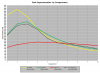
Consider the chart below.
View attachment 10055
The chart shows the maximum supersaturation experienced in compartments 1-10 for Don's planned 615ft dive (yellow line) as well as for VPM-B+3 (red line). This dive assumes GF60/70 was the target; I show 60/69 because it matched the run time of VPM-B+3.
To see what supersaturations the US Navy might allow in a deep dive I looked at several of their 300-320ft CCR profiles. The black dashed line is fairly representative of peak supersaturations implicit in the US Navy schedules. You can see that the highest fast compartment supersaturations are well below Don's dive (yellow line). I interpret the Navy example limits as some indication that the peak supersaturations from Don's dive are getting pretty high for compartments 1-3.
The green line on the chart shows Don's profile with one adjustment. The ascent rate remained at 55fpm, but only until supersaturation was initiated (at around 440ft). From that point the ascent rate was slowed to 30fpm. Contrary to Ross's statement that "I don't think going slower would have improved much", you can see that the standard ascent rate of 30fpm brings those higher peak supersaturations in compartments 1-3 back to the example limits from the US Navy. This might be expected since the US Navy schedules all prescribe a 30fpm ascent rate.
In any case, Don's higher initial supersaturations are brought back in line with a validated decompression model simply by using the standard ascent rate of 30fpm. However, we still can't say for sure that the peak supersaturation level of 3.3ATA in the fastest compartments was the cause of the DCS. Remember that Don had prior successful dives with these elevated ascent rates. But perhaps on this dive the elevated supersaturations contributed to the problem.
Another factor that could also have contributed to the DCS hit was exertion during the deepest part of the dive. This quote is from Dr. Pollock: "Exercise during the compression and bottom phase
increases inert gas uptake, effectively increasing the subsequent decompression obligation of any exposure. It is important to remember that dive tables and computers estimate inert gas uptake, they never know reality."
To get some idea of the potential impact that Don's reported exertion may have had on the profile I did the following: at 530ft I cut the descent rate in half and from 615ft back to 530ft I cut the ascent rate in half. This modification doubled the time spent below 530ft to model higher inert gas uptake due to exertion. Admittedly, this is an approximation, but given the reported level of exertion it seems likely there was some impact on the profile. I started the elevated gas uptake at 530ft because Don said the exertion started shortly after leaving his safety diver at 500ft. After this adjustment I simply followed the stops of the unadjusted schedule just as Don would have.
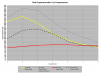
The results are shown below.
View attachment 10056
The purple dotted line shows the effective peak supersaturations in each compartment when the estimated impact of exertion is added to the bottom phase of the dive. Clearly peak supersaturations are substantially increased; the time the higher supersaturations would have persisted went up as well as did the number of compartments that diverged from the US Navy sample rates. If you believe the impact of the exercise would be somewhat less, then the line would be somewhere between the yellow and purple lines. As modelled, the time spent at supersaturations above 2 ATA went to 14 minutes, compared to about 6.5 minutes without exercise. Also, total supersaturation exposure (ISS) up to the 110ft stop (i.e. the point DCS was indicated) increased 50%. With this adjustment to account for exercise at depth, the fast compartments saw peak supersaturations as much as 70% higher than similar limits obtained by US Navy profiles.
We know that exertion at the bottom phase of a dive impacts decompression. This example shows one potential impact. Coupling the fast ascent with the potential effects of exertion during the bottom phase of the dive could easily explain the DCS hit occuring early in the decompression. The high effective peak supersaturations would not have been detected by Don's dive computer because the computer doesn't adjust for exertion. So, though Don has done several deep dives using higher ascent rates, on this dive his high ascent rate combined with exercise at depth may have thrown the profile into supersaturations that were riskier than anticipated.
So have we solved the problem? Well, we still don't know for sure exactly why the DCS occurred that day. But I think we've offered one plausible scenario that accounts for the DCS occuring early in the decompression. So what should we think about Ross's claim that this dive demonstrates a failure of GF and that only a bubble model, such as VPM-B, could have saved the day?
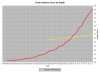
The chart below shows, for GF 60/70 and VPM-B+3, the gradient factors for Don's planned dive. The values shown are for the dive without any adjustment to the ascent rate and without modelling exertion during the bottom phase of the dive.
View attachment 10057
Now, if you're planning the same dive, and if you believe that the dive as planned by Don was too aggressive -- fast compartment supersaturation too high, ascent rate too fast, etc. -- do you really believe that the best corrective action is to switch to VPM-B+3? Is that the best way to adjust Don's profile?
If you switch to VPM-B+3 you'd surface at a GF>130. Also, not shown on the chart, your total supersaturation exposure (ISS) would increase 73%. Do you want to add 73% supersaturation exposure in order to solve a transitory fast compartment issue?
Perhaps a better solution, if you believe the initial elevated supersaturations contributed substantially to the DCS, would be to
- slow your ascent rate to 30fpm no later than the point at which you reach supersaturation - this adjustment alone moved the fast compartment peak supersaturations back down to example US Navy limits;
- perhaps choose a lower Lo GF on these very deep dives;
- be ready to significantly adjust your schedule if you are required to exert yourself at depth, especially extreme depth;
- maybe plan extra time on O2 at your 20ft stop, or for some period on the surface, for these extreme dives. Discretion may indeed be the better part of valor.
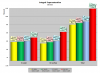
The adjustments listed above both lower initial supersaturation levels in your fast compartments and retain a substantial advantage in total supersaturation exposure as shown in the chart below. The profiles used in the chart assume an ascent rate of 30fpm from 440ft and all have the same runtime. Notice that even if you dropped your low GF to 20, the total supersaturation exposure is still significantly below that of VPM-B.
View attachment 10058
.......................
We can, using our own risk preferences, Monday-morning-quarterback the dive. But in the end Don's hit may have been random, or partly related to some medical issue or event, or unrelated to anything discussed above. Or maybe it was caused by a cascade of all these factors each working against him on this particular dive. The truth is we just don't know.