My DCS Hit

Status
Not open for further replies.
Hello Simon, to change the subject somewhat, do you or anybody else in in the scientific/medical fields know why saturation diving decompression is successful with rates of very slow ascent and deep stops, yet with no apparent additional penalties for their additional ongassing during those deeper stages and stops?

Hello Silent Running,

As pointed out by the authors of the NEDU study, the most plausible reason for deeper stops being a potential disadvantage in decompression from a bounce dive is that slower tissues continue to take up gas during the time spent deeper, and that this results in greater supersaturation in those slower tissues, and greater total supersaturations across all tissues for the dive during the later part of the ascent and after arrival at the surface. The difference with a saturation dive is that those slower tissues are already fully saturated before you even start the ascent, and therefore there is no downside to deep stops. You will not be taking up extra gas into slower tissues during very slow and very deep stops. You get the benefit without the disadvantage. Hope that makes sense.

In addition, we have done many more saturation decompressions than bounce dive decompressions from these very deep dives, and it follows that we "know how to do it". Saturation decompressions are well practiced and are actually relatively safe. Problems do occur during saturation decompressions though and that fact should be proof enough that problems can occur even with the ultimate deep stops approach. This, by the way is not presented as evidence of great significance to the current debate, but it is interesting that even the most careful deep stop decompressions undertaken at very slow rates can still result in problems. There is a degree of unpredictability that can never be completely ignored.

Simon M
 
Last edited:
So... no one can provide a valid rebuttal to my points of failure on this dive of Don's? No alternate theories?

It seems deeps stops do matter, and are essential in some cases.

.

"Your" points about Don's dive? Deep stops? How about ANY stops between 610' and 220'? Do you seriously think this profile would ever theoretically be given the thumbs up by anybody, except possibly Mr Lift Bag, Alex Deas? Heaven help us...
 
I've been following this for the last few weeks. Ross, you just come off as completely unhinged in the face of civil discussion and evidence.
All it's done is to make me wish I'd never purchased v-planner/multideco or recommended it to my students/friends.
 
"Your" points about Don's dive? Deep stops? How about ANY stops between 610' and 220'? Do you seriously think this profile would ever theoretically be given the thumbs up by anybody, except possibly Mr Lift Bag, Alex Deas? Heaven help us...

I would just give up. I'm sure that if a diver decided to come straight to the surface from 600' with no stops Ross would be trying to blame that on my advocacy for the current state of the evidence too. He thinks he has found some leverage, and he's not about to let rational discourse prize it from his grasp. He lacks the insight to realise he is just making himself look misinformed and petty.

Simon
 
Last edited:
Hello Silent Running,

As pointed out by the authors of the NEDU study, the most plausible reason for deeper stops being a potential disadvantage in decompression from a bounce dive is that slower tissues continue to take up gas during the time spent deeper, and that this results in greater supersaturation in those slower tissues, and greater total supersaturations across all tissues for the dive during the later part of the ascent and after arrival at the surface. The difference with a saturation dive is that those slower tissues are already fully saturated before you even start the ascent, and therefore there is no downside to deep stops. You will not be taking up extra gas into slower tissues during very slow and very deep stops. You get the benefit without the disadvantage. Hope that makes sense.

In addition, we have done many more saturation decompressions than bounce dive decompressions from these very deep dives, and it follows that we "know how to do it". Saturation decompressions are well practiced and are actually relatively safe. Problems do occur during saturation decompressions though and that fact should be proof enough that problems can occur even with the ultimate deep stops approach. This, by the way is not presented as evidence of great significance to the current debate, but it is interesting that even the most careful deep stop decompressions undertaken at very slow rates can still result in problems. There is a degree of unpredictability that can never be completely ignored.

Simon M

Thanks Simon, yes it finally makes sense. I see now how the total saturation diving baseline removes the slow tissue time bomb from the deep stops/ascent rate equation of a bounce dive. Which, apparently all our CCR diving is, considering none of us CCR divers can ever achieve full saturation given the limits of our equipment and physical endurance.

Is it fair to say then, that it is the interplay between the slowest and fastest tissue rates of perfusion and diffusion and the resulting ISS at depth, and during the initial stages of ascent, which is not understood enough and thus creates the uncertainty in bounce diving deco calculations?
 
Hi Ross, to begin at the end of your post, we have the man himself, Don, right here in this thread to ask the question: "Why did you plan and dive 60/90 to 600'?" There is literally no need to bring Simon into it or presume anything until Don has answered the question. My guess is that as with any self possessed person exercising their free will, the decision was based on his extensive deco experience and his personal tolerance for risks, which are multiple on such big dives. Surely you don't regard someone as honest and forthright as Don as anybody's fool?

....Snip...

Why did I pick a GF of 60/90? First of all let me remind everyone that I fu*ked up and forgot to reset my GF to the intended 60/80. I know that is not much difference but I did want to extend my shallow deco time a bit for this dive.

I know that I once cleared a 9 hour dive with over 7 hours of deco while running a 60/90 and be reasonably OK. I really pushed the ceiling hard on this dive with 1' increments rather than 10' stops. I did have some shoulder pain that time though and it began very slightly at 30' it did not become worse until just about 2' or 3' on my exiting the water.

I have been running 60/90 for a long time with no adverse effects (that I know of) on all my deep dives. Several of them were to 400+ foot. a couple of them had ascent and descent rates of 150 per minute to my first stops.

My 500' dive went perfectly with settings of 60/90 and descending at 100' per minute and ascending at 75' per minute.

I used my previous experience to attempt to make an informed and reasonably safe dive plan. I knew the risks would be exponentially greater as dive depth increased, and accepted those risks.
 
While Don may have planned 60/90 and had that set in his computer, his computer does some inbuilt rounding up and it's quite excessive at times. This stems back to the VR3 days, where those computers did some big rounding up too, so other computers followed suit. The real diveplan he followed was a 60/70..... You can use MultiDeco to re-plan a dive overlaying the computer print out, and find out what you really did.

Your other points have been answered numerous times. His unwavering conviction to a clearly faulty premise, is his problem.

.

We have communicated via PM's enough for you to know that is complete bullshit. I still think the deep stops (defined as a short stop midway from max bottom depth to your first deco stop) are a terrible idea. You also know damn good and well that I agree with you in regards that my first deco stop should have been deeper. NEITHER ONE OF US KNOW EXACTLY WHERE THAT NEEDED TO BE.

Yes, everything about my dive plan and DCS hit are indeed my problem and I am dealing with it just fine. I am willing to learn from my adventure and hopefully others will too.
 
So... no one can provide a valid rebuttal to my points of failure on this dive of Don's? No alternate theories?

It seems fast tissues do matter, and are essential in some cases. (contrary to what Simon says).

.
the only delusional one here is you ross..
if you would even try to understand what folks are writing you would already have the answer to your question..
we have been at that point many times before over the years of this ‘drama’
you either choose (likely) or even worse are not capable (unlikely and would be sad but possible) to understand and reflect what has been written as soon as it only slightly differs from your view of things..

you continue to state and imply a position of Simon ond others that isnt even there.. nobody is campaigning ant deep stops.. even here Simon has stated that again.. he just does not SUPPORT it anymore due to latest tests and observations..
Nobody states that fast tissues DO NOT matter.. you are making this up..
of course they matter.. the state of the art knowldege just suggest they MAY matter less than assumed in the past (early 2000s)

As for valid rebuttal to “your points of failures” of course that will not happen..
why? because one cant conclude anything from a single dive and nobody can pinpoint to a single point of cause for this accident.

So may the shallow first stop have contributed to the DCS? probably, but we dont know
has it for sure contributed to the DCS? Cant tell
Hve other factors (ascent speed to first stop, workload at depth, pain thus shallow breathing, low PO2, previous day diving etc. etc.) contributed to the DCs? very likely , but we dont know
Has any of thos factors for sure contributed? cant tell
Would the DCS have still occured with the first stop depth the same and other factors absent? Maybe, but wedont know
The latter is what you seem to claim to know.. How??? are you supernatural?
 
I have been running 60/90 for a long time with no adverse effects (that I know of) on all my deep dives. Several of them were to 400+ foot. a couple of them had ascent and descent rates of 150 per minute to my first stops.

My 500' dive went perfectly with settings of 60/90 and descending at 100' per minute and ascending at 75' per minute

so on all your deep dives you usually do you ascend 60-75ish fpm?
 
Is it fair to say then, that it is the interplay between the slowest and fastest tissue rates of perfusion and diffusion and the resulting ISS at depth, and during the initial stages of ascent, which is not understood enough and thus creates the uncertainty in bounce diving deco calculations?

Hello again Silent Running,

I think the main problem is that we are using a mathematical model that addresses only one component of a complex biological system to predict outcomes in that system. That's why a diver can do the exact same dive multiple times with no problems and then out of the blue get sick doing the same dive another time. If the decompression algorithm were the only thing that mattered then you would not expect events like that.

Having said that, decompression algorithms are a pivotal influence on risk, and there are also many unknowns in relation to the mathematical models as you imply. For example (and of relevance to Don's case) we know that fast tissue can tolerate more supersaturation than slow tissue, but we don't know by how much. We are learning that supersaturation in slower tissues may be more important than we previously thought, because these are probably the source of venous bubbles that can subsequently cross a right to left shunt into the arteries and cause problems when they arrive in the arterial supply to sensitive tissues like the spinal cord, inner ear, and brain. This has been one of the interesting outcomes of the various deep stops studies. You are right though: we still don't fully understand the correct balance between protecting the fast tissues from supersaturation early in the ascent (using deep stops), and preventing excess supersaturation in the slow tissue later in the ascent by doing less deep stopping and / or longer shallow stops.

You can do both of course: that is, have deep stops and longer shallow stops to compensate for them. But for any particular commitment of time to decompression, there will always be debate about the correct balance of deep vs shallow for optimal reduction of risk. What the recent studies have suggested is that for the total time committed to a decompression by a bubble model or another deep stops approach, the balance is overly weighted in favour of deep stops for optimal reduction of risk. As I have said many times, this does not mean you must not use bubble models or that they are unacceptably risky. But if you seek the truth about optimal decompression then the currently available evidence suggests that they are not the optimal approach. The problem, as I have also said many times is that we currently have not defined that approach, which is why I have suggested that backing away from deep stops as prescribed by such models should be undertaken cautiously, especially if you have been a long time user with no problems.

Hope that answers your question.

Simon M
 
Last edited:
Hello again Silent Running,

I think the main problem is that we are using a mathematical model that addresses only one component of a complex biological system to predict outcomes in that system. That's why a diver can do the exact same dive multiple times with no problems and then out of the blue get sick doing the same dive another time. If the decompression algorithm were the only thing that mattered then you would not expect events like that.

Having said that, decompression algorithms are a pivotal influence on risk, and there are also many unknowns in relation to the mathematical models as you imply. For example (and of relevance to Don's case) we know that fast tissue can tolerate more supersaturation than slow tissue, but we don't know by how much. We are learning that supersaturation in slower tissues may be more important than we previously thought, because these are probably the source of venous bubbles that can subsequently cross a right to left shunt into the arteries and cause problems when they arrive in the arterial supply to sensitive tissues like the spinal cord, inner ear, and brain. This has been one of the interesting outcomes of the various deep stops studies. You are right though: we still don't fully understand the correct balance between protecting the fast tissues from supersaturation early in the ascent (using deep stops), and preventing excess supersaturation in the slow tissue later in the ascent by doing less deep stopping and / or longer shallow stops.

You can do both of course: that is, have deep stops and longer shallow stops to compensate for them. But for any particular commitment of time to decompression, there will always be debate about the correct balance of deep vs shallow for optimal reduction of risk. What the recent studies have suggested is that for the total time committed to a decompression by a bubble model or another deep stops approach, the balance is overly weighted in favour of deep stops for optimal reduction of risk. As I have said many times, this does not mean you must not use bubble models or that they are unacceptably risky. But if you seek the truth about optimal decompression then the currently available evidence suggests that they are not the optimal approach. The problem, as I have also said many times is that we currently have not defined that approach, which is why I have suggested that backing away from deep stops as prescribed by such models should be undertaken cautiously, especially if you have been a long time user with no problems.

Hope that answers your question.

Simon M

Simon, it is this type of balanced response and in depth commentary which makes your posts of great value to this diving community. Thank you for spending the time to share this and other observations with us.
 
Nicely summarised statement in last post.

My personal experience for what it is worth.

Dived air for 10 years up to 1998 with no real issues. (BSAC 88 tables - definitely no deep stops) Deeper air diving up to 50m with 25 - 30 minutes air deco.

Moved on to nitrox diving on IANTD tables (old yellow ones fro those who remember) - which at the time I am guessing were equivalent to 65/65 got shoulder bend on this table on 90 minute 60ish m dive with padded shallow stops.(air and O2 deco) first stop say 21m. (Very cold March dive) In following couple of years I got niggles in my left shoulder several times following IANTD tables on anything over 40m for longish nitrox dives. This wasn’t solved by just padding shallow stops.

I ended up solving this in my view by using the VR3 and the Pyle type stops. I then later moved to 30/85 - no issues since - my gut feel tells me that for longer bottom times some level of deeper stops do have value particularly in my case where there was a historical weakness. I don’t think I would sacrifice the shallow stops for deep stops though. I do generally add some level of shallow stop padding also.

Not sure what this experience adds - but it gives for me at least some form of data point to cling to about what I can get away with - as pointed out by Simon prior to this Navy trial there was very limited hard data.
 
Be interested if anyone else out there got a bend in any form on a particular set of tables / algorithm and subsequently returned to diving and what algorithm/ safety factors they are now using when they went back to diving.
 
Hello again Silent Running,

I think the main problem is that we are using a mathematical model that addresses only one component of a complex biological system to predict outcomes in that system. That's why a diver can do the exact same dive multiple times with no problems and then out of the blue get sick doing the same dive another time. If the decompression algorithm were the only thing that mattered then you would not expect events like that.

Having said that, decompression algorithms are a pivotal influence on risk, and there are also many unknowns in relation to the mathematical models as you imply. For example (and of relevance to Don's case) we know that fast tissue can tolerate more supersaturation than slow tissue, but we don't know by how much. We are learning that supersaturation in slower tissues may be more important than we previously thought, because these are probably the source of venous bubbles that can subsequently cross a right to left shunt into the arteries and cause problems when they arrive in the arterial supply to sensitive tissues like the spinal cord, inner ear, and brain. This has been one of the interesting outcomes of the various deep stops studies. You are right though: we still don't fully understand the correct balance between protecting the fast tissues from supersaturation early in the ascent (using deep stops), and preventing excess supersaturation in the slow tissue later in the ascent by doing less deep stopping and / or longer shallow stops.

You can do both of course: that is, have deep stops and longer shallow stops to compensate for them. But for any particular commitment of time to decompression, there will always be debate about the correct balance of deep vs shallow for optimal reduction of risk. What the recent studies have suggested is that for the total time committed to a decompression by a bubble model or another deep stops approach, the balance is overly weighted in favour of deep stops for optimal reduction of risk. As I have said many times, this does not mean you must not use bubble models or that they are unacceptably risky. But if you seek the truth about optimal decompression then the currently available evidence suggests that they are not the optimal approach. The problem, as I have also said many times is that we currently have not defined that approach, which is why I have suggested that backing away from deep stops as prescribed by such models should be undertaken cautiously, especially if you have been a long time user with no problems.

Hope that answers your question.

Simon M

Hi Simon, thanks again for all the great information and explanations you consistently provide.

A few more questions if you don't mind:

-How well are the actual mechanisms of isobaric counter diffusion understood? Has it been well quantified and observed in humans and/or animals?

-During the initial stages of a deep ascent, it seems the tissues must be under great stress coping with simultaneous on/off gassing of multiple gasses, through multiple tissue barriers. Which part of this process creates mores tissue stress, the rising gradients which facilitate the offgassing and the resulting bubbles, or the friction between the incoming and outgoing gasses?

-Is there any evidence that the greater volumes of gas exchanging out of the tissues into the blood during an initial deep ascent slows the on-gassing?

-And relating to that, what do we know about the role ascent rates play in ICD? Is slower always better, or might a faster rate be better for the initial stage of a deep ascent?
 
So... no one can provide a valid rebuttal to my points of failure on this dive of Don's? No alternate theories?

I finally found some time to look at Don's dive so I'll take a stab at this.

In post #33, I showed how he ascended 400ft, and experienced 3+ ATA supersaturation ...
Agree. My model shows a maximum supersaturation of just under 3.4ATA at the 1st stop.

... [Don] continued to sustain this extreme level for the adjacent stops. i.e. up to 10 mins, up to and over 3 ATA.
I don't think so. The TOTAL time over 2 ATA would be more like 6 1/2 minutes. Time over 3 ATA in my model was not more than 1 minute.

The USN SurD diver will typically endure 3.5 ATA supersaturation for a max time of 3 1/2 mins during the surface transfer, after which the chamber re-compression puts them back at around 1.5 ATA supersaturation. If they reach or exceed 5 mins during the surface time, then it becomes a DCS treatment process. You have exceeded all those numbers by quite some margin.
None of the charts you posted show 3.5 ATA was ever exceeded, so clearly it wasn't exceeded for more than 3.5 minutes. The model I have shows 3 ATA was exceeded for perhaps 1 minute.

...........................

But, was that initial elevated supersaturation in the fast compartments (> 3.3ATA) a deal breaker? Did that alone cause the DCS? If so, is that a GF problem? And do we have any evidence from other validated models that those supersaturation levels are excessive?

Consider the chart below.
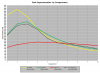
C1_2_PeakSS.png

The chart shows the maximum supersaturation experienced in compartments 1-10 for Don's planned 615ft dive (yellow line) as well as for VPM-B+3 (red line). This dive assumes GF60/70 was the target; I show 60/69 because it matched the run time of VPM-B+3.

To see what supersaturations the US Navy might allow in a deep dive I looked at several of their 300-320ft CCR profiles. The black dashed line is fairly representative of peak supersaturations implicit in the US Navy schedules. You can see that the highest fast compartment supersaturations are well below Don's dive (yellow line). I interpret the Navy example limits as some indication that the peak supersaturations from Don's dive are getting pretty high for compartments 1-3.

The green line on the chart shows Don's profile with one adjustment. The ascent rate remained at 55fpm, but only until supersaturation was initiated (at around 440ft). From that point the ascent rate was slowed to 30fpm. Contrary to Ross's statement that "I don't think going slower would have improved much", you can see that the standard ascent rate of 30fpm brings those higher peak supersaturations in compartments 1-3 back to the example limits from the US Navy. This might be expected since the US Navy schedules all prescribe a 30fpm ascent rate.

In any case, Don's higher initial supersaturations are brought back in line with a validated decompression model simply by using the standard ascent rate of 30fpm. However, we still can't say for sure that the peak supersaturation level of 3.3ATA in the fastest compartments was the cause of the DCS. Remember that Don had prior successful dives with these elevated ascent rates. But perhaps on this dive the elevated supersaturations contributed to the problem.

Another factor that could also have contributed to the DCS hit was exertion during the deepest part of the dive. This quote is from Dr. Pollock: "Exercise during the compression and bottom phase increases inert gas uptake, effectively increasing the subsequent decompression obligation of any exposure. It is important to remember that dive tables and computers estimate inert gas uptake, they never know reality."

To get some idea of the potential impact that Don's reported exertion may have had on the profile I did the following: at 530ft I cut the descent rate in half and from 615ft back to 530ft I cut the ascent rate in half. This modification doubled the time spent below 530ft to model higher inert gas uptake due to exertion. Admittedly, this is an approximation, but given the reported level of exertion it seems likely there was some impact on the profile. I started the elevated gas uptake at 530ft because Don said the exertion started shortly after leaving his safety diver at 500ft. After this adjustment I simply followed the stops of the unadjusted schedule just as Don would have.

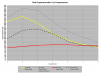
The results are shown below.
C2_2_PeakSSExercise.png
The purple dotted line shows the effective peak supersaturations in each compartment when the estimated impact of exertion is added to the bottom phase of the dive. Clearly peak supersaturations are substantially increased; the time the higher supersaturations would have persisted went up as well as did the number of compartments that diverged from the US Navy sample rates. If you believe the impact of the exercise would be somewhat less, then the line would be somewhere between the yellow and purple lines. As modelled, the time spent at supersaturations above 2 ATA went to 14 minutes, compared to about 6.5 minutes without exercise. Also, total supersaturation exposure (ISS) up to the 110ft stop (i.e. the point DCS was indicated) increased 50%. With this adjustment to account for exercise at depth, the fast compartments saw peak supersaturations as much as 70% higher than similar limits obtained by US Navy profiles.

We know that exertion at the bottom phase of a dive impacts decompression. This example shows one potential impact. Coupling the fast ascent with the potential effects of exertion during the bottom phase of the dive could easily explain the DCS hit occuring early in the decompression. The high effective peak supersaturations would not have been detected by Don's dive computer because the computer doesn't adjust for exertion. So, though Don has done several deep dives using higher ascent rates, on this dive his high ascent rate combined with exercise at depth may have thrown the profile into supersaturations that were riskier than anticipated.

So have we solved the problem? Well, we still don't know for sure exactly why the DCS occurred that day. But I think we've offered one plausible scenario that accounts for the DCS occuring early in the decompression. So what should we think about Ross's claim that this dive demonstrates a failure of GF and that only a bubble model, such as VPM-B, could have saved the day?

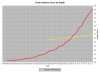
The chart below shows, for GF 60/70 and VPM-B+3, the gradient factors for Don's planned dive. The values shown are for the dive without any adjustment to the ascent rate and without modelling exertion during the bottom phase of the dive.
C3_GFbyDepth.png

Now, if you're planning the same dive, and if you believe that the dive as planned by Don was too aggressive -- fast compartment supersaturation too high, ascent rate too fast, etc. -- do you really believe that the best corrective action is to switch to VPM-B+3? Is that the best way to adjust Don's profile?

If you switch to VPM-B+3 you'd surface at a GF>130. Also, not shown on the chart, your total supersaturation exposure (ISS) would increase 73%. Do you want to add 73% supersaturation exposure in order to solve a transitory fast compartment issue?

Perhaps a better solution, if you believe the initial elevated supersaturations contributed substantially to the DCS, would be to
  1. slow your ascent rate to 30fpm no later than the point at which you reach supersaturation - this adjustment alone moved the fast compartment peak supersaturations back down to example US Navy limits;
  2. perhaps choose a lower Lo GF on these very deep dives;
  3. be ready to significantly adjust your schedule if you are required to exert yourself at depth, especially extreme depth;
  4. maybe plan extra time on O2 at your 20ft stop, or for some period on the surface, for these extreme dives. Discretion may indeed be the better part of valor.

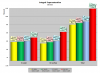
The adjustments listed above both lower initial supersaturation levels in your fast compartments and retain a substantial advantage in total supersaturation exposure as shown in the chart below. The profiles used in the chart assume an ascent rate of 30fpm from 440ft and all have the same runtime. Notice that even if you dropped your low GF to 20, the total supersaturation exposure is still significantly below that of VPM-B.
C4_2_ISS.png

.......................

We can, using our own risk preferences, Monday-morning-quarterback the dive. But in the end Don's hit may have been random, or partly related to some medical issue or event, or unrelated to anything discussed above. Or maybe it was caused by a cascade of all these factors each working against him on this particular dive. The truth is we just don't know.

 
I finally found some time to look at Don's dive so I'll take a stab at this.

Thank you UWSojourner. This is an extraordinarily useful and revealing analysis. I will comment in more detail later (I am travelling this weekend) but the most revealing points are:

1. simply bringing the ascent rate in Don's dive into line with standard recommendations reduces the peak supersaturation in fast tissues substantially (and into line with other profiles endorsed by expert bodies), and

2. that the GF approach reduces total integral supersaturation by a large amount for dives of equal run time compared to the bubble model.

It is worth pointing out that a total integral supersaturation analysis has correctly predicted the outcome of both formal comparative deep vs shallow stop studies to which it has been applied so far (NEDU and Spisni). There is no reason whatsoever to believe that it would not correctly predict the outcome if one of the GF profiles evaluated here were compared with VPM in a proper study.

Simon M
 
I finally found some time to look at Don's dive so I'll take a stab at this.


Agree. My model shows a maximum supersaturation of just under 3.4ATA at the 1st stop.


I don't think so. The TOTAL time over 2 ATA would be more like 6 1/2 minutes. Time over 3 ATA in my model was not more than 1 minute.


None of the charts you posted show 3.5 ATA was ever exceeded, so clearly it wasn't exceeded for more than 3.5 minutes. The model I have shows 3 ATA was exceeded for perhaps 1 minute.

...........................

But, was that initial elevated supersaturation in the fast compartments (> 3.3ATA) a deal breaker? Did that alone cause the DCS? If so, is that a GF problem? And do we have any evidence from other validated models that those supersaturation levels are excessive?

Consider the chart below.
View attachment 10055

The chart shows the maximum supersaturation experienced in compartments 1-10 for Don's planned 615ft dive (yellow line) as well as for VPM-B+3 (red line). This dive assumes GF60/70 was the target; I show 60/69 because it matched the run time of VPM-B+3.

To see what supersaturations the US Navy might allow in a deep dive I looked at several of their 300-320ft CCR profiles. The black dashed line is fairly representative of peak supersaturations implicit in the US Navy schedules. You can see that the highest fast compartment supersaturations are well below Don's dive (yellow line). I interpret the Navy example limits as some indication that the peak supersaturations from Don's dive are getting pretty high for compartments 1-3.

The green line on the chart shows Don's profile with one adjustment. The ascent rate remained at 55fpm, but only until supersaturation was initiated (at around 440ft). From that point the ascent rate was slowed to 30fpm. Contrary to Ross's statement that "I don't think going slower would have improved much", you can see that the standard ascent rate of 30fpm brings those higher peak supersaturations in compartments 1-3 back to the example limits from the US Navy. This might be expected since the US Navy schedules all prescribe a 30fpm ascent rate.

In any case, Don's higher initial supersaturations are brought back in line with a validated decompression model simply by using the standard ascent rate of 30fpm. However, we still can't say for sure that the peak supersaturation level of 3.3ATA in the fastest compartments was the cause of the DCS. Remember that Don had prior successful dives with these elevated ascent rates. But perhaps on this dive the elevated supersaturations contributed to the problem.

Another factor that could also have contributed to the DCS hit was exertion during the deepest part of the dive. This quote is from Dr. Pollock: "Exercise during the compression and bottom phase increases inert gas uptake, effectively increasing the subsequent decompression obligation of any exposure. It is important to remember that dive tables and computers estimate inert gas uptake, they never know reality."

To get some idea of the potential impact that Don's reported exertion may have had on the profile I did the following: at 530ft I cut the descent rate in half and from 615ft back to 530ft I cut the ascent rate in half. This modification doubled the time spent below 530ft to model higher inert gas uptake due to exertion. Admittedly, this is an approximation, but given the reported level of exertion it seems likely there was some impact on the profile. I started the elevated gas uptake at 530ft because Don said the exertion started shortly after leaving his safety diver at 500ft. After this adjustment I simply followed the stops of the unadjusted schedule just as Don would have.

The results are shown below.
View attachment 10056
The purple dotted line shows the effective peak supersaturations in each compartment when the estimated impact of exertion is added to the bottom phase of the dive. Clearly peak supersaturations are substantially increased; the time the higher supersaturations would have persisted went up as well as did the number of compartments that diverged from the US Navy sample rates. If you believe the impact of the exercise would be somewhat less, then the line would be somewhere between the yellow and purple lines. As modelled, the time spent at supersaturations above 2 ATA went to 14 minutes, compared to about 6.5 minutes without exercise. Also, total supersaturation exposure (ISS) up to the 110ft stop (i.e. the point DCS was indicated) increased 50%. With this adjustment to account for exercise at depth, the fast compartments saw peak supersaturations as much as 70% higher than similar limits obtained by US Navy profiles.

We know that exertion at the bottom phase of a dive impacts decompression. This example shows one potential impact. Coupling the fast ascent with the potential effects of exertion during the bottom phase of the dive could easily explain the DCS hit occuring early in the decompression. The high effective peak supersaturations would not have been detected by Don's dive computer because the computer doesn't adjust for exertion. So, though Don has done several deep dives using higher ascent rates, on this dive his high ascent rate combined with exercise at depth may have thrown the profile into supersaturations that were riskier than anticipated.

So have we solved the problem? Well, we still don't know for sure exactly why the DCS occurred that day. But I think we've offered one plausible scenario that accounts for the DCS occuring early in the decompression. So what should we think about Ross's claim that this dive demonstrates a failure of GF and that only a bubble model, such as VPM-B, could have saved the day?

The chart below shows, for GF 60/70 and VPM-B+3, the gradient factors for Don's planned dive. The values shown are for the dive without any adjustment to the ascent rate and without modelling exertion during the bottom phase of the dive.
View attachment 10057

Now, if you're planning the same dive, and if you believe that the dive as planned by Don was too aggressive -- fast compartment supersaturation too high, ascent rate too fast, etc. -- do you really believe that the best corrective action is to switch to VPM-B+3? Is that the best way to adjust Don's profile?

If you switch to VPM-B+3 you'd surface at a GF>130. Also, not shown on the chart, your total supersaturation exposure (ISS) would increase 73%. Do you want to add 73% supersaturation exposure in order to solve a transitory fast compartment issue?

Perhaps a better solution, if you believe the initial elevated supersaturations contributed substantially to the DCS, would be to
  1. slow your ascent rate to 30fpm no later than the point at which you reach supersaturation - this adjustment alone moved the fast compartment peak supersaturations back down to example US Navy limits;
  2. perhaps choose a lower Lo GF on these very deep dives;
  3. be ready to significantly adjust your schedule if you are required to exert yourself at depth, especially extreme depth;
  4. maybe plan extra time on O2 at your 20ft stop, or for some period on the surface, for these extreme dives. Discretion may indeed be the better part of valor.

The adjustments listed above both lower initial supersaturation levels in your fast compartments and retain a substantial advantage in total supersaturation exposure as shown in the chart below. The profiles used in the chart assume an ascent rate of 30fpm from 440ft and all have the same runtime. Notice that even if you dropped your low GF to 20, the total supersaturation exposure is still significantly below that of VPM-B.
View attachment 10058

.......................

We can, using our own risk preferences, Monday-morning-quarterback the dive. But in the end Don's hit may have been random, or partly related to some medical issue or event, or unrelated to anything discussed above. Or maybe it was caused by a cascade of all these factors each working against him on this particular dive. The truth is we just don't know.


Nice post, right up to the point where you start into the bullshit and attack VPM... for no valid reason. You are distorting the facts to invent some false justifications.

Our data base has 45+ dives to 600ft or more. As far as I know, they were all a success. They all use either a VPM-B or a GF setting that is something like a 20 to 40/x plan. None use Don's 60/x.

So before you start criticizing VPM-B or similar GF's on deep dives, remember that VPM-B and deeper GF's works, and Don's 60/x dive was a failure.

Don's 60/x is unique (old problems re-invented), and the most direct test of all of Dr. Simon Mitchell's recommended "new, more efficient" deco method. It's also a repeat of old dives from pioneer days, who also suffered injury, and the corrective action was deeper stops.

The extra exertion on-gas idea is not realistic. Don was near the bottom for seconds, and spent the shortest time possible down there. The opportunity to have any meaningful change in on-gas levels is n/a. And according to David and some testing, the only appreciable difference seen in exercise level ongassing is in the test lab, not the field.

As this dive of Don's highlights, a DCS injury is initiated in the water by excess in-dive supersaturation, so less in-dive supersaturation is better. But the surface levels of your ISS junk measure... are meaningless noise - they do not matter, and never will. Of course that reality shows (using your ISS junk measure) that VPM-B is the better choice every time. But as we all know, you and Simon will make up any load of rubbish just to prop up a fallacy.

The sad part of all this (other than Don getting unnecessarily injured) is how obsessed with the fallacy that you and Simon have become. More people will get injured following your / Simon's advise doing this dive or similar, and you people are spreading bad information.

.
 
Last edited:
It is worth pointing out that a total integral supersaturation analysis has correctly predicted the outcome of both formal comparative deep vs shallow stop studies to which it has been applied so far (NEDU and Spisni). There is no reason whatsoever to believe that it would not correctly predict the outcome if one of the GF profiles evaluated here were compared with VPM in a proper study.

Simon M

What a load of BS. Pure utter rubbish. You just make shit up to prop up your fallacy. More people will be injured following your "new, more efficient" deco method on a deep dive like this. You are so engrossed on fabricating noise to prop up your agenda.

Your ( Kevin's) ISS is junk science.... and (surprise surprise) it always favors the shallow stop profile.

.
 
You are distorting the facts ...
Please specify any fact that was distorted.

So before you start criticizing VPM-B or similar GF's, on deep dives, remember that VPM-B and deeper GF's works.
VPM-B is not like GF. The ISS chart, and the GFs, make that clear. The total supersaturation exposure moving from GF 60/84 to GF 20/95 increased by 9%. The total SS exposure moving from GF20/95 to VPM-B+3 increased 32%. And remember, VPM-B+3 would bring you to the surface at a GF exceeding 130. Setting your lo GF as low as 20 still only brings you to the surface at a GF of 95. So the odd man out here is VPM-B, not any of the GF profiles.

The extra exertion on-gas idea is not realistic ... Don was near the bottom for seconds, and spent the shortest time possible down there. The opportunity to have any meaningful change in on-gas levels is n/a.
My understanding of Don's account was that shortly after leaving 500ft he found himself in some form of exertion and that he recovered by the time he got back to the safety diver. The elevated exercise/heart rate/breathing was over some period, not just the few seconds on the bottom. That was taken into account by my model. If the effects were less, then the results would be somewhere between the yellow and purple lines as I indicated. But from his account, and from what we know about exertion at depth, I doubt there was no impact to his profile due to the exertion he experienced. And if that's the case, it starts to become clear how easily the risks could have mounted by the time he reached 110ft where it was clear something had gone wrong.
 
Status
Not open for further replies.
Back
Top