My DCS Hit

Status
Not open for further replies.
Are you suggesting a deeper first stop, slower ascent rate, or both? Why would any GF that is less than 100/100 allow such overpressure, or any overpressure for that matter?

From your description, you ascended 400ft at 57fpm. That is a lot by any measure or standard. Why did you feel you could avoid the basics of physics that generate bubble growth and injury? Those are well established cause/effect conditions for serious DCS.

The preventive measure to that problem condition, is deeper stops and/or slower ascent rate.

***********

re; GF 100/100. The ZHL model was not tested for this kind of diving, and 600ft (183m) is most likely too much extrapolation. The ZHL model is a "top down" fixed dimension design, proportional to the surface. But your short dive is a "bottom up" problem, which is addressed more correctly by a bubble model that includes calculations for those considerations.


********************

You followed the plan, and it nearly crippled you. We have not seen this kind of injury level in a long time. I wonder why?


ps. Please send me the profile or divelog picture, so I can complete the supersaturation picture.
 
First off, thanks for sharing this.

Completely agree. I'd go a bit further about the relevance, though.

We have a diver who experienced two instances of "mild" chest pain in the final stages of his descent. This remained a "minor uncomforting feeling" from 600' to 110'. Then suddenly "extreme pain" at 110'. "Diminishing" from 110' to 50', where the diver realised he was bent.

Now I have no idea what caused the chest pain. While inhaling extremely forcefully? Something to do with the pleural cavity? I have no idea. I does however seem reasonable to imagine that lung function may have become compromised at this point. So offgasing was possibly hindered from 600' to 110', and definitely hindered from 110' to 50', because in addition the diver was now breathing shallow to relieve the pain.

It seems a bit... bizarre to completely ignore all this and focus on the deco model.

Cheers,

Matthieu

A bad WOB, whatever the reason, could go beyond.
The position of the CL on the body and their shape (in case of CCR) could impact hydrostatic pressure and peak pressure (Lung Load). This could lead to Immersion Pulmonary Edema. Maybe this had a part in the onset? Also if IPE will keep up til the end usually...?!
Nad
 
I am not qualified to offer any formal opinion but I can't help but notice that the diluent used for this dive would give a gas density of approximately 7.84g/L. Considering Mitchells recommended limits for gas density in P.73 of the Rebreathers and Scientific Diving Report as set out below: thttps://www.omao.noaa.gov/sites/def...rs and Scientific Diving Proceedings 2016.pdf

The diluent would appear to exceed the upper recommended level of 6.2g/L by approximately 25% which in turn might have made a contribution to the difficulty in breathing at depth.
 
  • Like
Reactions: Nad
Good stuff, I may be finally seeing your point and understanding it better.
I will send a message this evening with the info.
 
From your description, you ascended 400ft at 57fpm. That is a lot by any measure or standard. Why did you feel you could avoid the basics of physics that generate bubble growth and injury? Those are well established cause/effect conditions for serious DCS.
.

Ross, that is actually not as bad as yoiu paint it to be.
What he did is ascending from 19,4Bar to 7,6 Bar at 1.7 Bar per minute which is actually pretty slow for a pressure drop to only 39% of his max pressure at a rate of 14% per minute of his max pressure to the first stop.
I'm afraid that you'll have to work harder in order to shoot holes in the deeper part of his dive.
Michael
 
Ross, that is actually not as bad as yoiu paint it to be.
What he did is ascending from 19,4Bar to 7,6 Bar at 1.7 Bar per minute which is actually pretty slow for a pressure drop to only 39% of his max pressure at a rate of 14% per minute of his max pressure to the first stop.
I'm afraid that you'll have to work harder in order to shoot holes in the deeper part of his dive.
Michael

And such dimensions are acceptable because... ????

I remind you that your body does not know or care for 39% of this, or 14% of that. It only knows about immediate supersaturation pressures, as that is what creates tissue and spinal bubbles.

As I pointed out, he exceeded the USN max times at max pressures for a SurD procedure, by a significant amount. He ascended 400ft (12 bar), at a recreational pace. This is the kind of thing that kills divers.

.
 
It's like going from a max depth of 130' to 32' in 8 minutes with only the fastest tissues needing to decompress.
The pressure drop as a percentage of the total is rather low.

Michael
 
It's like going from a max depth of 130' to 32' in 8 minutes with only the fastest tissues needing to decompress.
The pressure drop as a percentage of the total is rather low.

Michael
This is the kind of thinking that I have always believed in myself. I have never been a fan of deep stops and always figured there was no need to be on gassing when I am trying to do deco. I am open to learning where I might be wrong though.

After getting bent there is obviously something flawed in my profile/plan.
 
A bad WOB, whatever the reason, could go beyond.
The position of the CL on the body and their shape (in case of CCR) could impact hydrostatic pressure and peak pressure (Lung Load). This could lead to Immersion Pulmonary Edema. Maybe this had a part in the onset? Also if IPE will keep up til the end usually...?!
Nad

This is the sort of thing I had in mind, yes.
 
  • Like
Reactions: Nad
Why would any GF that is less than 100/100 allow such overpressure, or any overpressure for that matter?

Yeah, so there's a few important points to consider when considering this "supersaturation pressure".

One, a compartment is not a tissue. A compartment, and its pressure, are abstractions. In this case, the classical exponential compartment is taken to be an idealised tissue such that:
- its content is homogeneous; in particular any concentration/pressure is the same everywhere.
- its only interface with the outside world is via the capillaries (*cough* lymphatic system *cough*).
- this interface is perfect: on leaving the compartment, the blood is at equilibrium with the compartment.
There's other simplifications, including about what happens in the lungs, but the key thing is that by making these assumptions, we don't have to deal with Fick's second law, a.k.a the heat equation. This is important because it's notoriously hard to solve exactly. As in, you can count the problems we can solve exactly on your fingers. Mostly, this is the realm of computers - real ones. It's less a case of neglecting stuff we know not to be relevant with the happy consequence that the math gets easier without changing the result, and more a case of removing difficulties until the math is tractable at all and hope for the best. That joke about a guy looking for his keys under the street light because that's where there's light comes to mind. Luckily enough, in diving applications, when we use a lot of these in parallel, we get a pretty good representation of what's happening to the whole body. That should not be taken to mean that those compartments and compartment pressures are a physical reality.

The bottom line is that care must be taken not to assign too much significance to arbitrary figures plucked out of the model. To stay with the streetlight joke, with enough streetlights you can model daytime pretty well, but that doesn't mean that if someone in a specific spot get blinded he'd also get blinded there in daylight.

Two, how helium is treated is... sloppy. It's taken to be dissolving faster because of its higher diffusivity. Well, maybe. But in our assumptions above, we've taken the whole compartment to be uniform, or, equivalently, diffusivities are taken to be infinite. We specifically avoided Fick's laws. So it's a bit of a fudge to reintroduce this through the backdoor "just because". That doesn't mean it's wrong, but one needs to bear this in mind. As it happens, there is experimental evidence that it is, in fact, wrong, at least for the faster tissues.

Three, Haldanian models take it that the allowed overpressure increases linearly with depth. So it should not be a surprise that GF 60/90 allows an overpressure at 66m (220') higher than what would on the surface be considered a "go straight to the chamber" situation. That's what they do.

As an aside, SurDO2 (that's Surface Decompression, FWIW) does not specify a "max pressure". That would make little sense for the reason stated above. What it says is finish your 40' stop, then you have 5 minutes to be in the pot.

Cheers,

Matthieu

 
As an aside, SurDO2 (that's Surface Decompression, FWIW) does not specify a "max pressure". That would make little sense for the reason stated above. What it says is finish your 40' stop, then you have 5 minutes to be in the pot.

Cheers,

Matthieu


SurD.... depth is pressure. Ascending creates supersaturation pressure. Shifting from 40ft directly to the surface involves a further known increase in supersaturation pressure.

This is relevant, because SurD has been thoroughly tested to establish some well defined human limits of short term and tolerable high supersaturation values (max pressure). This gives us some idea of what is too much SS. Ignore this information at your peril.


From David Doolette:

The "obsession" with supersaturation versus bubble mechanics is well founded. The putative cause of DCS is injury as a result of bubble formation. Supersaturation is a required condition for bubble formation and growth. There is broad (universal?) agreement that modelling tissue gas uptake with a range of exchange rates - as we do for instance with a collection of compartments with mono-exponential gas exchange - captures the essential processes, at least crudely. David Doolette SB post


.
 
Last edited:
Bent in water clearly demonstrates that the deep deco was incorrect - it can't possibly be the result of shallow deco which you haven't done/reached. Having seen a few incidences of in water decompression presenting in the 30 ish m range on 4-5h profiles I am in no particularly rush out of deep water despite current trends moving away from deep stops.
 
Updated,

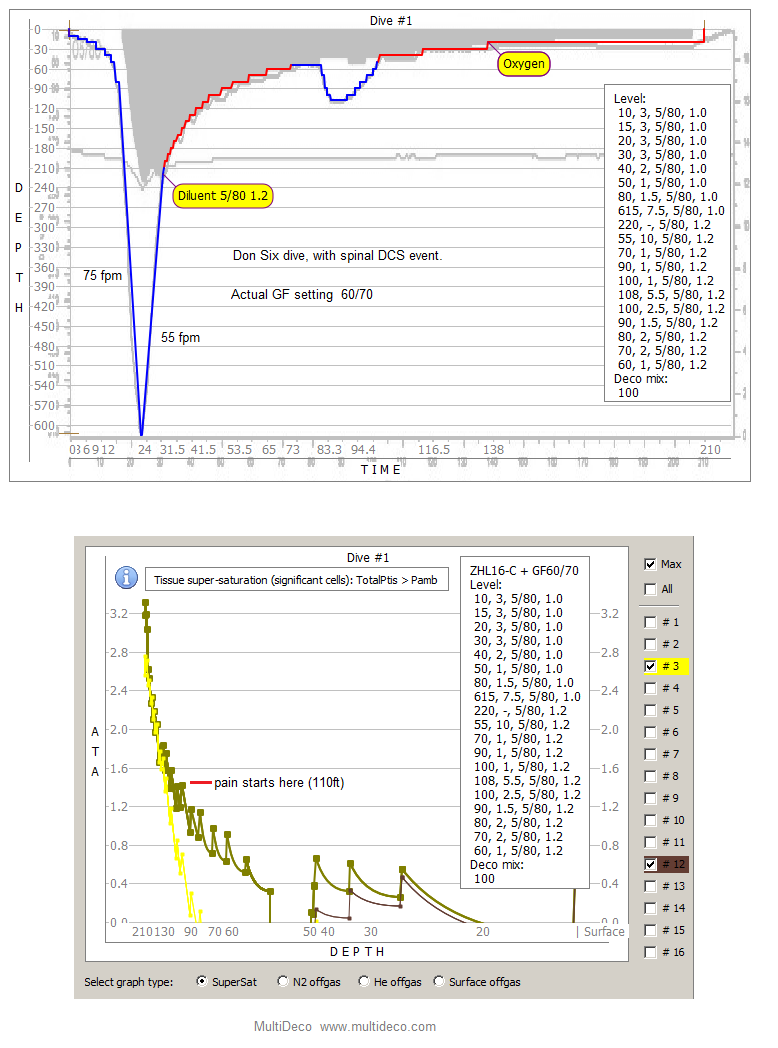
Here is a revised supersaturation chart with the 2nd descent included. Note that the profile is much closer to a 60/70 than the 60/90 reported. This rounding up is rather typical of one brand of computer.

dsix36_profile.png
 
Bent in water clearly demonstrates that the deep deco was incorrect - it can't possibly be the result of shallow deco which you haven't done/reached. Having seen a few incidences of in water decompression presenting in the 30 ish m range on 4-5h profiles I am in no particularly rush out of deep water despite current trends moving away from deep stops.

I asked Ross privately about how or if a VPM deep stop model would have avoided this. I'll leave it up to Ross if he wishes to share that. I found it interesting. But also aware the flame war posting it would likely start...
 
Thanks for sharing this Don, lots of good things to learn from in this incident!

60/90 is to me very aggressive, but it has worked for you so far so you used that which is fine.

I have a question regarding the ascent. From the write-up I read the following:
I dropped another 10’ to 110’ and stayed there a few minutes before beginning another ascent. Mark was super vigilante the entire time. The rest of deco was uneventful with the exception that I began to get cold in the last several minutes.

After you realised you had a problem and went back down; did you then do the recommended deco by the Shearwater/TTS or did you add any more stops and/or time to the stops as would be the case for a proper IWR?

Not judging, only curious. I think myself I would have tried to stay as long as possible, padding all stops and doing maybe 1,5x the 9m/30ft stop and double the 6m/20ft. This is because you already know you are/was bent, and with paralysed legs it is the more serious kind so you would want to really make sure you offgas as much as possible. You also said you were cold in the end, and that is a factor to consider of course.
 
Thanks for sharing this Don, lots of good things to learn from in this incident!

60/90 is to me very aggressive, but it has worked for you so far so you used that which is fine.

I have a question regarding the ascent. From the write-up I read the following:


After you realised you had a problem and went back down; did you then do the recommended deco by the Shearwater/TTS or did you add any more stops and/or time to the stops as would be the case for a proper IWR?

Not judging, only curious. I think myself I would have tried to stay as long as possible, padding all stops and doing maybe 1,5x the 9m/30ft stop and double the 6m/20ft. This is because you already know you are/was bent, and with paralysed legs it is the more serious kind so you would want to really make sure you offgas as much as possible. You also said you were cold in the end, and that is a factor to consider of course.
I pretty much filled the Swearwater
 
I asked Ross privately about how or if a VPM deep stop model would have avoided this. I'll leave it up to Ross if he wishes to share that. I found it interesting. But also aware the flame war posting it would likely start...

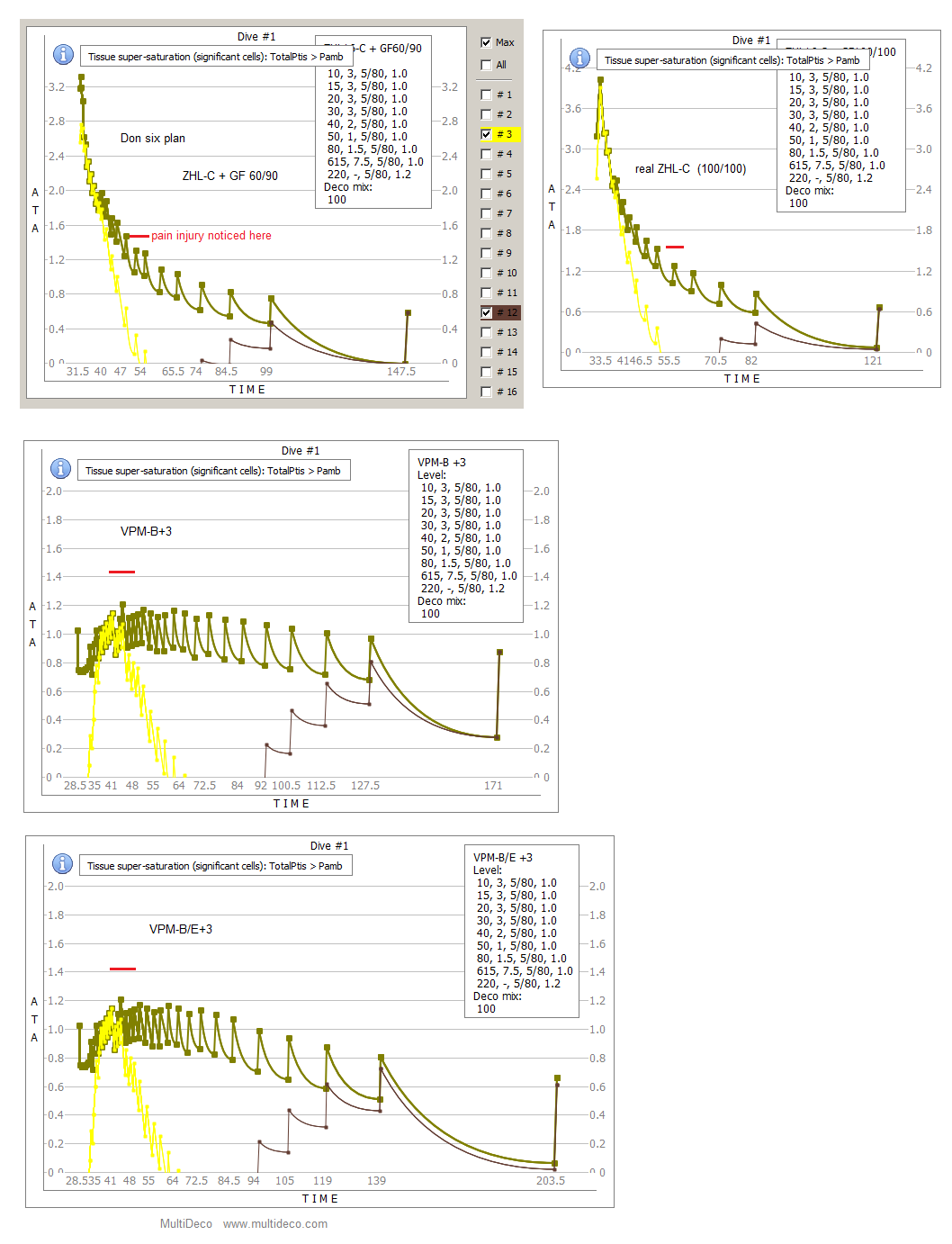
OK. here is alternative plans. Please take note of the supersaturation levels, and where Don's injury took place.

dsix36_plan-alt.png


The 60/90 plan has 3 times the amount of supersaturation exposure in water, compared to a VPM-B plan.

Which is the safer plan? Obviously the one that prevents harmful supersaturation pressures from occurring.

Fast tissues do matter, and they will get you injured, as Don has painfully re-discovered.

.
 
Hi Don. I am glad you are still around and sharing your incidents freely for all to hopefully learn. I on the other hand decided the risk vs reward was no longer motivating me. Having traveled the world and done many outstanding CCR deep dives at locations that only a handful of other divers have been did not provide much future reward potential. I have never been motivated to have a depth goal but I understand yours and others motivation in this area. Recover well my friend your still here and both of us know many others personally that are not.

John
 
OK. here is alternative plans. Please take note of the supersaturation levels, and where Don's injury took place.

The 60/90 plan has 3 times the amount of supersaturation exposure in water, compared to a VPM-B plan.

Which is the safer plan? Obviously the one that prevents harmful supersaturation pressures from occurring.

Fast tissues do matter, and they will get you injured, as Don has painfully re-discovered.

.

Hi, where do you think the depth/time limits of a zhlc + GF plan lie?

I used zhlc 50/60 successfully to 400ish feet in Belize previously. I will say I stayed on 02 for 30 mins after on the boat ride home as a precautionary measure. This was after getting mildly bent on 50/70 to similar depths.

Now, there is a hole in the ocean floor that merits a look at 500ft, which has been plumbed to 650ft.... It's in my sights to attempt this at some point in the (distant!) future. Mine is not a depth goal, rather an intriguing hole with a decent depth.
 
Hi, where do you think the depth/time limits of a zhlc + GF plan lie?

I used zhlc 50/60 successfully to 400ish feet in Belize previously. I will say I stayed on 02 for 30 mins after on the boat ride home as a precautionary measure. This was after getting mildly bent on 50/70 to similar depths.

Now, there is a hole in the ocean floor that merits a look at 500ft, which has been plumbed to 650ft.... It's in my sights to attempt this at some point in the (distant!) future. Mine is not a depth goal, rather an intriguing hole with a decent depth.

Hi,

I would not try to box this into some fixed depth or boundary, because its all proportional to the dynamic depth / time conditions. example, if Don had stayed on the bottom for 5 mins, then his first stop would be at 100ft deeper at 310ft, and his time spent at high SS pressure, would come down to 5 mins, which might just have been reduced enough to get away with it, or at least lower his injury impact or onset time. However, the supersaturation is still way too high to be considered a safe ascent.

The basic problem here, is that ZHL-C is way beyond its useful range. In the case of quicky deep bounce dives, the model parameters do not create proper limits on the small accumulated tissue time. i.e. the model is still getting "warmed up". The immediate problem is bubble growth from supersaturation in faster tissues, and ZHL-C simply does not have any math to check for this condition. This is why GF was invented - to fix these problems, so the diver can manually adjust ZHL-C into something more desirable. But GF is not a model and its not consistent across the dive spectrum - GF is just a user adjusted patch onto the end of a ZHL-C plan.

The trouble today (and in this dive) is the new planning trend back towards shallow stop planning, seems to have forgotten and ignored the past hard earned lessons of pioneer divers, and these new GF settings are no longer sufficient for the job.


For these deep dives, you really need to be following a bubble model plan (or emulating it). Only these models have the required math to check and prevent for exceptionally high supersaturation pressures.

.
 
Last edited:
Status
Not open for further replies.
Back
Top