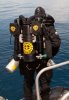
Hello - New to CCRs....Melbourne based.

G'day have you considered the MCCR RBs like the Classic Kiss Pelagian & the rEvo's, I would of thought that the GUE minded types would go down that route but for some reason a lot like the JJs'

Hi Rick,

Kiss WOB does not impress me, what we know about CO2 these days I don't want to chance it. Revo is great but cannot take larger tanks. Pelagian also looks good but after training on a meg I wanted a clear chest.
 
Hi Rick,

Kiss WOB does not impress me, what we know about CO2 these days I don't want to chance it. Revo is great but cannot take larger tanks. Pelagian also looks good but after training on a meg I wanted a clear chest.
There are 2 options........

First is the Manta Lung which sits behind your head and uses remote manual add valves which sit just under the shoulder D rings. Some guys didn't like the "Pillow Effect" with the counterlung sitting at the back of their head. But it certainly cleared up the chest area and if set up correctly breathed fairly nicely.

The second option is the TOS counterlungs. They breathe very similar to the std OTS and now have a similar ADV to that used on the OTS CLs. They sit further up on the shoulders and come down to the D rings on the shoulder harness and breathe very similar to the OTS

Regards,

Lance
 
Hi Rick,

Kiss WOB does not impress me, what we know about CO2 these days I don't want to chance it. Revo is great but cannot take larger tanks. Pelagian also looks good but after training on a meg I wanted a clear chest.

I could send you a picture of a rEvo with 2 80 cft on it for O2 and DIL...
 
Hi Paul, it was a few years back at Oztek and I asked you during a revo workshop if the unit could take larger tanks, you said "just sidemount them". I also asked when you thought manufacturers would offer a HUD with numbers rather than flashing lights to indicate PP02. I cannot remember exactly what was said, the essence being that you did not see the point. Come 2014 and we have the NERD, you are also telling me that larger tanks can be attached, both of which are great progressions. I would love to see photos of the unit with bigger tanks, I would also add this to your marketing literature as I think most people are not aware it is something the unit can cope with.
 
There are 2 options........

First is the Manta Lung which sits behind your head and uses remote manual add valves which sit just under the shoulder D rings. Some guys didn't like the "Pillow Effect" with the counterlung sitting at the back of their head. But it certainly cleared up the chest area and if set up correctly breathed fairly nicely.

The second option is the TOS counterlungs. They breathe very similar to the std OTS and now have a similar ADV to that used on the OTS CLs. They sit further up on the shoulders and come down to the D rings on the shoulder harness and breathe very similar to the OTS

Regards,

Lance

Hi Lance,

I was excited to try the TOS lungs during training in Thailand as I genuinely thought they could solve my personal issue with the FMCL lungs. I consider myself pretty capable at gaining flat trim. With the centre of buoyancy so high with the lungs I was fighting the whole dive to get comfortable. I tried them on the meg and pathfinder, both with the same outcome, they wanted to rise off my shoulders and force me to do a seahorse impression. The only way it worked was by going head down which forced the lungs to ride into the shoulder. The challenge with that position is that if you try to back kick, you rise to the surface. Trim once sorted should not be a fight underwater, i didn't want to have to fight the unit for several hours of deco.

The FMCL were great from a trim perspective, but they were also clipped through my crotch strap with bungy to keep them down. I know people who love both systems, but for me they both ended up being compromises I did not like. The ATS lungs would have solved the issue but at 1700 aud it forced the meg and pathfinder prices over the JJ which came configured nicely from scratch. I also know that ISC don't condone ATS lung usage, as per previous threads about IP and also WOB tests in all positions.

Both units are awesome and used successfully for massive dives. I personally could not come to terms with the lungs.
 
Hi Lance,

I was excited to try the TOS lungs during training in Thailand as I genuinely thought they could solve my personal issue with the FMCL lungs. I consider myself pretty capable at gaining flat trim. With the centre of buoyancy so high with the lungs I was fighting the whole dive to get comfortable. I tried them on the meg and pathfinder, both with the same outcome, they wanted to rise off my shoulders and force me to do a seahorse impression. The only way it worked was by going head down which forced the lungs to ride into the shoulder. The challenge with that position is that if you try to back kick, you rise to the surface. Trim once sorted should not be a fight underwater, i didn't want to have to fight the unit for several hours of deco.

The FMCL were great from a trim perspective, but they were also clipped through my crotch strap with bungy to keep them down. I know people who love both systems, but for me they both ended up being compromises I did not like. The ATS lungs would have solved the issue but at 1700 aud it forced the meg and pathfinder prices over the JJ which came configured nicely from scratch. I also know that ISC don't condone ATS lung usage, as per previous threads about IP and also WOB tests in all positions.

Both units are awesome and used successfully for massive dives. I personally could not come to terms with the lungs.

I've found the Meg needs top trim weight added to get the unit into a more neutral horizontal position. I don't think it is a problem and is easily remedied by adding trim weight to the top of the unit. I personally have added trim pouches to the top of the tanks and see many other divers have adopted my approach. As I travel a lot to diving locations I don't want to pay excess baggage for dead weight I can easily get at the destination.

IMG_8478sc.jpg

The Pathfinder with either the TOS or OTS CLs I have had no issues trimming it whilst either diving wet or dry as it is with a SS backplate but adding trim weights could be a quick fix for it also. Like any piece of dive gear it needs to be set up and your trim adjusted. Once you have it right it's no harder than counting the weights needed on a weight belt before you jump in and you know you're going to be very close to right every dive unless you change something in your equipment or setup. My favourite fins are my trusty old Jets but at a kilo and a half heavier than the Mares Quatro fins I use now check how much weight you have strapped to your feet before adding too much additional weight at the opposite end.

If you don't plan to travel I have seen a few different remedies but the best was lead blocks bolted directly to the backplate. They were out of sight and didn't get in the way and once set, their trim was spot on every time they dived......More importantly they never forgot to take their weights when they packed the dive gear!!

Regards,

Lance
 
Hi Lance, all fair points. With an Ali plate, 2l tanks, halcyon CCR wing and a 7mm wetsuit in freshwater I didn't need any weight on the meg. My last option would have been to de-invert the tanks. The pathfinder I had a tiny bit more leeway but not much. In a drysuit I am sure it would have been a different story. I usually dive dry btw. I did however want it to work in all environments, including the tropics when you only wear a stinger suit. Fair point on the fins but I can usually compensate reasonably well for that extra weight out back by pulling my feet closer to my centre as opposed to stretching them out in a drysuit. Hope to head up your way in the near future for some diving, will touch base so I can see your setups.
 
......I would love to see photos of the unit with bigger tanks, I would also add this to your marketing literature as I think most people are not aware it is something the unit can cope with.

the point is that any rebreather, (except those that house the tanks INSIDE a cover) can take larger tanks for DIL and O2, but you really don't want to, if you don't have to. more weight, more drag, and no use for it, as dil and O2 can never substitute bail-out.
only on the rare occasion where you go remote, and don't find any 2l or 3l tanks, you can mount bigger tanks on all these units
for the rEvo, just slide 2 weight belts (without weights on it:-)) between the case of the unit and the wing, install the 2 tanks, and close the weight belts: both tanks stay perfectly in place.
we did this in egypt when part of our luggage was lost for some days, and we had no tanks locally.

as for mounting separate bail out on the back: 2 liter tanks for O2 and Dil inboard, 3-6 liter carbons 300b on both sides of the unit using the quadro locks: this gives bail-out for shallow to intermediate dive depths.. but makes the unit a lot wider

paul
 
Thanks for that insight Paul, honestly had no idea it could be done. My plan is to have twin 7's.....one dil and one 02. For dives above 30m, non deco, I don't need additional bailout. For dives beyond that I add offboard tanks as required. Back gas 02 forms part of my deco gas as I can plumb it via a reg. Heavy...yes...but it is also consolidated. If I travel, 80s or 40s will be the order of the day....heavy once again but you can get 80's everywhere. All Onboard will be accessible via manifold reg and BOV. Can you post some photos of those configs?
 
My plan is to have twin 7's.....one dil and one 02. For dives above 30m, non deco, I don't need additional bailout...

now please explain me why you would do this... I don't see any reason .. have you used this setup before on another unit?

for 30m no deco, you can have a unit with 2 x 2 liter tanks for O2 and Dil, .. that will do the job... so why make your rig so terribly heavy?

my rig with 2 x 2 liter is like 26kg ready to jump, (but I do take bail out !! so I add a 5liter sling on the side... )

your rig with 2 x 7liter...??
 
Hi Paul, your setup has 6kg in 2l tanks and 7kg in sling tank excluding regs, 13 total. 2 x 7l are 15.2 kg excluding regs. Add on your additional reg and we are probably talking 1kg difference. I am also more streamlined as I don't have a sling tank, the frontal area of 2's vs 7's would be no more than a few cm squared difference. As for what it weighs in total, no idea yet as I don't have the unit....it is on its way. But if we took your unit as an example at 26kg + 7kg in the stage, I would be 2 kilos above you. The difference being you can carry the stage separately if you see fit, I cannot. Having jumped off rocking boats with twin 15's, 3 stages and a scooter....the slight difference won't be the deal breaker for me.

I guess the nub of my point is that I don't see a downside in being able to fit bigger tanks. Like you I can also run 2l's if I should choose. I do however see a downside if you can only accept small tanks as 80's are commonly available almost everywhere diving occurs, 2s, 3s etc are more rebreather specific and I don't want to carry cylinders.

Take what I say with a grain of salt, you have forgotten more about rebreathers than I know, perhaps my mind will be shaped over time to follow your line of thinking.

 
Hi Paul, your setup has 6kg in 2l tanks and 7kg in sling tank excluding regs, 13 total. 2 x 7l are 15.2 kg excluding regs. Add on your additional reg and we are probably talking 1kg difference. I am also more streamlined as I don't have a sling tank, the frontal area of 2's vs 7's would be no more than a few cm squared difference. As for what it weighs in total, no idea yet as I don't have the unit....it is on its way. But if we took your unit as an example at 26kg + 7kg in the stage, I would be 2 kilos above you. The difference being you can carry the stage separately if you see fit, I cannot. Having jumped off rocking boats with twin 15's, 3 stages and a scooter....the slight difference won't be the deal breaker for me.

I guess the nub of my point is that I don't see a downside in being able to fit bigger tanks. Like you I can also run 2l's if I should choose. I do however see a downside if you can only accept small tanks as 80's are commonly available almost everywhere diving occurs, 2s, 3s etc are more rebreather specific and I don't want to carry cylinders.

Take what I say with a grain of salt, you have forgotten more about rebreathers than I know, perhaps my mind will be shaped over time to follow your line of thinking.

yes but... you must compare apples with apples: in your 2x7l tank setup: you carry no bail-out, so you should compare it with my 2x2l setup...

my guess is your 2x7l setup with no bail-out will be around 45 kg...
 
I've gone off the 7L onboard dil/bailout idea to be honest. What if your Dil first stage fails and you have to shut it off? Also how are you planning to access your Dil OC? BOV only, or also a standard reg?
The JJ is great, because it has options. LPI hoses on your bailout tanks mean they can all be plugged in to the loop.

I've done a number of decent dives now and have never felt the need for bigger onboard tanks. The new GUE JJ setup is interesting, but I really think they are over complicating things. Its CCR with an OC mentality.

Just my $2 worth.

Sent from my XT905 using Tapatalk
 
In the example above I am talking about no deco, shallower than 30m diving. I will have a BOV and a long hose. Should dil fail.....I would stay on the unit and ascend. If DIL and rebreather fail I would get gas from a buddy like I would if diving on a single OC setup. I will have a manifold running adv, BOV and long hose. Wing inflator will be on back gas dil. When running 7's only this would be plugged into the manifold. When running from offboard this would be plugged into the manifold and Onboard disconnected. If adv, long hose or BOV should fail, disconnect all manifold connections and bail....no biggie.

These are the connections, it is the same as clare and Al's setup. I actually got it from Neil at Bristol Channel diving where they got their setup working. All connections are CEJN 221 compatible, including drysuit, wing and O2 mav. I can plug in Onboard 02 and with a CEJN double ended reg hose I can use offboard regs as a manifold to access all Onboard gas should the manifold setup fail (BOV, long hose, adv).

ajujane9.jpg
 
Jason and Tiptopperroo,

This setup would also work in your 130m dive example. Run normoxic dil in backgas at all times, connect hypoxic dil on the boat but have it shut off. When you get to 10m+ simply disconnect normoxic Onboard and switch on hypoxic offboard. On ascent, reverse the procedure or plug in another gas altogether if you wanted.

Also means I am carrying an intermediate mix on my back for a switch at 57m....one less stage. Should the manifold fail use a double ended CEJN fitting and an off-board stage reg as a manifold to access 02 or backgas dil.
 
Jason and Tiptopperroo,

This setup would also work in your 130m dive example. Run normoxic dil in backgas at all times, connect hypoxic dil on the boat but have it shut off. When you get to 10m+ simply disconnect normoxic Onboard and switch on hypoxic offboard. On ascent, reverse the procedure or plug in another gas altogether if you wanted.
.

Hi Gareth
This is all needlessly complicated, and has caused problems for people in the past.
99.something percent of all dives you do, the rebreather will just work fine from surface to surface with an onboard dil appropriate for you max depth and 2 or 3l tanks. It's really not a good trade off to add the complexity of a gas swap on every dive to maybe make bailout somewhat easier if you ever need to do it.

For your 30m dive, onboard 3l has plenty of gas for bailout. I've bailed out after hitting the sand with a thud in the vicinity of the J4 sub onto a 2.7 litre ali and had plenty of gas. And I was sucking pretty hard on that bailout for the first few breathes...

I have swapped all my fittings to CEJN as well, including the second stages on my bailout. So I have the ability to cross connect anything to anything if needed, but stlll have the rebreather as a simple stand alone unit. And each of my bailout tanks are also stand alone and not connected to anything. So I can easily take them off when tangled, or hand them off if needed.

A lot of people have played around with big tanks, and offboard connections etc. Most have gone back to using the CCR as designed as a simple stand alone unit.

Mike
 
Hi Mike,

I did the numbers on 3's and they are only really good for the CCR operation based on a 45lpm SAC rate with a C02 hit. 2 mins sorting on the bottom and then a 3 min ascent, average depth of 3ata. 675litres of gas required. 3l only has 690l. The 7's give me options and can allow me to remove a travel gas on 60m+ diving. I would also be prepared to eliminate an 02 stage down to 75m as I can access this bottle via the manifold.

Like I have said to others, I may change my thoughts over time and am prepared to do so. I want to make things as easy and safe as possible, if it's all to much hassle I will simplify and standardise. Looking forward to joining the Melbourne CCR community shortly, I expect to have the piss taken regularly. I would feel cheated if I did not.....:-)
 
I did the numbers on 3's .....

... if it's all to much hassle I will simplify and standardise.

I agree - you can take worse case numbers and calculate that you don't have enough. One anecdote shouldn't outvote that if you don't feel comfortable.

You should play around with different configurations - most people do. I'd just make the suggestion that it might be easier to start with the configuration everyone else tends to use and modify from there, rather than start with something more convoluted.
You might also find that people have a bunch of bits and pieces you can borrow and play with, rather than spending money yourself.

You should be a year or so away from doing any dives that you can't do with a stock unit and a 5l ali of air (But almost all the divers I know are hypocrits who jumped deeper quicker). At the least, this is a cheap and simple way to start out - I don't see any downside of trying it for a while until you get used to diving a rebreather. Go rediscover sites you may not have dived for a while and see what they are like with time to just float there.

Mike
 
Back
Top