My DCS Hit

Status
Not open for further replies.
Depends on the GF used. You can putz around with GF and get similar to VPM, as you did, but where here is anyone running these GFs? I think the answer is almost no one.
Most are running 30/70 or 80, or 40/70-80.


Yes but that wasnt the point you raised. You offered that VPMB gave longer bottom times and shorter decompression times.

That's fundamentally wrong.

GFs give the longer bottom times and shorter deco times.

GF 100 100 would give a dive time of 183mins for this 30mins at 100m dive where as VPMB 0 would give 196mins


The question then is which is safer? VPMB 0 with 77mins of shallow stops and first stop at 54m or 100/100GF with 84mins of shallow stops and first stop at 44m
 
My dive profile and planning was NOT recommended to me by anyone. It was done totally on my own using what knowledge and experience I had at the time.

Everyone needs to keep in mind that there were several things, other than the plan or profile, that were not optimum for a dive like this and any one (or combination of) could have been the cause for my DCS. Maybe tomorrow the profile would work just fine for me, maybe not?

What prompted you to do the ascent rates you did?

I remember 20 years ago there was a short lived trend of doing the initial ascent at break neck speed. But its been pretty much 9m min (35FPM) since then

Also any chance of seeing a profile chart o the dive?
 
I went that fast to be conservative from my previous ascents from 400-500 at around 150fpm
 

Attachments

  • Bent profile.jpg
    Bent profile.jpg
    83.3 KB · Views: 41
I went that fast to be conservative from my previous ascents from 400-500 at around 150fpm

Hi Dsix
The CNS numbers don,t seem to add up, your po2 line looks lower then the avg needed to hit 164, in your 220 run time ,

The po2 line looks like you never went more than 1.35 or less ,
164% over 220 should be1.45 ish

Maybe im missing something , but that could spoil your day , no matter what death planner your on.
 
Last edited:
Hi Dsix
The CNS numbers don,t seem to add up, your po2 line looks lower then the avg needed to hit 164, in your 220 run time ,

The po2 line looks like you never went more than 1.35 but 164% over 220 should be1.45 ish

im missing something ,
Because there is no PO2 line shown. That line is the temp line.
 
Yes but that wasnt the point you raised. You offered that VPMB gave longer bottom times and shorter decompression times.

That's fundamentally wrong.

GFs give the longer bottom times and shorter deco times.

GF 100 100 would give a dive time of 183mins for this 30mins at 100m dive where as VPMB 0 would give 196mins


The question then is which is safer? VPMB 0 with 77mins of shallow stops and first stop at 54m or 100/100GF with 84mins of shallow stops and first stop at 44m

ok, let me state it more clearly VPM gives more bottomtime and less deco than "THE GFs MOST PEOPLE RUN". Hows that.
 
ok, let me state it more clearly VPM gives more bottomtime and less deco than "THE GFs MOST PEOPLE RUN". Hows that.
And arguably more risk. More might be 2 DCS cases in 1,000 dives instead of 1 DCS event in 1,000 dives. So you might not have noticed the increase personally. But its still more. In part (probably) because integral supersaturation is higher and in part due to the higher surfacing tissue tensions.

Did you post one of your VPM based shearwater profiles? I looked back and didn't see any but might have missed it.
 
I dont disagree its probably higher risk, but in 7 years and well over 1k hours of dives between Jeff and I, never a niggle. From discussions with Simon, I largely attribute it to physical conditioning being a major factor in susceptibility to DCS.
 
I dont disagree its probably higher risk, but in 7 years and well over 1k hours of dives between Jeff and I, never a niggle. From discussions with Simon, I largely attribute it to physical conditioning being a major factor in susceptibility to DCS.


Me too, I ran deep stop deco for many years without a hit. However I am always looking for the deco system with the least risk

The point I am labouring is, couldn't you do the same bottom times with the same deco time and adjust the deco stop profile to emphasise shallow stops and have higher margin of safety?

Your post reads like you still working on the principle the VPMB deco is more efficient. By which I mean lower risk for the same in water time?

Do you reject the NEDU testing as flawed?
 
I dont accept the NEDU study as the burning bush of deco. I think were such a study done today, by todays standards and knowledge, it would be interesting to see the result and if differed.
 
The only thing is it's more than just the NEDU study. Also, the NEDU study is less than 10 years old...

The basic issue, is the nedu test did "nedu stops".... not deep stops, not tech stops, not anything relevant to tech or our bubble model world. None of the experts have made a valid science connection from the nedu test to tech diving, but they will bully us with pretend association through word play games. Such is the sad state of this "body of evidence..."

.
 
None of the experts have made a valid science connection from the nedu test to tech diving, but they will bully us with pretend association through word play games. Such is the sad state of this "body of evidence.

The relevance of the NEDU data to tech diving decompressions has been explained to you time after time. You either don't understand it, or don't want to accept it, or perhaps both. The face validity of the inferences drawn from the NEDU data has been markedly enhanced through extensive post hoc evaluation of the supersaturation data, and confluence with the results of 3 other studies of human decompression that have compared deeper vs shallower approaches. There are no contradictory studies at this time.

You have still not answered the questions:

Do you still believe inert gas supersaturation is important prior to arrival at the surface, but it doesn't matter after arriving at the surface? I would also be interested to know if your fundamental misunderstanding of this issue has affected your programming of VPM in any way because that could result in unsafe errors in the algorithm.

Based on your attribution of blame for Don's outcome to me, do you now accept blame for all cases of DCS that have occurred using deep stop approaches?

Simon M
 
The basic issue, is the nedu test did "nedu stops".... not deep stops, not tech stops, not anything relevant to tech or our bubble model world. None of the experts have made a valid science connection from the nedu test to tech diving, but they will bully us with pretend association through word play games. Such is the sad state of this "body of evidence..."

.
And yet VPM-B is very similar to the A2 bubble model profile tested in the NEDU study. I hope you don't feel bullied by the following information.

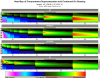
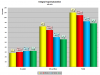
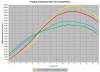
NEDU A2 (DCS~5%) looks very similar to VPM-B (as you would expect two deep stop profiles to look). Also NEDU A1 (DCS~1.6%) and GF are more similar.

For review,

1. Supersaturation Heatmap -- The heat map supersaturation similarities between A2 and VPM-B are self-evident.
Hm.png


2. Total Integral Supersaturation. Clearly A2 (DCS~5%) and VPM-B are closer. And A1 (DCS~1.6%) and GF are closer as well. The ISS of A2 is about 25% higher than A1, VPM is about 19% higher, and GF is about 5% higher than A1. The difference in ISS between A2 and A1 is the best explanation of the difference in observed DCS according to the NEDU scientists.
ISS.png


3. Supersaturation Exposure by Tissue Compartment. It's clear that both A2 and VPM-B protect compartments 1-3 similarly, especially compared to A1 and GF. The cost of this "protection" is the ballooning up of the exposure in the slower tissue compartments 9-12. Clearly A2 and VPM-B would be expected to perform more alike than A1 and GF.
ISS by cmpt.png


There are other similarities that have been posted. But I think this clearly establishes A2 and VPM-B as similar. About the same thing was said by Dr. Doolette in this presentation -- see minute 34 thru minute 38.
 
The relevance of the NEDU data to tech diving decompressions has been explained to you time after time. You either don't understand it, or don't want to accept it, or perhaps both. The face validity of the inferences drawn from the NEDU data has been markedly enhanced through extensive post hoc evaluation of the supersaturation data, and confluence with the results of 3 other studies of human decompression that have compared deeper vs shallower approaches. There are no contradictory studies at this time.

You have still not answered the questions:

Do you still believe inert gas supersaturation is important prior to arrival at the surface, but it doesn't matter after arriving at the surface? I would also be interested to know if your fundamental misunderstanding of this issue has affected your programming of VPM in any way because that could result in unsafe errors in the algorithm.

Based on your attribution of blame for Don's outcome to me, do you now accept blame for all cases of DCS that have occurred using deep stop approaches?

Simon M


The irrelevance of the NEDU data to tech diving decompression has been explained to you time after time. All of the attempts by you and others to make a valid scientific connection, have been shown invalid or just plain wrong. You either don't understand it, or don't want to accept it, or perhaps both. The face validity of the inferences drawn from the NEDU data has been conclusively dismissed through extensive post hoc evaluation of the supersaturation data. Instead all that you can offer is eye candy graphs and junk science, and fake data points, all wrapped up in marketing fluff by Kevin Watts as shown above.

The same false interpretations is made with the results of 3 other studies of human decompression that have compared deeper vs shallower approaches. There are no complimentary studies at this time to support your claims.

You have still not answered the questions:


Do you still believe inert gas supersaturation is important prior to arrival at the surface, but it doesn't matter after arriving at the surface?
Simon M


Your question is moot: the two are not exclusive, and we have no methods available to manipulate surface supersaturation on its own. Our only control is dive supersaturation levels, and therefore that's the only dimension that matters. Further more the absolute value comparisons you want to make are irrelevant as can demonstrated by attempting to compare an NDL diver to a deco diver. Surface values are not important.


I would also be interested to know if your fundamental misunderstanding of this issue has affected your programming of VPM in any way because that could result in unsafe errors in the algorithm.
Simon M

Stop trying to make shit up... Your insulting attitude and this making false implications is a deliberate effort to manipulate the public again.


I remind you again... your deco theories and ideas "new, more efficient, lower risk", as tested here in Don's dive, has failed, simply because it ignored the basics of decompression physics, and the experiences of pioneer divers.


Based on your attribution of blame for Don's outcome to me, do you now accept blame for all cases of DCS that have occurred using deep stop approaches?
Simon M

What a stupid question.

Lets see,.. there is Pyle stops.. not mine. There is GF stops... not mine. There is RD stops.. not mine. Other DIR stops... not mine.. There is Suunto stops.. not mine. There is RGBM stops... not mine. There is NEDU stops... not mine. There is VPM-B stops (Yount) .. not mine etc,etc.

I don't think I invented the deep stop (there are no Ross stops) but maybe you could have your marketing spin wizard cook up another eye candy graph.

.

 
The irrelevance of the NEDU data to tech diving decompression .... etc (inverted plagiarised argument).

I doubt you will convince many people taking the conversation to this level Ross. And the difference between what I said and your plagiarised version of it is that you are the only one who believes your version, and mine is endorsed by both the evidence and every expert in the field who has contributed to the conversation.

Your question is moot: the two are not exclusive, and we have no methods available to manipulate surface supersaturation on its own. Our only control is dive supersaturation levels, and therefore that's the only dimension that matters. Further more the absolute value comparisons you want to make are irrelevant as can demonstrated by attempting to compare an NDL diver to a deco diver. Surface values are not important.

Wow, Ross, doubling down on something that basically says you don't understand this topic. I have presented you with incontrovertible evidence that tissue supersaturation drives bubble formation after arrival at the surface, and you continue to insist that surface supersaturation doesn't matter. The way we decompress can make a huge difference to surfacing supersaturation. Bubble models allow more of it (see UWSojourners heat maps above) so its not surprising that you will try to dismiss its importance. But please explain to me why supersaturation during the dive (which you is say is important) will initiate and drive bubble growth, but supersaturation at the surface (which you say isn't important) won't .

Stop trying to make shit up... Your insulting attitude and this making false implications is a deliberate effort to manipulate the public again.

I'm not making anything up. You have categorically stated that surface supersaturation does not matter, and you do it again in your most recent post. This claim is demonstrably false. Any reasonable person can deduce that someone who believes that surface supersaturation does not matter and who is writing decompression software for the general public could be inappropriately applying that belief in the implementation of the algorithm. I'm serious Ross. Should someone be writing decompression software if their understanding of the field is so poor that they believe surfacing supersaturation is not important ?

What a stupid question.

Lets see,.. there is Pyle stops.. not mine. There is GF stops... not mine. There is RD stops.. not mine. Other DIR stops... not mine.. There is Suunto stops.. not mine. There is RGBM stops... not mine. There is NEDU stops... not mine. There is VPM-B stops (Yount) .. not mine etc,etc.

I don't think I invented the deep stop (there are no Ross stops) but maybe you could have your marketing spin wizard cook up another eye candy graph.

Breathtaking application of a double standard. You seem to have a lot of trouble appreciating things that are blindingly obvious to just about everyone else.

As stated ad nauseum on this thread by myself and others, Don's decompression is "not mine" either. But that has not stopped you falling over yourself gleefully trying to blame me for the unfortunate outcome of his dive. Clearly you intend blaming me for any bad outcome in a dive that de-emphasises deep stops even if the de-emphasis exceeds that which I consider an appropriate response to the current evidence. On that basis, since you have strongly argued for deep stops for years now, why shouldn't you carry the blame for every poor outcome on a dive that emphasises deep stops, even if they are deeper or longer or whatever than you recommend?

Simon M
 
Last edited:
Ross you are giving every impression of a toddler who's been caught lying to the grown-ups and is trying to shout and tantrum his way out of trouble. It's embarrassing.
Implying that Simon is knowingly causing harm to divers for his own gain is not acceptable. Or plausible. Calling his arguments "stupid", "junk" and "made up" is just shout-y, desperate noise. Argue the science, not the man.

Could I ask that someone offer a link or even a short explanation to how integral supersaturation is calculated? UWSojourner your heatmaps and graphs are fascinating; could I ask for some explanation of the units/scales of the axes? I'm not convinced I understand mb/min.
Thanks
Jason
 
Could I ask that someone offer a link or even a short explanation to how integral supersaturation is calculated?

Integral supersaturation is the sum of all supersaturations experienced during, and after, the dive. Let's say you had 3 compartments and for 1 minute the supersaturations were 0.5, 1, and 0.5 atmospheres. The integral supersaturation would be 2 atmosphere-minutes. It's just the exposure to supersaturation-time the diver endures.

UWSojourner your heatmaps and graphs are fascinating; could I ask for some explanation of the units/scales of the axes?

Dr. Mitchell described the interpretation of the heat map here. The entire presentation is great, but see minute 34:45 thru about minute 45 for his description of how to interpret the heat map.
 
Status
Not open for further replies.
Back
Top