
Simon Mitchell
Well-Known Member
Michael, Rubicon is your friend http://archive.rubicon-foundation.org/xmlui/handle/123456789/5523
Thanks Gareth, I forgot that it was there.
Simon

Michael, Rubicon is your friend http://archive.rubicon-foundation.org/xmlui/handle/123456789/5523
You have no basis for your claim that shallow stop profiles will make more extravascular bubbles;
....... that bubble models could control extravascular bubbles better than another approach while at the same time producing higher numbers of VGE.
All deco models are concerned first and foremost with preventing symptoms of DCS. Go and look at your copy of Bennett and Elliott, in Bill Hamilton and Ed Thalmann's chapter on "Decompression Practice", after mentioning both intravascular and extravascular bubbles, they clearly state:
2/ Sure, but you will need to a/ abuse the procedure, or b/ have defective circulation, or c/ have other health issues, and more.
Which one of these applied to Neal's 4 cases of cardiopulmonary DCS?
VGE can clearly cause direct harm. This thread has already contained discussion of cardiopulmonary symptoms ("chokes") associated with intravascular bubble loads that are high enough to overwhelm the lungs filtration ability and impair effective gas exchange. This has been well demonstrated in animal studies, and we have had four cases in our lab. One of these was beautifully captured in one of our NASA studies. Very high bubble loads preceding the onset of mild but escalating symptoms of coughing, retrosternal pain, and anxiety. Rapid descent brought rapid resolution of the symptoms; it could very well have been a life-threatening situation had the fast action not been taken.
I trust you have seen Neal's comment.

You on the other hand, are in a frenzy to twist this all into yet another anti-deep stop/bubble model message. You over hype the immediate dangers, distort the information on the topic, employ scare tactics and endless deception, so you can bully your agenda through. This doesn't help anybody Simon.
I suggest you think about taking a softer approach.
Its the same argument and that you use against deep stops, where you say: the higher supersaturation in tissue after a dive is giving more VGE.
Basic physics and the central concept of decompression theory. If some supersaturation makes extravascular micro-bubbles, then it stands to reason that more supersaturation will make more/larger extravascular micro-bubbles.
If microbubbles are in extravascular tissue, then our best control of these is to limit supersaturation in ascent i.e. deep stops.
You can't have it both ways Simon.
You have no basis for making that statement. We have no information to suggest that these two bubble sources are the same. The details so far are conducive to the long standing theory of independent growth of each.
You are just grasping at straws Simon, trying to invent stories to suit your arguments in the worst possible way
Expect, that VGE does not directly cause DCS in 99.99% of us. We have millions of dive samples every year, from all types of diving, all with VGE to show that fact.
The goal of the NASA testing mentioned above, was to speed up the pre breath process for EVA. One would expect the experimenting to be on the edge at some point. So that would be a procedural matter again - going too fast.
But in normal dives, we don't do these aggressive procedures, so we don't encounter the issue.
I am quite sure the scientific comunity would disown any person found guilty of this I am equaly certain all the other reserch scientists involved in the studdy would round on who ever was discrediting their work from the inside.
Yes I did. It's a pleasure to read Neals posts.

Arterial gas emboli in altitude-induced decompression sickness
Author and Affiliation:
Pilmanis, Andrew A.(Aerospace Medical Research Labs., Brooks AFB, TX, United States);
Olson, Robert M.(Krug Life Sciences, Inc., San Antonio, TX., United States)
Abstract: Exposure to high altitudes can result in the evolved-gas condition referred to as decompression sickness (DCS). Ultrasonic monitoring techniques have clearly demonstrated the presence of venous gas emboli (VGE) during decompression. Although important to DCS research and our understanding of the physiological mechanisms of this condition, Venus gas emboli have not been considered clinically hazardous, unless in extreme numbers.
It then goes on to say that AGE are viewed with great concern, VGE can cross via the pulmonary circulation and the clinical implications are yet to be determined.
In all five cases, at the time of AGE onset, the VGE scores were high from all monitored locations.
It was also published in 1993 and quite likely opinions on VGE , much like deco theory, is ever evolving.
What mean not all VGE is bad, but extreme numbers.
Sent from my PAP4500DUO using Tapatalk 2
Arterial gas emboli in altitude-induced decompression sickness
Author and Affiliation:
Pilmanis, Andrew A.(Aerospace Medical Research Labs., Brooks AFB, TX, United States);
Olson, Robert M.(Krug Life Sciences, Inc., San Antonio, TX., United States)
Abstract: Exposure to high altitudes can result in the evolved-gas condition referred to as decompression sickness (DCS). Ultrasonic monitoring techniques have clearly demonstrated the presence of venous gas emboli (VGE) during decompression. Although important to DCS research and our understanding of the physiological mechanisms of this condition, Venus gas emboli have not been considered clinically hazardous, unless in extreme numbers.
http://ntrs.nasa.gov/search.jsp?R=19940007071
Sent from my PAP4500DUO using Tapatalk 2
Extravascular and intravascular bubbles are both derived from supersaturated gas in the tissues. Are you seriously trying to suggest that there is one reservoir of supersaturated gas that drives intravascular bubble formation and a separate one that drives tissue bubble growth? Within a tissue, the growth of intravascular and extravascular bubbles is inextricably linked by the local inert gas supersaturation pressure that is driving both processes. Simon M
1. Efforts to suggest that intravascular bubbles are somehow a completely unique thing does not make sense.
2. It is not valid to talk about microbubbles in the bloodstream as different from microbubbles in any other tissue.
3. If the research community had any reason to believe the genesis of bubbles was wildly different between blood and non-blood tissue, we would probably have some evidence at this point. We do not.
4. The Bennett and Elliott chapter does not state that the process of bubble formation is fundamentally different in different tissues, and the best evidence we have also supports a fairly consistent formation process.
Simon M
Igor,
In an abstract that goes on to describe 5 cases of DCS all occurring in subjects who concurrently had high grade VGE, and in which the authors go on to propose that the mechanism of injury is right to left shunting of VGE, why is this the part you choose to cite!!!????
This abstract supports everything we have been saying. Low grade VGE are rarely associated with symptoms of DCS. High grade VGE (the one's Ross says we should ignore) are often associated with symptoms of DCS.
Simon M
I see you still trying to sell the Nedu study, despite every one of your arguments and "plausible explanations" on that test was found to be invalid or wrong.
You state above that greater SS causes more VGE microbubble.
Then you dismiss the same argument assertion that greater SS will also create more extravascular microbubble, i.e. shallow stop models.
I see you still trying to sell the Nedu study, despite every one of your arguments and "plausible explanations" on that test was found to be invalid or wrong.
Do you think they grow in tandem? Tissues on gas, then they off gas. Logic dictates that Bubbles will grow as extravascular in the tissue first. Then after gas leaves the tissue, the intravascular VGE has a chance to grow. I would expect its a different set of conditions that drives the growth and destruction of each bubble (if it could ever be measured so small). For those reasons, they should (and are) treated separately by decompression models and planning.
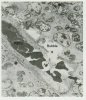
It's plain obvious that the 1:1 relation you imagine, does not exist. Using VGE is simply not a reliable or consistent indicator or gas load. The mere fact that high VGE does not create DCS is enough. Likewise, not all neurological DCS has high VGE either.
But where do "normal" sized VGE really come from? A 20-200um VGE bubble does come from a 5um capillary.

Yes I did. It's a pleasure to read Neals posts. What a difference there is writing style between he and you. Neal keeps to facts, gives a honest and balanced assessment of the information at hand.
You over hype the immediate dangers, distort the information on the topic, employ scare tactics and endless deception, so you can bully your agenda through.
Found to be invalid or wrong by Ross and ....... ?????
..mathematics.