"re-assessing deco profiles and deep stops", plus other bits..

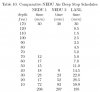
I don't know who drew the diagrams, but they are not right. Someone got the times badly mixed up. Its really sad. All that work based on a big math error :clap:

If the profiles are not right then it is Bruce Wienke who got the "times badly mixed up" for his own model. They are drawn from the table in his paper which is obviously a direct comparison between a "suggested" RGBM deep stop profile (labelled LANL in the table) and the two NEDU profiles. I have attached another version of the Table which includes the total run times which I had cut off the previous one. This is very different from Ross's claim and its what the NEDU guys were working from. If Ross is correct about the profile then its Bruce's "math error" he should be applauding.

This debate about the NEDU study is a sidebar to the most important point, which I address in my post below.

Simon M
 

Attachments

  • Wienke table.jpg
    Wienke table.jpg
    63.9 KB · Views: 36
Last edited:
The elephant in the room

I have spent a lot of time on this thread, and Bruce Partridge is correct; it is like the Monty Python sketch with the debate not going anywhere. Moreover, everyone is ignoring the elephant in the room:

Whether you believe the NEDU study is fantastic or a load of cr@p, the fact remains that there is no comparative evidence that supports a belief that deep stop decompression from a technical dive is superior. Ross has offered only criticism of the evidence from comparative studies that actually suggest deep stops are disadvantageous, and anecdote (a weak form of evidence) to support his own argument.

If follows that the conclusion of the experts at the deep stop workshop is the correct one. I reproduce it below because these things always seem to resonate more when you produce the "orginal" form. The entire point of this statement, released under the aupices of the world's premier diving science organisation, was to warn the diving community that there is no evidential basis for claiming superiority of the deep stop approach (or any other approach). You can choose to factor that into your thinking, or ignore it.
 

Attachments

  • DDS_Final-1.jpg
    DDS_Final-1.jpg
    90.6 KB · Views: 38
  • Statement.jpg
    Statement.jpg
    112.3 KB · Views: 38
Last edited:
I have spent a lot of time on this thread, and Bruce Partridge is correct; it is like the Monty Python sketch with the debate not going anywhere. Moreover, everyone is ignoring the elephant in the room:

Whether you believe the NEDU study is fantastic or a load of cr@p, the fact remains that there is no comparative evidence that supports a belief that deep stop decompression from a technical dive is superior. Ross has offered only criticism of the evidence from comparative studies that points in the opposite direction, and anecdote (a weak form of evidence) to support his own argument.

If follows that the conclusion of the experts at the deep stop workshop is the correct one. I reproduce it below because these things always seem to resonate more when you produce the "orginal" form:

Dr. Mitchell,

humbly, if you look at the result of the CDM-18 Model, according to this model the "deep stops" schedule produced by VPM are fine.

By fine, I mean that they do not produce/flag DCS risk according to the algorithms by:

Buhlmann
COMEX
DCAP
USM-Workman

Conversely, according to the CDM-18 Model the last 6 meter stop, that is the "shallow stop," is too short and does produce DCS risk.

To remove the "DCS risk" according to CDM-18 the shallow stop (6 meters) should be extended by 33 minutes.

My point is that it appears that the elephant in the room is that all the conclusions thus far are one contradicting the other based on the mathematical algorithms cited.

The only logical hypothesis to explain arterial bubbles in the study we are discussing is not that VPM produces too much "deep stops" - but that VPM produces too short "shallow stops" (and not the other way around).
 
...this is not my field (and I may very well be saying something entirely stupid), but to verify the hypothesis that VPM, if anything, produces too short "shallow stops" (relative to CDM-18 based models), I have removed all "deep stops" from the dive profile we have been looking at (without flagging DCS risk), and CDM-18 still requires longer decompression (80 minutes run time) than VPM (67 minutes run time).

See: http://www.rebreathermallorca.com/video/CCRX/nodeepstops.pdf
 
The only logical hypothesis to explain arterial bubbles in the study we are discussing is not that VPM produces too much "deep stops" - but that VPM produces too short "shallow stops" (and not the other way around).

Call me stupid but, to me, either way the result is the same as in stress in the system.

The profile may not result in fully blown dcs but sure it's probably not good to come close to that blurry grey line...


To me the outcome is simple. If you want to do deep stops you need to extend a lot your shallow stops.

Hopefully one day we'll have a definitive answer but not today.

Can't contribute a lot but closely following this thread.

D


Sent from my GT-I9300 using Tapatalk 2
 
Call me stupid but, to me, either way the result is the same as in stress in the system.

The profile may not result in fully blown dcs but sure it's probably not good to come close to that blurry grey line...


To me the outcome is simple. If you want to do deep stops you need to extend a lot your shallow stops.

Hopefully one day we'll have a definitive answer but not today.

Can't contribute a lot but closely following this thread.

D


Sent from my GT-I9300 using Tapatalk 2

Very true, but you also have to ask yourself at what point of the dive the potential damage is happening, and here the man-tested models now to include VPM point to too short shallow stop.

I'd like to hear from the experts though on the specific of the dive profile we are looking at which caused arterial gas bubbles in a significant way using VPM.

"Consensus Statements" are a product of a big compromise and loose meaning and significance, although they are true.
 
Very true, but you also have to ask yourself at what point of the dive the potential damage is happening, and here the man-tested models now to include VPM point to too short shallow stop.

I'd like to hear from the experts though on the specific of the dive profile we are looking at which caused arterial gas bubbles in a significant way using VPM.

"Consensus Statements" are a product of a big compromise and loose meaning and significance, although they are true.

Ok, seems reasonable. I wouldn't know how to manipulate VPM to make the deep stops shallower and the shallow stops longer. Without taking Simon's deco settings as gospel ... they sound good to me.
 
Ok, seems reasonable. I wouldn't know how to manipulate VPM to make the deep stops shallower and the shallow stops longer. Without taking Simon's deco settings as gospel ... they sound good to me.

Be reasured, you do not need to do VPM deep stops shalower and shalow longer, that could be with GF10/90, but not VPM-B. They are already correctely calculated by the model. Make some comparisions of the profiles divers here are talking about wtih GF 10/90 and GF30/70 on one side and VPM-B with cons. +2 or +3 and than you will see if you realy need to tweak VPM profiles. I think you do not, but if you feel you should, than do it.
 
I have spent a lot of time on this thread, and Bruce Partridge is correct; it is like the Monty Python sketch with the debate not going anywhere. Moreover, everyone is ignoring the elephant in the room:

Whether you believe the NEDU study is fantastic or a load of cr@p, the fact remains that there is no comparative evidence that supports a belief that deep stop decompression from a technical dive is superior. Ross has offered only criticism of the evidence from comparative studies that actually suggest deep stops are disadvantageous, and anecdote (a weak form of evidence) to support his own argument.

If follows that the conclusion of the experts at the deep stop workshop is the correct one. I reproduce it below because these things always seem to resonate more when you produce the "orginal" form. The entire point of this statement, released under the aupices of the world's premier diving science organisation, was to warn the diving community that there is no evidential basis for claiming superiority of the deep stop approach (or any other approach). You can choose to factor that into your thinking, or ignore it.

Hi Simon,

there will never be agreement between decompression modelers and scientists that try to see DCS in every bubble they see. If the researchers/scientists would know more about what they are trying to judge would be better. Mean decompression models, modeling, profiles etc. At least they could study the bubble dynamics on Eric Maiken's website to understand bubble dynamics, growth and meaning of bubble stable form. Than maybe someone would start to track bubble physical dimensions during tests and parallel them with bubble count.

Than maybe someday maybe we would be more successful in finding correlation between bubbles and DCS events. This is my opinion. I do not believe every bubble is calling DCS. Gas in some form must travel to lungs to be released in atmosphere.

When talking about bubbles we need to know two things. Bubbles in their form are stable until certain dimensions (diameter), after that they start with ability to merge in bigger unstable bubbles.
Smaller stable bubbles are not harmful and will not provoke DCS as they are small enough that they can safely travel to lungs to be exhaled during breathing.
Bigger bubbles are harmful because they can not safely travel to lungs to be exhaled during breathing because of their dimensions. They can stuck somewhere on their way to lungs and than there provoke DCS.

So until we limit our ascent to such speed that it maintains supersaturation of tissues low (with appropriate profile of the dive) the bubbles will not form bigger ones but remain small enough to be stable and safely travel to lung for exhalation. Yes we will be able to detect them probably but they shouldn't provoke any DCS as they are small enough not To stuck anywhere on their way to lungs and small enough not to merge and form bigger ones.

Remember how bubbles you exhale through regulator underwater grow - small ones remain for long time small and do not merge together and don't grow fast, bigger ones rapidly grow and merge in even bigger ones. Small ones travel slow, bigger much faster.

Best regards,

Igor P
 
...this is not my field (and I may very well be saying something entirely stupid), but to verify the hypothesis that VPM, if anything, produces too short "shallow stops" (relative to CDM-18 based models), I have removed all "deep stops" from the dive profile we have been looking at (without flagging DCS risk), and CDM-18 still requires longer decompression (80 minutes run time) than VPM (67 minutes run time).

See: http://www.rebreathermallorca.com/video/CCRX/nodeepstops.pdf

This CDM 18 is not so good. For example, that same dive in Buhlmann ZHL16B is a 54 minute dive (34 min deco), and it also fails the CDM 18 tests in the same manner. Most models do fail CDM18.

The problem is the CDM 18 design - because its a composite of several models, a plan from any one single model will not pass, including the very models CDM 18 is composed of.
.
 
Last edited:
I have spent a lot of time on this thread, and Bruce Partridge is correct; it is like the Monty Python sketch with the debate not going anywhere. Moreover, everyone is ignoring the elephant in the room:

Whether you believe the NEDU study is fantastic or a load of cr@p, the fact remains that there is no comparative evidence that supports a belief that deep stop decompression from a technical dive is superior. Ross has offered only criticism of the evidence from comparative studies that actually suggest deep stops are disadvantageous, and anecdote (a weak form of evidence) to support his own argument.

If follows that the conclusion of the experts at the deep stop workshop is the correct one. I reproduce it below because these things always seem to resonate more when you produce the "orginal" form. The entire point of this statement, released under the aupices of the world's premier diving science organisation, was to warn the diving community that there is no evidential basis for claiming superiority of the deep stop approach (or any other approach). You can choose to factor that into your thinking, or ignore it.


Simon, The consensus position statement said (in part) "....there is conflicting evidence regarding the relative efficacy....of deep stops".

To me this sounds like a neutral position, with room on either side to put forward ones ideas.

Ross fails to acknowledge the fact that there is effectively NO evidence that supports the deep stop approach he defends. The most relevant evidence we have suggests the opposite.

What I am saying is that the best evidence currently available does not support Ross's contention that these methods are demonstrably superior.
This is dancing around with word play. In plain English, these quotes are in conflict with the consensus position.
My objection is to your claim of superiority for deep stop algorithms, which is baseless. You don't know and you should stop claiming it.

Does not sound neutral to me, or allowing for conflicting evidence?


I make and sell GF ZHL and GF and VPM-B + GF software too. These are used on your side of the pool. I do understand both sides of the discussion.

I'm fully entitled to be critical of the NEDU test. And it does not stand up well based on the methods, or its results.

But your position seems to be to defend the NEDU at any cost, and ignore its errors and obvious flaws and mostly unrelated findings to our tech world. You ignore the comments and findings made by your peers regarding the weak linkage of VGE to DCS. I suspect you need this data includuing the weak and invalidated parts, to support some future revelations, and a biased stance.

For the benefit of readers here, this is below is the statement you proposed Simon, for the conference consensus position "In technical, deep military, and occupational diving, there is no evidence that empirical or bubble model derived deep stops are superior to decompression regimens prescribed by gas content models". This sounds very much like the views you have been promoting here and against me. There was ten pages of debate that arrived at the final consensus position "...there is conflicting evidence..." That is a long way from your initial position.
.
 
This CDM 18 is not so good. For example, that same dive in Buhlmann ZHL16B is a 54 minute dive (34 min deco), and it also fails the CDM 18 tests in the same manner. Most models do fail CDM18.

The problem is the CDM 18 design - because its a composite of several models, a plan from any one single model will not pass, including the very models CDM 18 is composed of.
.

CDM-18 is just a tool.

It always validated my Vplanner VPM tables.

However, this is the first time it has not validated a VPM table AND there were in the divers significant arterial bubbling.

As a planning tool, the strength of CDM-18 is precisely because it is a "combined model."

I do not understand the logic or the math of your anti-CDM statement above.

The issue here is the arterial bubbles in a VPM profile which no one can argue that they should/can be disregarded.
 
For the benefit of readers here, this is below is the statement you proposed Simon, for the conference consensus position "In technical, deep military, and occupational diving, there is no evidence that empirical or bubble model derived deep stops are superior to decompression regimens prescribed by gas content models". This sounds very much like the views you have been promoting here and against me. There was ten pages of debate that arrived at the final consensus position "...there is conflicting evidence..." That is a long way from your initial position.

I was going to stay out of further discussion in this thread but here is yet another baseless Hemingway allegation to go along with his "roadshow" and scaremongering ones.

Ross, I chaired the consensus discussion that modified the draft statements. Frans Cronje (not me) drafted them based on events that had taken place up to that time. I word-smithed them a little, but Frans drafted them. It actually states this in the proceedings if you read carefully enough. So, clumsy, impetuous accusation / conspiracy theory which is false. I would think it appropriate that you apologise.

I'm fully entitled to be critical of the NEDU test.
Of course you are, but your criticisms need to be accurate. In putting two of your key criticisms (bubbles don't matter and the trial was about to invalidate itself) all you have succeeded in doing is showing that you are happy to speak authoritatively about things you dont understand. But if I was not here to point it out everyone would just believe you.

But your position seems to be to defend the NEDU at any cost, and ignore its errors and obvious flaws and mostly unrelated findings to our tech world.

I'm far from convinced they are unrelated to "our tech world". You need to get yourself a copy of Navy Experimental Diving Unit; 2011 Jul. Report No.: 11-06. 53 p and have a very careful read. There is no point in debating it further here.

You ignore the comments and findings made by your peers regarding the weak linkage of VGE to DCS.

This exemplifies why I will refuse to discuss this with you any further. You seem to write your replies in an angered frenzy and pay no attention to the discussion that has taken place before. I have, in fact, agreed with all the commentary from Neal Pollock that you cited....

Simon Mitchell post number 93 said:
You are misinterpreting what Neal is saying. I don't disagree with any of the above statements but they simply articulate what I have already said: that high bubble grades do not accurately predict the occurrence of DCS. This is very different to your categorical statement that there was no link between bubbles and risk of DCS.

How is this ignoring comments of my peers? The problem is that you don't understand these comments, and you continue to look foolish by raising this matter again. I actually find your failure to appreciate this issue a little concerning given that you purport to be an expert in decompression physiology. Go back and look at the tables I posted. Yes, only ~40% of divers with Grade 4 bubbles suffered DCS (that is, the high bubble grade has a weak positive predictive value for DCS), but 40% is a much greater percentage incidence than is associated with the lower bubble grades. Therefore, Neal Pollock, on page 218 of the Deep Stop Workshop Proceedings says: "Higher bubble grades are associated with an increased risk of DCS". Although it requires careful interpretation in application it is a simple unassailable truth.


Finally, the consensus statement. Yes, it says "conflicting evidence". That was a charitable acknowledgement of the anecdote you have already mentioned in this thread (your "database"). This is evidence, but it is weak, and it is not comparative evidence where one method has been formally tested against another in some way. There is none of this latter type of evidence in favour of deep stops for decompression diving. In contrast, there are the NEDU and Blatteau studies that are comparative and indicated a possible disadvantage for deep stops. You don't like NEDU. Fine, forget it. There is still Blatteau. But the truth is neither "side" has definitive evidence either way as I have said many times. Thus, there is "conflicting evidence".

You must remember that this statement was released at a time when deep stops mania was gripping the tech diving world and its purpose was to signal to divers that the matter was not as clear cut as people like you, Ross, would have them believe. And the key point remains the same: you have no basis for claiming superiority for a deep stop approach to decompression.

I am not the deep-stop antichrist so stop trying to portray me as such. I have modified the deep stop aspects of my diving in the light of available evidence, but I have not abandoned them wholesale. I have been very neutral about the conclusions that can and can't be drawn on this matter. The trouble is, your entrepreneurial implication that deep stops are "more successful" (your words) forces me to take issue with you.

Simon M

 
Last edited:
CDM-18 is just a tool.

It always validated my Vplanner VPM tables.

However, this is the first time it has not validated a VPM table AND there were in the divers significant arterial bubbling.

As a planning tool, the strength of CDM-18 is precisely because it is a "combined model."

I do not understand the logic or the math of your anti-CDM statement above.

The issue here is the arterial bubbles in a VPM profile which no one can argue that they should/can be disregarded.

CDM 18: Your using many models to judge one other model. And you expecting that the model under test will comply with all the combined rules of all the judging models. That wont work. The sum of all models is not the "best of" all models. The sum of all models includes the deepest, the longest, the fattest, the slowest of all combined. Its a community opinion, where the subject has to comply to everyone's rules completely. No model on its own will comply. Its only when we add conservatism to test subjects that they exceed the base lines of the judges and might just pass.

To give you an example, the ZHL 16 is one of the included judging models. But take a plan from a ZHL 16 (no GF), and try it as a test model, and it will fail. Its not a good test system if it fails one of its own kind.

In this case, the VPM test dive in the report is nominal settings (conservatism 0), so yes, at this 'fast' deco setting, you would expect to be closer to the edge. The CDM 18 suggested that too. Situation normal.


********


That test profile was at nominal (0) conservatism. Its on the edge of no DCS. This is where all models are calibrated too. All deco models are tested and calibrated against the edge of no DCS. From there diver add conservatism, as desired.

If your fit and strong and young, you might use a profile like this. No one got DCS from 27 man dives in the test.

This is the first time we have seen up close what it looks like at 0 conservatism. I would expect to see it looking a bit ragged. If it wasn't then you model needs to better calibrated or redesigned.

Under normal circumstance, divers add conservatism, so there is no problem.

Your normal dive profile have conservatism, so that's why they clear the CDM 18.
 
The issue here is the arterial bubbles in a VPM profile which no one can argue that they should/can be disregarded.

In normal circulation there is always a small % of blood (2-4% from recall) from a physiological shunt that travels past the lungs without gas exchange. There is also some debate that under certain events such as stress hypertension or immersion oedema you can have very large % volumes shunted without exchange happening.

As such, there may not a direct correlation between bubbles and DCS but that would be more to do with the lottery of life in terms of both the blood that's being shunted and the destination of that blood as to if it would be symptomatic or not. To say high bubble counts are irrelevant overlooks this aspect entirely, you will be re-circulating them, the question is to where.
 
Finally, the consensus statement. Yes, it says "conflicting evidence". That was a charitable acknowledgement of the anecdote you have already mentioned in this thread (your "database"). This is evidence, but it is weak, and it is not comparative evidence where one method has been formally tested against another in some way. There is none of this latter type of evidence in favour of deep stops for decompression diving. In contrast, there are the NEDU and Blatteau studies that are comparative and indicated a possible disadvantage for deep stops. You don't like NEDU. Fine, forget it. There is still Blatteau. But the truth is neither "side" has definitive evidence either way as I have said many times. Thus, there is "conflicting evidence".

You must remember that this statement was released at a time when deep stops mania was gripping the tech diving world and its purpose was to signal to divers that the matter was not as clear cut are people like you, Ross, would have them believe. And the key point remains the same: you have no basis for claiming superiority for a deep stop approach to decompression.

I am not the deep-stop antichrist so stop trying to portray me as such. I have modified the deep stop aspects of my diving in the light of available evidence, but I have not abandoned them wholesale. I have been very neutral about the conclusions that can and can't be drawn on this matter. The trouble is, your entrepreneurial implication that deep stops are "more successful" (your words) forces me to take issue with you.

Simon M

Simon, there was no comparision aples to aples in NEDU experiment if aples is our diving profiles but more oranges to aples.
That is all to say about it. Noone dives scedules similar or like BVM3 profile. So how can someone compare those results to scedules/profiles we dive?
 
In normal circulation there is always a small % of blood (2-4% from recall) from a physiological shunt that travels past the lungs without gas exchange. There is also some debate that under certain events such as stress hypertension or immersion oedema you can have very large % volumes shunted without exchange happening.

As such, there may not a direct correlation between bubbles and DCS but that would be more to do with the lottery of life in terms of both the blood that's being shunted and the destination of that blood as to if it would be symptomatic or not. To say high bubble counts are irrelevant overlooks this aspect entirely, you will be re-circulating them, the question is to where.

To get better view, one should monitor them throught all decompression. The discovered bubbles were discovered after the dive and noone can speculate when they start to travel to the arterial side. So if they are present on surface the pressure arround is not changing and they remain in stable form small enought to form no harm. Or they were measured and determined to be big bubbles that could do harm and provocate DCS - This is my question?

Igor P
 
CDM 18: Your using many models to judge one other model. And you expecting that the model under test will comply with all the combined rules of all the judging models. That wont work. The sum of all models is not the "best of" all models. The sum of all models includes the deepest, the longest, the fattest, the slowest of all combined. Its a community opinion, where the subject has to comply to everyone's rules completely. No model on its own will comply. Its only when we add conservatism to test subjects that they exceed the base lines of the judges and might just pass.

To give you an example, the ZHL 16 is one of the included judging models. But take a plan from a ZHL 16 (no GF), and try it as a test model, and it will fail. Its not a good test system if it fails one of its own kind.

In this case, the VPM test dive in the report is nominal settings (conservatism 0), so yes, at this 'fast' deco setting, you would expect to be closer to the edge. The CDM 18 suggested that too. Situation normal.


********


That test profile was at nominal (0) conservatism. Its on the edge of no DCS. This is where all models are calibrated too. All deco models are tested and calibrated against the edge of no DCS. From there diver add conservatism, as desired.

If your fit and strong and young, you might use a profile like this. No one got DCS from 27 man dives in the test.

This is the first time we have seen up close what it looks like at 0 conservatism. I would expect to see it looking a bit ragged. If it wasn't then you model needs to better calibrated or redesigned.

Under normal circumstance, divers add conservatism, so there is no problem.

Your normal dive profile have conservatism, so that's why they clear the CDM 18.

Yeah, and that is why I like Vplanner and VPM, but I would not use blindly any single model as the gospel.

Vplanner and VPM are planning tools and as a planning tool CDM-18 gives me that which Vplanner in isolation does not.

I would not put all my eggs in a single programmer or model and trust blindly the numbers which appear on screen, but Vplanner and VPM in conjunction with CDM-18 help me make a reasoned decision about the dive plan.

VPM 0 - definitely, no thank-you.

Which VPM conservatism for the specific dive of the study would pass CDM-18?

That is the one I would have used for the dive, and maybe further ethical human experimentation should adopt (or use pigs instead of divers).
 
Last edited:
For the benefit of readers here, this is below is the statement you proposed Simon, for the conference consensus position "In technical, deep military, and occupational diving, there is no evidence that empirical or bubble model derived deep stops are superior to decompression regimens prescribed by gas content models". This sounds very much like the views you have been promoting here and against me. There was ten pages of debate that arrived at the final consensus position "...there is conflicting evidence..." That is a long way from your initial position.
.
Comparison of saturation decompression model with other models is a strong argument to scale.
This type of decompression is actually one tissue model. Longest tissue controls virtually all poces decompression. All they manage to degas faster, with little saturation.

Empirical model of the U.S. Navy (Direction of Comander, Naval Sea Systems Command, 2008) is a surprisingly good correlation with the model Hempelman.
Hempelman model is a model of one tissue. In its structure there are no places where there may be problems with the formation of bubbles.

Heliox decompression of high ppO2 is already full field of problems, as well as TMX or Nitrox decompression. A wide range of tissues involved in decompression, it is necessary to remove the inert gas is released.

Comparisons of the problem, to the models one tissue, are not an argument.

greet rc
 
Back
Top