My DCS Hit

Status
Not open for further replies.
That's not all that has been provided on the topic, but this "friend" of Dr. Mitchell's is a recognized decompression expert (and you are not). So his testimony on the matter matters.

Dr. David Doolette is a research scientist specializing in undersea and submarine medicine and physiology. His principal expertise is the development and testing of innovative decompression strategies for deep sea diving and submarine rescue. Other areas of expertise are diving and life support systems, diving safety, and occupational health surveillance. He has published widely in the scientific and military technical literature. Dr. Doolette has conducted basic academic research ranging from cellular to integrated system physiology. He has conducted applied research, providing solutions for recreational technical diving, commercial diving, and military submarine and diving communities.

And just like the other experts in the field, he has opposed your views at every turn. The quotes we keeps providing from Dr. Pollock, Dr. Mitchell, and Dr. Doolette are easy enough to find online because you've come against them, the recognized experts in decompression, time and time again. So yes, "providing quotes" is a form of validation because they come from recognized experts.

Same message for you.

If you really believe you are following the existing nedu pDCS method, then you will be able to provide the technical report or instruction paper they use. Then we can see for ourselves. Do you have the reference please?


Because so far, you are just grabbing at quotes off the internet, all written by the friend of Simon (for whom you are obviously creating this for), that amount to nothing that give any validation or authenticates your home made ISS version.
 
Haldane's breakthrough was to realise, via experiments, and against obvious but naive physics, that tolerable compartment pressure increased linearly with ambient pressure. By a factor of 2, in his case. That 2 times across the board was later found dangerous and refined. Nobody ever said that surfacing saturated from 20m would ever work.

I'm not sure where you're getting that 2 bar idea.

In any case, I have a number of dives where my SS pressure exceeded 2 bar for 5+ minutes. I checked because you said it was a "major concern". Nothing ever happened.


So? You do the same. You take the maximum. Still one big number.


Nobody claimed it was perfect.

Having said that, it's not clear at all that, like you said, 100 mins at 0.3 ATA is harmless while 10 mins x 3.0 ATA is a serious risk. 100 mins at 0.3 bar SS is a lot of time to sustain a big bubble and therefore create serious damage, while 10 mins at 3 bar SS may create a bubble, sure, but one that will rapidly disappear.


This is just the same as point two, rephrased. So I'll elaborate.

You seem to have an incomplete understanding of bubble physics.

A bubble will grow and shrink due to a combination of Boyle's law and the surroundings gas pressure. Both of which will have a linear impact on the bubble volume - in terms of radius, of course, it's the third power. In particular, a stable bubble's growth is limited by the diffusion in the surrounding medium. But the surrounding gas pressure is decreasing exponentially. So a deep fast tissue high pressure bubble won't grow because the surrounding gas pressure is dropping faster. Whereas a shallow slow tissue low pressure bubble can keep growing for a long time and do real damage because it's not being reduced effectively by surrounding gas pressure.


I think everybody agrees on this. The thing is, the only person in this thread who claimed to have The Answer to anything, and to this dive in particular, is you. I'd be glad to remove that statement if you would concede that Don's case may not have been caused by his deco profile.

Cheers,

Matthieu

"if you would concede that Don's case may not have been caused by his deco profile."....

So it was caused by a bad hamburger then?

I realize the above quote is poorly worded. But in most basic terms, Don suffered a tissue over pressure injury during his dive, which his decompression choices failed to keep within tolerable limits. The deco stop placement and speed and transit within, all fall into the dive profile considerations. You can't have 400ft of free ascent and expect to get away with it, at any speed.

You forgot to mention about bubble skin tension, permeability, and its effect on internal bubble pressure / size.

The combining of a mbb/min from 5 ATA ambient, and the same at 1 ATA ambient, is two different ambient pressure base. If you want to add them all together as Kevin does, you need to transpose them into the same ambient pressure base. Remember that ZHL has no concept or math to keep a bubble size stable, so the underlying deco steps can cause an unstable bubble, and increasing stress / risk, without knowing it by simplistic ISS.

.

.
 
Last edited:
If you really believe you are following the existing nedu pDCS method, then you will be able to provide the technical report or instruction paper they use. Then we can see for ourselves. Do you have the reference please?

Yes, NEDU TR 11-06. In that paper Dr. Doolette uses the ISS measure to analyse the NEDU profiles exactly as I've done on a number of occasions with similar profiles. Dr. Doolette has said as much here,

"... the raw integral supersaturation is not calibrated, but this does not detract from it's utility for comparing similar profiles, such as Kevin has done here, or I did in NEDU TR 11-06."

In TR 11-06 Dr. Doolette uses Integral Supersaturation to analyze 500,000+ dive profiles in every combination of stops to establish his "deep stop skew". The point is, since he called me out specifically in his quote, he knows what I'm doing and sees nothing wrong, and in fact sees utility, in how ISS is being used to compare similar profiles.

snip.PNG

For anyone that wants to hear Dr. Doolette discuss this you can start at about minute 32 of this presentation.
 
Yes, NEDU TR 11-06. In that paper Dr. Doolette uses the ISS measure to analyse the NEDU profiles exactly as I've done on a number of occasions with similar profiles. Dr. Doolette has said as much here,

"... the raw integral supersaturation is not calibrated, but this does not detract from it's utility for comparing similar profiles, such as Kevin has done here, or I did in NEDU TR 11-06."

In TR 11-06 Dr. Doolette uses Integral Supersaturation to analyze 500,000+ dive profiles in every combination of stops to establish his "deep stop skew". The point is, since he called me out specifically in his quote, he knows what I'm doing and sees nothing wrong, and in fact sees utility, in how ISS is being used to compare similar profiles.

View attachment 10088

For anyone that wants to hear Dr. Doolette discuss this you can start at about minute 32 of this presentation.


You seem to have forgotten: VGE is not DCS. And if we look at the hidden data for the nedu test - the full set of tissue cell values, you see that Davids points about differences in schedules, are wrong. But hey - that's getting too close to the truth.


**************

Still no references.... only internet quotes... they don't count.

If you really believe you are following the existing nedu pDCS method, then you will be able to provide the technical report or instruction paper they use. Then we can see for ourselves. Do you have the reference please?

.
 
If you really believe you are following the existing nedu pDCS method, then you will be able to provide the technical report or instruction paper they use. Then we can see for ourselves. Do you have the reference please?
Yes, NEDU TR 11-06. In that paper Dr. Doolette uses the ISS measure to analyse the NEDU profiles exactly as I've done on a number of occasions with similar profiles. Dr. Doolette has said as much here,

"... the raw integral supersaturation is not calibrated, but this does not detract from it's utility for comparing similar profiles, such as Kevin has done here, or I did in NEDU TR 11-06."

In TR 11-06 Dr. Doolette uses Integral Supersaturation to analyze 500,000+ dive profiles in every combination of stops to establish his "deep stop skew". The point is, since he called me out specifically in his quote, he knows what I'm doing and sees nothing wrong, and in fact sees utility, in how ISS is being used to compare similar profiles.

snip-png.10088


For anyone that wants to hear Dr. Doolette discuss this you can start at about minute 32 of this presentation.
 
Yes, NEDU TR 11-06. In that paper Dr. Doolette uses the ISS measure to analyse the NEDU profiles exactly as I've done on a number of occasions with similar profiles. Dr. Doolette has said as much here,

"... the raw integral supersaturation is not calibrated, but this does not detract from it's utility for comparing similar profiles, such as Kevin has done here, or I did in NEDU TR 11-06."

In TR 11-06 Dr. Doolette uses Integral Supersaturation to analyze 500,000+ dive profiles in every combination of stops to establish his "deep stop skew". The point is, since he called me out specifically in his quote, he knows what I'm doing and sees nothing wrong, and in fact sees utility, in how ISS is being used to compare similar profiles.

snip-png.10088


For anyone that wants to hear Dr. Doolette discuss this you can start at about minute 32 of this presentation.


But you have been making claims of stress and risk relevance...... which is significantly beyond Davids simple geometry exercise in the tr11-06.

Further more, the nedu tr11-06 method, use 2 cells only, while your method uses 16 cells and results is significant duplication and compounding of unrelated adjacent data points. Your unique design, precludes a valid connection to tr11-6 or nedu pDCS methods.

If you want to claim stress and risk measure metrics (as you have been doing) , then you need to prove YOUR version. Please have some independent and valid analysis and peer reviewed reporting done.
.
 
But you have been making claims of stress and risk relevance...... which is significantly beyond Davids simple geometry exercise in the tr11-06.
If you think Dr. Doolette's analysis was primarily simple geometry, I would highly recommend that you read this and then go back through his paper.

Further more, the nedu tr11-06 method, use 2 cells only, while your method uses 16 cells and results is significant duplication and compounding of unrelated adjacent data points. Your unique design, precludes a valid connection to tr11-6 or nedu pDCS methods..

Since it is Dr. Doolette's analysis I think he can represent better what is a valid connection to it. He said, "... the raw integral supersaturation is not calibrated, but this does not detract from it's utility for comparing similar profiles, such as Kevin has done here, or I did in NEDU TR 11-06."

In TR 11-06 Dr. Doolette uses Integral Supersaturation to analyze 500,000+ dive profiles in every combination of stops to establish his "deep stop skew". The point is, since he called me out specifically in his quote, he knows what I'm doing and sees nothing wrong, and in fact sees utility, in how ISS is being used to compare similar profiles.

snip-png.10088


For anyone that wants to hear Dr. Doolette discuss this you can start at about minute 32 of this presentation.

....
The clear reason you're saying ANYTHING to discredit integral supersaturation is because of charts like the one below that clearly show something has gone awry with VPM-B. I ask you again, what is VPM-B giving the diver that is worth 38% more supersaturation exposure?
C4_ISS.png
 
Last edited:
So it was caused by a bad hamburger then?

No.

You decided upfront that a pain in the sternum at 600 feet, followed by "mild discomfort", and then "pain" again, all in the same area, were unrelated. Even though you don't have the faintest clue about the nature of the first one, and you're unsure about the nature of the last, you know for a fact that they're unrelated. I contend the obvious: they are related. The result of this pain was Don breathing inadequately, which obviously can have an effect on offgasing, and therefore DCS risk. Because of the clear link between those in Don's report, it's on to you to show that they were not, not on me to show that they were. Just because your crappy model can't model breathing, clearly, as I explained on page 2 of this thread, doesn't mean it's irrelevant.
There are also other hypotheses, such as the one suggested by UWSojourner.

Nobody claims to know what the root cause was, or even that there was a singular root cause. Except you decided that your hypothesis was The One And Only Truth.

You forgot to mention about bubble skin tension, permeability, and its effect on internal bubble pressure / size.

I forgot nothing of relevance. Gas pressure in the medium is decreasing exponentially, so that's it. In fast tissues, bubbles will collapse simply because there's no gas in the medium to support them, regardless of anything else. In slow tissues, the low but lasting gas pressure will sustain them, and they'll do more damage.

The combining of a mbb/min from 5 ATA ambient, and the same at 1 ATA ambient, is two different ambient pressure base. If you want to add them all together as Kevin does, you need to transpose them into the same ambient pressure base. Remember that ZHL has no concept or math to keep a bubble size stable, so the underlying deco steps can cause an unstable bubble, and increasing stress / risk, without knowing it by simplistic ISS.

Ambient pressure is absolute. The base is 0. There's no problem.
 
No.

You decided upfront that a pain in the sternum at 600 feet, followed by "mild discomfort", and then "pain" again, all in the same area, were unrelated. Even though you don't have the faintest clue about the nature of the first one, and you're unsure about the nature of the last, you know for a fact that they're unrelated. I contend the obvious: they are related. The result of this pain was Don breathing inadequately, which obviously can have an effect on offgasing, and therefore DCS risk. Because of the clear link between those in Don's report, it's on to you to show that they were not, not on me to show that they were. Just because your crappy model can't model breathing, clearly, as I explained on page 2 of this thread, doesn't mean it's irrelevant.
There are also other hypotheses, such as the one suggested by UWSojourner.

Nobody claims to know what the root cause was, or even that there was a singular root cause. Except you decided that your hypothesis was The One And Only Truth.


I forgot nothing of relevance. Gas pressure in the medium is decreasing exponentially, so that's it. In fast tissues, bubbles will collapse simply because there's no gas in the medium to support them, regardless of anything else. In slow tissues, the low but lasting gas pressure will sustain them, and they'll do more damage.


Ambient pressure is absolute. The base is 0. There's no problem.

The awkward breathing caused significant on/off changes to Don's dive explanation, is so lame. If there was any real world truth to that, then it would be common for the same injury in many divers, which it is not. Don's dive was unique in that he ascended a very long distance before stopping, and suffered an over pressure injury before he reached the surface - no rocket science required here. It was lucky he had the courage to do some IWR, as it probably bought him some valuable time to reach the chamber.

Face it guys. On big dives, fast tissues do matter, deeper stops do work, and are essential in some cases.


Microbubble studies show that real size / volume changes are affected by additional surfactant and surface tensions considerations, giving bubble skin permeability and bubble size changes. Your simple description is insufficient to describe bubble mechanics in decompression. There are numerous papers on the topic by Yount, Wienke and others.

.
 
Last edited:
If you think Dr. Doolette's analysis was primarily simple geometry, I would highly recommend that you read this and then go back through his paper.


Since it is Dr. Doolette's analysis I think he can represent better what is a valid connection to it. He said, "... the raw integral supersaturation is not calibrated, but this does not detract from it's utility for comparing similar profiles, such as Kevin has done here, or I did in NEDU TR 11-06."

In TR 11-06 Dr. Doolette uses Integral Supersaturation to analyze 500,000+ dive profiles in every combination of stops to establish his "deep stop skew". The point is, since he called me out specifically in his quote, he knows what I'm doing and sees nothing wrong, and in fact sees utility, in how ISS is being used to compare similar profiles.

snip-png.10088


For anyone that wants to hear Dr. Doolette discuss this you can start at about minute 32 of this presentation.

....
The clear reason you're saying ANYTHING to discredit integral supersaturation is because of charts like the one below that clearly show something has gone awry with VPM-B. I ask you again, what is VPM-B giving the diver that is worth 38% more supersaturation exposure?
View attachment 10089


More internet quotes.... more unsubstantiated claims about stress... more eye candy graphs... made up junk - the lot of it. You go round and round in circles, hoping you can post it often enough to trick people - plain old mass marketing technique. You have not told us who paying for all this?

Your home made ISS method is not the pDCS nedu method. Your home made ISS method is not the nedu tr11-06 method.


If you want to claim stress and risk measure metrics (as you have been doing) , then you need to prove YOUR version. Please have some independent and valid analysis and peer reviewed reporting done.

.
 
Last edited:
More internet quotes....
By the author of NEDU TR 11-06, and a recognized expert in his field.

Please have some independent and valid analysis and peer reviewed reporting done.

Since it is Dr. Doolette's analysis I think he can best affirm what is a valid connection to it. He said, "... the raw integral supersaturation is not calibrated, but this does not detract from it's utility for comparing similar profiles, such as Kevin has done here, or I did in NEDU TR 11-06."

For anyone that wants to hear Dr. Doolette discuss his analysis you can start at about minute 32 of this presentation.

....
The clear reason Ross will say ANYTHING to discredit integral supersaturation is because of charts like the one below that clearly show something has gone awry with VPM-B. I ask you again, what is VPM-B giving the diver that is worth 38% more supersaturation exposure?
C4_ISS.png
 
Owww look. Kevin posted his sham marketing graph again..... this time with big bold letters.

More internet quotes.... more unsubstantiated claims about stress... more eye candy graphs... made up junk - the lot of it. You go round and round in circles, hoping you can post it often enough to trick people - plain old mass marketing technique. You have not told us who paying for all this?

Your home made ISS method is not the pDCS nedu method. Your home made ISS method is not the nedu tr11-06 method.


If you want to claim stress and risk measure metrics (as you have been doing) , then you need to prove YOUR version. Please have some independent and valid analysis and peer reviewed reporting done.

.
 
More internet quotes....
By the author of NEDU TR 11-06, and a recognized expert in his field.

You have not told us who paying for all this?
My understanding is the Thorntons own all this. Why they would pay for the absolute crap you post I have no idea.

Your home made ISS method is not the nedu tr11-06 method.
Since it is Dr. Doolette's analysis I think he can best affirm what is a valid connection to it. He said, "... the raw integral supersaturation is not calibrated, but this does not detract from it's utility for comparing similar profiles, such as Kevin has done here, or I did in NEDU TR 11-06."

For anyone that wants to hear Dr. Doolette discuss his analysis you can start at about minute 32 of this presentation.

....
The clear reason Ross will say ANYTHING to discredit integral supersaturation is because of charts like the one below that clearly show something has gone awry with VPM-B. I ask you again, what is VPM-B giving the diver that is worth 38% more supersaturation exposure?
c4_iss-png.10090
 
Why do I have the feeling that this thread degenerated to a cockfight shortly after Ross and Simon started posting. For at least the last 6 weeks there hasn't been anything posted that could possibly help Don with his DCS.
Either put Ross and Simon in a cockfighting ring chained to each other on their left hands with a Bowieknife each until only one is still bleeding, or make each of them prepay $10 per posting in the future in order to post.
Michael

Say what?

Cockfighting implies a sort of equality of purpose and fitness not in evidence.

While I find a small entertainment value in the verbal sparring, the real value is educational. Ross is demonstrating how ridged belief systems are sometimes dismantled by science, however limited the stakes, demographically.

What is truly dismaying is how petty and inflexible people can be about something so neutral and yet important as our health regarding something so elective as tech diving!

The mind boggles trying to come up with a subject which should elicit more curiosity and cooperation.

No wonder politics and public policy are so divorced from reason, if something so new and factually outcome based as deco science can become this contentious..:-(
 
The 2 ATA value is a common limit value to diving research. Haldane used it in some of his initial work.

Actually Ross, Haldane's "2 ATA value" was a surfacing supersaturation. It has no relevance to supersaturation at deeper depths which is the scenario you are referring to here. Haldane's approach allowed much greater supersaturation at deeper depths. You can't use Haldane to justify your arbitrary choice of 2 ATA as a deep supersaturation limit.

Stress cannot be summed across the cells of a parallel model.

Yes it can. This is exactly what NEDU scientists have done in the development of several of their decompression models. Provided you define your cells in a sensible and identical way for any two dives you are comparing it is entirely valid to do this.

If you want to claim stress and risk measure metrics (as you have been doing) , then you need to prove YOUR version. Please have some independent and valid analysis and peer reviewed reporting done.

Ross, I am a member of two diving medicine journal editorial boards and frequently solicit independent peer review of a multitude of claims in submitted manuscripts. If UWSojourners method was submitted to either of the journals I review for, it would almost certainly be sent to Dr Doolette for peer review because he is recognised as the world's leading decompression modeller who is also involved in technical decompression diving. We are fortunate that he has already opined on this matter:

He said, "... the raw integral supersaturation is not calibrated, but this does not detract from it's utility for comparing similar profiles, such as Kevin has done here, or I did in NEDU TR 11-06."

You have a succinct unambiguous independent peer review report right there.

Then you have to decide if simplistic 'pressure x time' is appropriate, given that 'pressure to risk' is not a linear relationship. example 100 mins at 0.3 ATA, is harmless while 10 mins x 3.0 ATA is a serious risk, but they have the same ISS value.

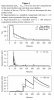
How do you justify your claim that 100 min at 0.3 ATA is harmless? The differences in slower tissue supersaturation that are the only plausible explanation for the worse outcomes in the NEDU deep stops profile occurred in the 0.2 - 0.5 ATA range (see the diagram below). Doesn't seem harmless to me.

Doolette - Recreational tech diving part 2-4.jpg

Figure from: Doolette DJ, Mitchell SJ. Recreational technical diving part 2. Decompression from deep technical dives. Diving Hyperb Med 43, 96-104, 2013

Next problem to solve - how does stress accumulated at say 5ATA depth, relate to stress on the surface? How to transpose whole dive stress into one common pressure scale? Obviously a stress and tissue bubble that started at 5ATA depth with 1 ATA supersaturation, and grew threw Boyles law, time and ascent from 5 to 1 ATA, represents a higher stress than a new 1 ATA stress recorded at the surface. This is why dive stress is far more important than surface stress.

This is a fair question, but your confident conclusion is not supported by the clinical reality. For obvious logistical reasons there is an lack of data about bubble formation during decompression in immersed divers. It must occur in some cases because occasionally divers develop symptoms in the water. But there are multiple studies showing bubble formation gathers momentum after surfacing, and the vast majority of cases present at the surface. It follows that your conclusion that "dive stress is far more important" is unsupportable. In any event, UWSojourner presents ISS for in water, surface, and total (see post above), and its not good for VPM-B any way you look at it.

That is just 3 little points that show serious flaws in the raw ISS

Except that none are valid.

Simon M
 
Last edited:
Actually Ross, Haldane's "2 ATA value" was a surfacing supersaturation. It has no relevance to supersaturation at deeper depths which is the scenario you are referring to here. Haldane's approach allowed much greater supersaturation at deeper depths. You can't use Haldane to justify your arbitrary choice of 2 ATA as a deep supersaturation limit.


Yes it can. This is exactly what NEDU scientists have done in the development of several of their decompression models. Provided you define your cells in a sensible and identical way for any two dives you are comparing it is entirely valid to do this.


Ross, I am a member of two diving medicine journal editorial boards and frequently solicit independent peer review of a multitude of claims in submitted manuscripts. If UWSojourners method was submitted to either of the journals I review for, it would almost certainly be sent to Dr Doolette for peer review because he is recognised as the world's leading decompression modeller who is also involved in technical decompression diving. We are fortunate that he has already opined on this matter:

He said, "... the raw integral supersaturation is not calibrated, but this does not detract from it's utility for comparing similar profiles, such as Kevin has done here, or I did in NEDU TR 11-06."

You have a succinct unambiguous independent peer review report right there.


How do you justify your claim that 100 min at 0.3 ATA is harmless? The differences in slower tissue supersaturation that are the only plausible explanation for the worse outcomes in the NEDU deep stops profile occurred in the 0.2 - 0.5 ATA range (see the diagram below). Doesn't seem harmless to me.

View attachment 10091

Figure from: Doolette DJ, Mitchell SJ. Recreational technical diving part 2. Decompression from deep technical dives. Diving Hyperb Med 43, 96-104, 2013


This is a fair question, but your confident conclusion is not supported by the clinical reality. For obvious logistical reasons there is an lack of data about bubble formation during decompression in immersed divers. It must occur in some cases because occasionally divers develop symptoms in the water. But there are multiple studies showing bubble formation gathers momentum after surfacing, and the vast majority of cases present at the surface. It follows that your conclusion that "dive stress is far more important" is unsupportable. In any event, UWSojourner presents ISS for in water, surface, and total (see post above), and its not good for VPM-B any way you look at it.


Except that none are valid.

Simon M

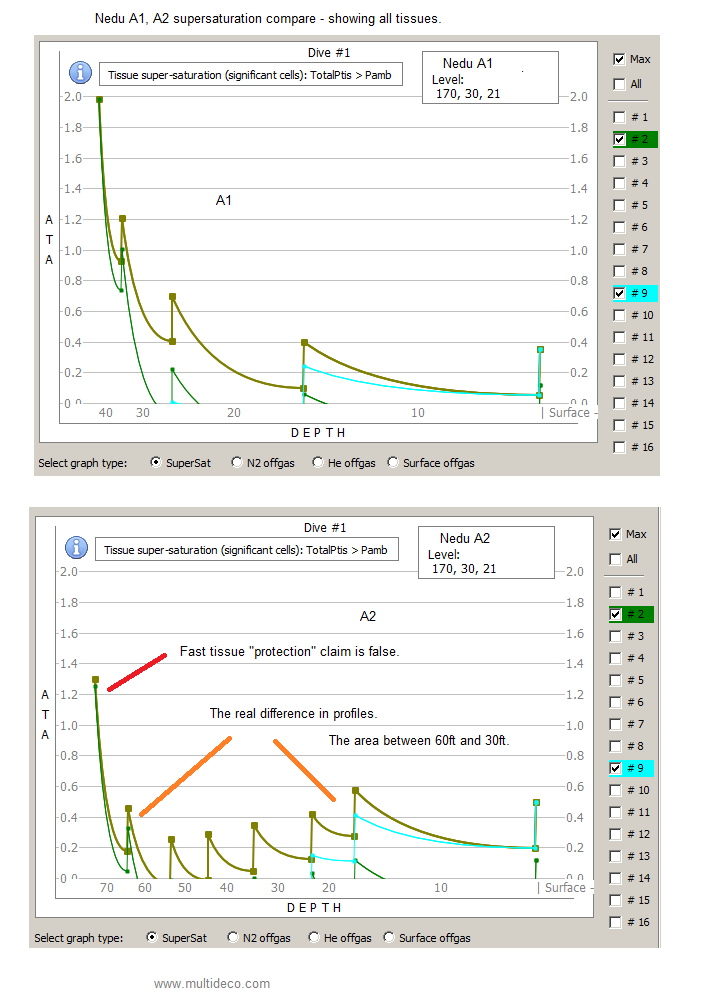
Sadly, the nedu report you quote, is hiding the most important details. The middle tissues are missing completely from the report and all discussions. When you take those into consideration, the first / last difference and theory offered in the report, turns into a laughable bad explanations.


nedu_a1-a2-sscompare.png


The nedu report claim that a fast tissue difference, three hours later, has some effect on the outcome, is laughable. The real cause on the outcome, is the piece they forgot to mention - the vast difference in the middle of the dive, between 60 and 30 ft ( making it a multi level test, not a deep stop test).

The cause of injury in the nedu test was elevated thermal stress over a three hour period.... which interfered with circulations. It's bad form for you to be quoting the nedu test out of context... again.

*************

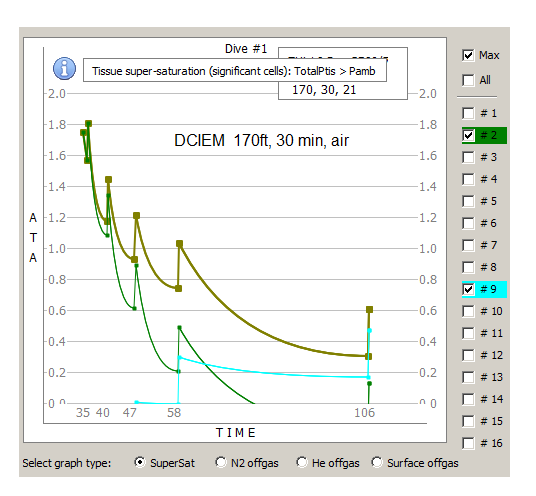
A realistic dive deco graph for this dive, is the DCIEM table, which looks like this:

ss_dciem_170-30ft.png


Note how the supersaturation is 0.6 when surfacing. So its a pretty safe bet to say that half at 0.3 is safe.

Note also the dive time is 106 minutes, vs the elongated 210 of the nedu test. i.e the nedu test had double the required amount of deco time, and therefore the nedu test was NOT testing high tissue pressure stress, and therefore, difficult to make claims about tissue stress as the cause.


*****************

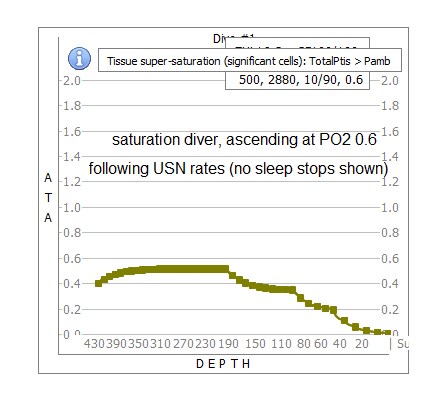
For interest sake, here is a saturation diver supersaturation graph.

ss_saturation_0-6.png


*****************


If you want to claim stress and risk measure metrics (as you have been doing) , then you need to prove YOUR version. Please have some independent and valid analysis and peer reviewed reporting done.


Independent ....... that means not you, not David, and not Kevin. Because you will just rubber stamp anything the three of you do.
.
 
Last edited:
The real cause on the outcome, is the piece they forgot to mention - the vast difference in the middle of the dive, between 60 and 30 ft ( making it a multi level test, not a deep stop test).

The real cause of the outcome is that the bubble model distributed stops deeper than the gas content model, resulting in protection of the fast tissues early in the ascent, with a consequent increase in supersaturation of slower tissues later in the ascent, and at the surface. The result of the NEDU study has been corroborated by the only two other published comparisons of deeper vs shallower stop approaches which involved dives more aligned with technical diving activity. Moreover, the same disadvantageous pattern of supersaturation (protection of fast tissues early and more supersaturation in slower tissues later) seen in the bubble model decompression in the NEDU study has been demonstrated in real world tech profiles prescribed by VPM-B. All of these issues have been extensively discussed previously.

While on the subject of "protection of the fast tissues early" your inability to properly or objectively interpret even your own graphs is illustrated by the comment "Fast tissue protection claim is false" that appears on one of them. Although difficult to interpret, your own graphs demonstrate protection of fast tissues by the NEDU bubble model (Dive A2). Look at your plot for tissue 2 (the green line). In the shallow stop profile supersaturation peaks at 2 atm and does not fall to zero until the diver is at ~25', where as in the deep stop profile supersaturation peaks at 1.3 atm (a 35% reduction) and falls to zero when the diver is at ~63'. Obvious fast tissue protection.

The cause of injury in the nedu test was elevated thermal stress over a three hour period.... which interfered with circulations.

Its hard to keep up with your constantly changing perspectives Ross. you have STRONGLY argued that perfusion has nothing to do with tissue inert gas kinetics elsewhere when it suited you. Here is exactly what you said (and you doubled down on it multiple times):

You are all assuming that on/off gassing is limited by perfusion. But none has provided any evidence, test data, report, field data, case report summary, or anecdotal indications of this assumption. It's been assumed it must be true, based on what ...? In the results or the case reports, I see no evidence or implied suggestions that different perfusion rates has a dramatic / any effect on the dive outcome .

Now here you are categorically stating the opposite: that the "cause of the injury in the NEDU test" is thermal stress interfering with perfusion!! I don't know what to say, except to point out the obvious: either you have no idea what you are talking about, or you will say whatever it takes just to try to win an debate on the internet. Neither option is very satisfactory, but one of them must be true.

For the record, even if the NEDU study was influenced by divers getting cold, both groups of divers were subjected to exactly the same thermal conditions. So if getting cold disadvantages you when you do deep stops then that is a real-world-relevant part of the study results.

Note also the dive time is 106 minutes, vs the elongated 210 of the nedu test. i.e the nedu test had double the required amount of deco time, and therefore the nedu test was NOT testing high tissue pressure stress, and therefore, difficult to make claims about tissue stress as the cause.

Another profoundly naïve comment. You appear to have no concept of relative risk. The length of a profile is more about how much risk its designers are prepared to accept than its status as the divine truth about how to decompress. It may will be that the DCIEM profile has more risk. Another factor you are forgetting (though you have been told it many times) is that the NEDU study had the divers conduct moderate exercise throughout their bottom time which markedly increases risk and decompression requirements. Oh, that's right, you don't believe that perfusion matters, but hang on, you do … Oh God my head's spinning. I'm going to bed.
 
Last edited:
I just showed you the FULL picture of all tissues for the nedu test, and its very clear how the end of the dive (and the differences in slow tissues) is driven by the effects of the middle part and middle tissues. However, the Nedu report claims (in Fig 5 descriptions) it's all isolated to a single first tissue and claim that is the sole cause.

So which is right? The full picture of tissues, or the censored nedu picture with only two parts of the view?

I realize you Simon are locked into supporting the nedu explanation, and can never publicly change on this.

But the facts do not support the nedu explanations, and do not support your claims surrounding its outcome. Further more, there is no connection from the nedu test to the tech world deco or VPM-B, not scientific, not math, not modelling, and no relevant or valid explanation has been shown or proven by you or anyone else.


You can keep posting your excuses and double speak, and everything else you use to wriggle out of the truth. But inside you know that those descriptions you promote of the nedu test is built on a false premise.


.
 
Last edited:
UWSojourners ISS and heat map evaluations of the NEDU study have always included all tissues. We are well aware of the contributions of all tissues, and how the deeper distribution of stops by a bubble models changes the distribution of supersaturation. Go back to RBW - it is all there.

More to the point, in a debate about decompression pathophysiology you have been caught red handed abjectly contradicting yourself on one of the field’s most fundamental concepts. In doing so, you also contradict one of your most tenaciously held criticisms of the NEDU study; your claim that it was all about cold and not about deep stops. So that there is no ambiguity about this, here is what I am referring to:

On this thread you said:

The cause of injury in the nedu test was elevated thermal stress over a three hour period.... which interfered with circulations.

But on October 15 2017 you said:

You are all assuming that on/off gassing is limited by perfusion. I see no evidence or implied suggestions that different perfusion rates has a dramatic / any effect on the dive outcome.

Having had this blatant self-contradiction pointed out, in your latest post above you just carry on (in fact you try to reset the direction of the debate) as though it never happened. But it did, and it cannot be ignored. It illustrates that you either don’t understand even the most basic concepts of decompression physiology, or that you will simply say anything to try to win whatever argument you happen to be in, or most likely a bit of both.

Now, with that behaviour in mind, you want to resurrect a debate on the NEDU study that has been played out in immense detail over multiple forums over at least 5 years. You want to try once more to sell the concept that you a more reliable source of decompression wisdom than the world's leading decompression modelling professionals. I will indulge in these discussions until they reach a point where it is sufficiently obvious how ill-equipped and / or disingenous you are to be considered credible. With the above in mind I think we have reached that point and I suspect everyone has had enough of it. In summary:

On one side you have multiple undisputed experts attempting to draw rational inferences from published data from all relevant studies, which (at this point in time) unanimously discredit your point of view. It is impossible to impute any motivation among these experts other than defending the science against your irrational attacks.

On the other you have you; a solitary untrained amateur who appears not to understand (and blatantly contradicts himself on) the field's most fundamental concepts, who constantly demands more evidence whilst ignoring that which exists while never producing anything other than his own idiosyncratic interpretations, all in the defence of a commercial product.

Simon M
 
Last edited:
This is typical. In a debate about decompression pathophysiology you have been caught red handed abjectly contradicting yourself on one of the field’s most fundamental concepts. In doing so, you also contradict one of your most tenaciously held criticisms of the NEDU study; your claim that it was all about cold and not about deep stops. So that there is no ambiguity about this, here is what I am referring to:

On this thread you said:

The cause of injury in the nedu test was elevated thermal stress over a three hour period.... which interfered with circulations.

But on October 15 2017 you said:

You are all assuming that on/off gassing is limited by perfusion. I see no evidence or implied suggestions that different perfusion rates has a dramatic / any effect on the dive outcome.

Having had this blatant self-contradiction pointed out, in your latest post above you just carry on as though it never happened. But it did, and it cannot be ignored. It illustrates that you either don’t understand even the most basic concepts of decompression physiology, or that you will simply say anything to try to win whatever argument you happen to be in, or most likely a bit of both.

Now, with that behaviour in mind, you want to resurrect a debate on the NEDU study that has been played out in immense detail over multiple forums over at least 5 years. You want to try once more to sell the concept that an untrained financially conflicted amateur is a more reliable source of decompression wisdom than the world's leading decompression modelling professionals. I will indulge in these discussions until they reach a point where it is sufficiently obvious how ill-equipped and / or disingenous you are to be considered credible. With the above in mind I think we have reached that point and I suspect everyone has had enough of it. In summary:

On one side you have multiple undisputed experts attempting to draw rational inferences from published data from all relevant studies, which (at this point in time) unanimously discredit your point of view. It is impossible to impute any motivation among these experts other than defending the science against your irrational attacks.

On the other you have you; a solitary untrained amateur who appears not to understand (and blatantly contradicts himself on) the field's most fundamental concepts, who constantly demands more evidence whilst ignoring that which exists and never producing anything other than his own idiosyncratic interpretations, all in the defence of a commercial product.

Simon M

This is typical. In a debate about decompression pathophysiology you have been caught red handed taking the perfusion discussion out of context... yet again.

The discussion on SB you refer is about increased perfusion, and how its simply not visible in typical / usual dive conditions as it lack of effect on real divers. David confirmed the same in the summary of his report. From the summary: "However, don’t expect the substantial differences seen in the experimental trials were extreme levels of risk factors were used." DAN tech conf 2008 p129.

The getting cold and shutting down circulation issue, and its effect with off gassing, is not in dispute. A nedu report (TR 06-07) showed how dramatic that can be.

Looks like my views are in line with the science and reports.

Of course you know you are making ad hominem attack based on your deliberate distortions .... because its the only way you ever win these things. The claims you make are not supported by the science, so you attack the opponent for irrelevant matters, and hope that scares them away, leaving you unopposed. I imagine much of your career advances are done in a similar way too..

.
 
Last edited:
Status
Not open for further replies.
Back
Top