My DCS Hit

Status
Not open for further replies.
Please specify any fact that was distorted.


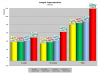
VPM-B is not like GF. The ISS chart, and the GFs, make that clear. The total supersaturation exposure moving from GF 60/84 to GF 20/95 increased by 9%. The total SS exposure moving from GF20/95 to VPM-B+3 increased 32%. And remember, VPM-B+3 would bring you to the surface at a GF exceeding 130. Setting your lo GF as low as 20 still only brings you to the surface at a GF of 95. So the odd man out here is VPM-B, not any of the GF profiles.


My understanding of Don's account was that shortly after leaving 500ft he found himself in some form of exertion and that he recovered by the time he got back to the safety diver. The elevated exercise/heart rate/breathing was over some period, not just the few seconds on the bottom. That was taken into account by my model. If the effects were less, then the results would be somewhere between the yellow and purple lines as I indicated. But from his account, and from what we know about exertion at depth, I doubt there was no impact to his profile due to the exertion he experienced. And if that's the case, it starts to become clear how easily the risks could have mounted by the time he reached 110ft where it was clear something had gone wrong.

Every dive has exertion. Don is not unique in this regard. I have to imagine, nearly everyone who ventures this deep into the unknown, is overwhelmed with fear, anxiety, and extreme stress of worry. Don's initial problems likely involved the same issues, with adrenaline added too. Don was CCR, so had some extra gear, but others were OC with a bundle more stuff to drag through the water, and probably needed more effort than Don's dive. Trying to use exercise level as an explanation, requires Don's dive to be unique and extreme, which I seriously doubt.


Your version of ISS is junk science.... plain and simple. Made up noise. The fact that your surface number is comprised of mostly harmless amounts of supersaturation, shows how biased and worthless your version is. Your version has no mechanism to separate dangerous from harmless levels of supersaturation. If your ISS was done properly, it would be weighted correctly to eliminate the background noise. But its not, because as we all can see.... the objective is to invent any load of rubbish and eye candy to trick the public into Simon's agenda..

I remind you again... VPM-B has success at these levels, along with deeper GF's. So that shows your junk ISS calculations prove to be invalid and worthless noise.

.
 
Every dive has exertion. Don is not unique in this regard.
And that's why you assumed there was no impact due to exertion at extreme depth. I think the chance the exertion had no impact is small.

Your version of ISS is junk science.... plain and simple. Made up noise.
And yet, as Dr. Mitchell mentioned, this simple ISS metric would have predicted the better profile in both the NEDU study and the Spisni study. It's not a perfect metric, but it does seem to have some predictive value.

I just think it's foolhardy to ignore the fact that one profile has 30+% more supersaturation exposure than another given the same runtime. You have to at least ask what that profile is giving you at the cost of the additional exposure. I haven't heard a good answer to that.

I remind you again... VPM-B has success at these levels, along with deeper GF's. So that shows your junk ISS calculations prove to be invalid and worthless noise.
You consistently demonstrate that you simply don't understand concepts of risk.
 
And that's why you assumed there was no impact due to exertion at extreme depth. I think the chance the exertion had no impact is small.


And yet, as Dr. Mitchell mentioned, this simple ISS metric would have predicted the better profile in both the NEDU study and the Spisni study. It's not a perfect metric, but it does seem to have some predictive value.

I just think it's foolhardy to ignore the fact that one profile has 30+% more supersaturation exposure than another given the same runtime. You have to at least ask what that profile is giving you at the cost of the additional exposure. I haven't heard a good answer to that.


You consistently demonstrate that you simply don't understand concepts of risk.


If you can explain why Don's dive has unique and extreme exertion, at double what 45+ other dive samples in our database have incurred, plus the hundreds of other dives that have successfully been to this depth on VPM-B, and RD and similar deep GF numbers.... then you will have a difference at best. Of course, those other dives went through their own set of dramas too. All of which means Don's experience is typical for the task he undertook, and his decompression failure was from the uniqueness of the ascent - the Simon Mitchell recommended "new, more efficient" deco method.


Your home made version of ISS measure is a fake measure... It's tailored to always favor the shallow profiles... It has no relevance to risk. It ignores the basics of decompression stress, and does nothing to correct for its obvious errors. There is a phrase for this .. junk science. You can claim any number of things, but implying its some relevant and quantifiable measure of risk... is a lie. A lie that you and Simon seemingly want to sham the public with.

.
 
Your home made version of ISS measure is a fake measure... It's tailored to always favor the shallow profiles... It has no relevance to risk. It ignores the basics of decompression stress, and does nothing to correct for its obvious errors. There is a phrase for this .. junk science. You can claim any number of things, but implying its some relevant and quantifiable measure of risk... is a lie. A lie that you and Simon seemingly want to sham the public with.

See this post by Dr. Doolette.

"You are completely misrepresenting the use of, and the utility of, the summed integral supersaturation as a measure of decompression stress."

"The time integral supersaturation is used as an index of decompression stress because both the magnitude and the duration of supersaturation are important."
 
Our data base has 45+ dives to 600ft or more. As far as I know, they were all a success. They all use either a VPM-B or a GF setting that is something like a 20 to 40/x plan. None use Don's 60/x.

Ross, pages of the famous RBW thread were dedicated to multiple commentators explaining why you cannot put your "database" to the purposes you are attempting here. You have admitted you don't collect dive outcomes. So the truth is you do not know the outcomes of these dives. More importantly, you have no idea of how many divers injured themselves doing dives of this nature using VPM and did not report the dives to you. The "database" is useless in regard to this debate.

So before you start criticizing VPM-B or similar GF's on deep dives, remember that VPM-B and deeper GF's works

As I point out above, you have no quantitative basis whatsoever for the inference you are making here. To take this further though, I am quite happy to accept that VPM has no doubt worked on dives to these depths. The real question is if you put it up against an approach that places less emphasis on deep stops over the same period of decompression, which approach would produce a lower incidence of DCS in a large study? UWSojourner's analysis, based on an ISS methodology endorsed by NEDU and which has correctly predicted the outcome in real comparative studies of deep vs shallow stops, provides a rock solid reason for believing that VPM would do worse.

Don's 60/x is unique (old problems re-invented), and the most direct test of all of Dr. Simon Mitchell's recommended "new, more efficient" deco method.

By repeating this so many times when it is patently clear it is not true you only make a bigger fool of yourself. I did not recommend GFLo 60, and I did not recommend an ascent rate of 18m/min (60'/min). The latter is potentially very important. UWSojourner's analysis has demonstrated what a dramatic reduction in fast tissue supersaturation accrues from merely bringing the ascent rate back to normal.

As this dive of Don's highlights, a DCS injury is initiated in the water by excess in-dive supersaturation, so less in-dive supersaturation is better. But the surface levels of your ISS junk measure... are meaningless noise - they do not matter, and never will. Of course that reality shows (using your ISS junk measure) that VPM-B is the better choice every time. But as we all know, you and Simon will make up any load of rubbish just to prop up a fallacy and....

Your ( Kevin's) ISS is junk science.... and (surprise surprise) it always favors the shallow stop profile.

Nothing seems to embarrass you, so it is too much to hope that you will be embarrassed by David's post that UWSojourner has linked to. But is a valuable illustration to others reading this thread how your vehement vitriolic accusations are unequivocally (and almost comically) wrong. Why would anyone believe anything you say about this subject.

I strongly recommend that engaged participants in the thread read David's post. It is very revealing.

Here is the link again

And by the way, ISS does not always favour the shallow stops. Go and have a look at the NEDU deep stops TR (the cloud diagram on page 17). If the stops get too shallow, the ISS starts to rise just like you would expect.

The sad part of all this (other than Don getting unnecessarily injured) is how obsessed with the fallacy that you and Simon have become.

I don't think it is UWSojourner and I who have become "obsessed with a fallacy" Ross.

More people will get injured following your / Simon's advise doing this dive or similar, and you people are spreading bad information.

Leaving aside the fact that Don was not "following advice" from me or anyone else, are we going to have a thread like this every time someone suffers DCS using VPB where you take full responsibility for that person getting injured?

UWSojourner has provided compelling evidence that a relatively minor change to Don's ascent protocol (adopting the normal ascent rate) would have brought his fast tissue supersaturation back into a range that is confluent with other approaches endorsed by expert groups. Provided that was done, the analysis also suggests that the GF approach will produce less total supersaturation and likely better outcomes for decompressions of the same duration than VPM.

Simon M
 
Last edited:
On one side of this discussion I see a very level, reasonable person with a clear record of research and publication and nothing significant to lose from being wrong stating opinions based on verifiable facts backed by published data and offered citations. On the other side, I see someone with a vested commercial interest in being right furiously digging in to a seemingly less and less defensible position sticking their fingers in their ears going "neener neener neener" and whenever they are presented with verifiable, cited research data replying with "that's junk science" (though never offering any particular support to this claim).

I don't have the technical expertise to contribute to this discussion (though I've learned a lot from reading it), but (like a previous commenter in this thread) I can say that the disposition of one of the participants has led me to regret having purchased their software product.
 
On one side of this discussion I see a very level, reasonable person with a clear record of research and publication and nothing significant to lose from being wrong stating opinions based on verifiable facts backed by published data and offered citations. On the other side, I see someone with a vested commercial interest in being right furiously digging in to a seemingly less and less defensible position sticking their fingers in their ears going "neener neener neener" and whenever they are presented with verifiable, cited research data replying with "that's junk science" (though never offering any particular support to this claim).

I don't have the technical expertise to contribute to this discussion (though I've learned a lot from reading it), but (like a previous commenter in this thread) I can say that the disposition of one of the participants has led me to regret having purchased their software product.

Have you been told to say that? Sounds like it.

Simon and Kevin are peddling a false position, a fake science measure, a model concept that plainly fails at this depth, and trying to cover it all up as best as possible.

Simon is ignoring the reality, and putting future people at unnecessary risk with his bad advise.

.
 
Last edited:
See this post by Dr. Doolette.

"You are completely misrepresenting the use of, and the utility of, the summed integral supersaturation as a measure of decompression stress."

"The time integral supersaturation is used as an index of decompression stress because both the magnitude and the duration of supersaturation are important."

You're a smart guy Kevin Watts (UWSojourner).

You know full well that your home made version of ISS measure is a fake measure... It's tailored to always favor the shallow profiles... It has no relevance to risk. It ignores the basics of decompression stress, and does nothing to correct for its obvious errors.

So why do you keep peddling this ISS junk?


.............................

The green line on the chart shows Don's profile with one adjustment. The ascent rate remained at 55fpm, but only until supersaturation was initiated (at around 440ft). From that point the ascent rate was slowed to 30fpm. Contrary to Ross's statement that "I don't think going slower would have improved much", you can see that the standard ascent rate of 30fpm brings those higher peak supersaturations in compartments 1-3 back to the example limits from the US Navy. This might be expected since the US Navy schedules all prescribe a 30fpm ascent rate.


If we use 2.0 ATA supersaturation as the threshold, above which we call excessive:

Don's original dive (55 fpm ascent) exceeded 2.0 ATA SS in ascent passing 300ft, and remained above 2.0 ATA SS up to the end of the 180 ft stop == 7 mins above 2.0 ATA SS.

At 30fpm ascent rate he encounters 2.0+ at 250ft in ascent, and keeps it until end of 180ft stop. == 7 mins above 2.0 ATA SS.

615ft, 55fpm == 7 mins above 2.0 ATA SS. peak 3.2
615ft, 30fpm == 7 mins above 2.0 ATA SS. peak 2.6


If we take his previous dive to 500ft, at 55fpm, then it has SS at 2.0+ from passing 200ft through to end of 130ft stop == 5 mins above 2.0 ATA SS.

500ft, 30fpm == 5 mins above 2.0 ATA SS. peak 2.6


**********

So, at 615ft, even though a 30fpm rate does lower the peak SS values, it still exceeds the time he spent with excessive SS on the previous 500ft dive. The 7 mins above 2.0 is a major concern for any dive. Plus of course, a 30fpm rate on a 615ft dives, adds 90 mins to the deco time, which is an issue concern too.

.
 
Last edited:
Big thanks to Don for telling his story and best wishes for a full recovery.

Perhaps rather than wasting inordinate amounts of time criticizing one another, perhaps some of the participants on this thread could actually work together to improve knowledge and understanding with respect to suitability of the various dive planning decompression models for use in planning deeper bounce dives.

What appears not to be in dispute between the warring factions are the following points:
1. In the public domain, there exists no comparative, scientific study of the DCS risk of divers following particular Decompression models for bounce diving in the depths Don dived.
2. Different parties e.g Ross with his database, and parties such as dive computer manufacturers have, or may have databases of dives undertaken using their models or equipment; but will not necessarily have all the critical information about the dive such as profile on diver identifying their personal DCS risk factors, or dive outcome with respect to any minor or major DCS outcomes.
3. Just as one swallow does not a spring make, the outcome of one dive does not a DCS risk-model make; nor settle a dispute over the best balance between deep and shallow decompression stops.
4. Given the inherent risks with deep bounce diving, limited population of divers capable of safely diving to such depths, and the ethical problems associated in designing a study which may involve deliberately bending divers to test the limits of existing and/or proposed new mathematical models of DCS risk, as well as cost; no one is going to undertake a planned diving program of sufficient scale to provide statistically meaningful data.

Without quality data, people will spend the next 5 years arguing as they have in the past 5 years, when the answer is simple, though much more difficult to put into practical effect. The diving community needs to collectively build the database of dives and dive profiles with relevant metadata to enable the scientists, and decompression model builders to better refine existing DCS models, or build a new one for the type of diving undertaken by Don and others.

Over the past few years improvement in diving technology such has CCR has enabled more divers to push the limits of their diving, both in depth and duration without a commensurate increase in the level in the true understanding of DCS risk for this diving. It is very telling when acknowledged experts such as Dr Simon Mitchell readily concede that based on current knowledge, it is not possible to give definitive advice of DCS risk management for Don's dive because comparative scientific studies of DCS risk outcomes under different dive profiles for such a bounce dive (as compared to saturation diving at such a depth) don't exist. This is not meant as a criticism, just a reflection of reality.

While potentially personally embarrassing to reveal ones mistakes or near misses re DCS etc, there is an overwhelming self interest for divers to share such information as currently people are really diving blind on DCS risk when performing such dives. No model will ever be perfect, but greater data on the actual DCS outcomes on many dives will afford a much better understanding of the real DCS risk divers face based upon outcomes from numerous similar dives.

Ross believes in his models. Incorporation of dive outcomes with respect to any adverse DCS symptoms with the dive profile data which he currently obtains will help any refining to enhance its suitability for such dives; or assist demonstration of its validity for its application to different types of diving.

I am sure Dr Simon Mitchell and other scientists or medical professional in the study of DCS or treatment in divers would appreciate access to quality data on incidence or otherwise of DCS for these deep bounce dives using different dive profiles.

Such information will be of no use to me for my diving (Don's pair are much larger than mine will ever be), but I am sure there are many out there who would benefit from an initiative which was capable of turning individual anecdotes and dive history into useful collective data to help the diving community more safely execute bounce dives to the depth undertaken by Don on his ill-fated dive.

Dive safe.
Tony
 
Last edited:
What appears not to be in dispute between the warring factions are the following points:
1. In the public domain, there exists no comparative, scientific study of the DCS risk of divers following particular Decompression models for bounce diving in the depths Don dived.
2. Different parties e.g Ross with his database, and parties such as dive computer manufacturers have, or may have databases of dives undertaken using their models or equipment; but will not necessarily have all the critical information about the dive such as profile on diver identifying their personal DCS risk factors, or dive outcome with respect to any minor or major DCS outcomes.
3. Just as one swallow does not a spring make, the outcome of one dive does not a DCS risk-model make; nor settle a dispute over the best balance between deep and shallow decompression stops.
4. Given the inherent risks with deep bounce diving, limited population of divers capable of safely diving to such depths, and the ethical problems associated in designing a study which may involve deliberately bending divers to test the limits of existing and/or proposed new mathematical models of DCS risk, as well as cost; no one is going to undertake a planned diving program of sufficient scale to provide statistically meaningful data.

Tony

Tony, let me help answer some of those.

DAN has the data and outcome reports on thousands of real dives, including some directly from our database and the dive computers it came from. It was part of the DAN PDE program which was directed to computer makers / firmware makers, to extract this info and have the diver make reports to DAN. This reporting system went on for nearly 20 years. So a great deal of useful data exists.

Sadly DAN does not seem to have done anything with the information, and almost nothing has been released about the trends or rates involved. Such a waste really, as it would settle many continuous arguments, and give us a solid footing of trends and generic risk levels.

.
 
Last edited:
Ross, pages of the famous RBW thread were dedicated to multiple commentators explaining why you cannot put your "database" to the purposes you are attempting here. You have admitted you don't collect dive outcomes. So the truth is you do not know the outcomes of these dives. More importantly, you have no idea of how many divers injured themselves doing dives of this nature using VPM and did not report the dives to you. The "database" is useless in regard to this debate.

Simon M


But we do know know the successful out come of many of these deep one off dive experiences. The divers involved often seek input beforehand, and share afterwards for these big personal adventures. Furthermore, they often submit the dive record and report to the DAN PDE program (which we.know the outcome from).

You have been told this many times... but the truth interferes with your anti-VPM agenda.


Leaving aside the fact that Don was not "following advice" from me or anyone else, are we going to have a thread like this every time someone suffers DCS using VPB where you take full responsibility for that person getting injured?


You make youtube sham videos, loaded with your unsubstantiated opinions and fallacy interpretations, designed specifically to persuade and coerce the public into your "new, more efficient" deco method. You provide your own personal GF choices on request and probably volunteered the information many times too. You are central to deco method used by Don.

For you to be now claiming some arms length separation from those diving your "new, more efficient" deco method, is an insult to ones intelligence.

Your "new, more efficient" deco method Simon, is a re-invention of an old deep problem, as painfully demonstrated by Don's dive here.


I don't know of any report using VPM-B, where the diver became symptomatic of spinal DCS half way through ascent. Nor do I have a single report of anyone who followed the VPM-B plan, and then suffered the months of injury / recovery that Don has gone through.


As I point out above, you have no quantitative basis whatsoever for the inference you are making here. To take this further though, I am quite happy to accept that VPM has no doubt worked on dives to these depths. The real question is if you put it up against an approach that places less emphasis on deep stops over the same period of decompression, which approach would produce a lower incidence of DCS in a large study? UWSojourner's analysis, based on an ISS methodology endorsed by NEDU and which has correctly predicted the outcome in real comparative studies of deep vs shallow stops, provides a rock solid reason for believing that VPM would do worse.

Simon M


The UWSojourner's / Kevin watts / Simon Mitchell version of ISS method is not the Nedu method, and is not how pDCS is assessed. The Nedu method is researched, calibrated, has weighted components and factors and controls, to ensure it does not generate noise values.

But your home made "add up everything into one giant number", has none of the controls, limits, corrections to make it a useful measure, and is therefore a junk method, that deliberately favors the shallow version of any profile. i.e. junk science

.
 
Last edited:
The sad part of all this (other than Don getting unnecessarily injured) is how obsessed with the fallacy that you and Simon have become. More people will get injured following your / Simon's advise doing this dive or similar, and you people are spreading bad information.

The sad part of all this is we have one diver who makes an extensive post about a dive that went wrong containing a number of interesting details, such as:
- a high gas density at depth, ~8g/L, with a finning diver and a hard ADV and BMCLs
- a mysterious sternum pain at 600' - on the descent
- manual 50% nitrox injection below 400' during the ascent
- a high ascent rate
- a 60/x GF
- the diver not breathing properly in response to pain from 110' onwards
(there's another one - at least).

All of which could have been the root cause or contributed to the unfortunate conclusion, and each of which is worthy of discussion on its own.

Unfortunately, one individual instantly spotted his favorite bugbear and went looking for a way to blame it. In the process he missed or ignored all but two of the above, dismissing one of those two in a single sentence without even bothering to spend the extra 20s to check what the impact actually was, and going so far as stating that one of them did not even happen ("Pain starts here", LOL). He then proceeded to flame anyone who disagreed with his "analysis", preventing any sensible discussion of the points above.

Matthieu
 
Last edited:
I have to say that I agree with the above. This thread has a lot of potential for educational value. And, I believe that a spirited discussion of various strategies, and their implications for such a dive, or any decompression diving, would add to that value. However, the fact that the proponent of one strategy cannot seem to have a civilized discussion about these matters has, for me, greatly reduced the above potential. That is a true shame, and it takes away from the value of these fora... Additionally, such behavior will affect my buying decisions - after using V-Planner for the first time recently, I had considered moving from my current diving planning software to it. That won’t happen, as I will not support a person who is, apparently, incapable of seeing any merit in a well constructed and seemingly logic argument that opposes their personal view point.

Before you say it, no, no one has put me up to writing this... and, it shouldn’t be necessary for me to preemptively include this statement...
 
When I posted here a"plausible scenario" for Don's dive, I estimated the impact of exertion during the bottom phase of the dive as being roughly equivalent to doubling the time below 530ft. That obviously would have a major impact on the supersaturations experienced up to the 110ft level where DCS was indicated. When I posted I hadn't yet found the reference I wanted to include. Now I have.

Dr. Doolette on impact of exercise at bottom.
"We know that the conditions in NEDU TR 11-06, work on the bottom and cold during decompression, are equivalent to doubling our tripling bottom time compared to more benign conditions (rest, warm)."

The paper cited by Doolette states it succinctly: "Exercise during bottom time has been shown to increase decompression requirements."

FYI
 
When I posted here a"plausible scenario" for Don's dive, I estimated the impact of exertion during the bottom phase of the dive as being roughly equivalent to doubling the time below 530ft. That obviously would have a major impact on the supersaturations experienced up to the 110ft level where DCS was indicated. When I posted I hadn't yet found the reference I wanted to include. Now I have.

Dr. Doolette on impact of exercise at bottom.
"We know that the conditions in NEDU TR 11-06, work on the bottom and cold during decompression, are equivalent to doubling our tripling bottom time compared to more benign conditions (rest, warm)."

The paper cited by Doolette states it succinctly: "Exercise during bottom time has been shown to increase decompression requirements."

FYI
You should read the summary...

Summary
There are a number of well-established factors that will increase the risk of DCS. For safer decompression, try to avoid being cold during and following decompression and heavy exercise at any time immediately before, during, or soon after diving. In addition DCS risk will be greatest on the first day of diving and after a break of about a week. Conversely, decompression safety might be increased by keeping cool on the bottom and using active warming during decompression, limiting exertion on the bottom, for instance, by using a scooter instead of swimming, and exercising gently during decompression. However, don’t expect the substantial differences seen in the experimental trials were extreme levels of risk factors were used. Additionally, common sense dictates that these factors not be applied in such a fashion as to increase other diving risk such as hypothermia, hyperthermia, dehydration or oxygen toxicity.


**************

As I said above. Don's dive was not likely to meet the criteria from Davids paper, and Don's dive and experiences are no different to any others going to these extreme depths.

Don's description, does not bring his dive up to the extreme exercise level of the test paper / report.
.
 
Last edited:
such as:
- a high gas density at depth, ~8g/L, with a finning diver and a hard ADV and BMCLs
- a mysterious sternum pain at 600' - on the descent
- manual 50% nitrox injection below 400' during the ascent
- a high ascent rate
- a 60/x GF
- the diver not breathing properly in response to pain from 110' onwards
(there's another one - at least).

Matthieu

- gas density / WOB - high while at the bottom - a few seconds only, easier in descent / ascent. which comprised the bulk of the on gas period.
- sternum pain - could be anything, including apprehension and a big shot of adrenaline, or onset of HPNS.
- nitrox inject - to counter a falling PO2? Diver fast tissues entered supersaturation by this time... the damage had already begun.
- GF 60/70 profile - addressed already,
- pain / poor breathing at 110ft upwards - girdle pain from spinal DCS onset. Note also.... circulation continues and tissue off gas continues. Poor breathing increases the effective dead air space, which CCR divers are familiar with. DCS process already in motion by 110ft. By this 110ft location, he had 45 mins of dive time elapsed.


Matt and others, I realize this dive report is a slap in the face to all those trying to justify the "new, more efficient" deco method. We have all been subjected to 5 years of made up BS against deep stops, with no actual valid science justifications. Truth is that fast tissue do matter, deep stops do work, and are essential to a safe outcome in some dive profiles.
 
You should read the summary...
You should read the paper.

Although the summary clearly states that "limiting exertion on the bottom, for instance, by using a scooter instead of swimming" will enhance safety. Exercise at depths of 600ft is likely to have an impact on the profile since any enhanced inert gas uptake at those extreme depths would have a relatively large impact on the profile.

But in reality we don't know what caused Don's DCS. My opinion is that the exertion at depth was not helpful to Don and increased the risk of the profile, and perhaps substantially. But attempting to use this one negative outcome to discount a number of carefully conducted studies showing bubble-model-style deep stops are detrimental to safety is without merit.

And, there's no justification for the claim that switching to VPM-B+3 -- with a surfacing GF over 130, and with a 38% increase in supersaturation exposure over various GF profiles (see below) -- is a rational response to this dive given the state of current research. Only Ross, no researcher, would make such a statement.

C4_2_ISS.png
 
Last edited:
Matt and others, I realize this dive report is a slap in the face to all those trying to justify the "new, more efficient" deco method. We have all been subjected to 5 years of made up BS against deep stops, with no actual valid science justifications. Truth is that fast tissue do matter, deep stops do work, and are essential to a safe outcome in some dive profiles.

Speechless. Just speechless.
 
You should read the paper.

Although the summary clearly states that "limiting exertion on the bottom, for instance, by using a scooter instead of swimming" will enhance safety. Exercise at depths of 600ft is likely to have an impact on the profile since any enhanced inert gas uptake at those extreme depths would have a relatively large impact on the profile.

But in reality we don't know what caused Don's DCS. My opinion is that the exertion at depth was not helpful to Don and increased the risk of the profile, and perhaps substantially. But attempting to use this one negative outcome to discount a number of carefully conducted studies showing bubble-model-style deep stops are detrimental to safety is without merit.

And, there's no justification for the claim that switching to VPM-B+3 -- with a surfacing GF over 130, and with a 38% increase in supersaturation exposure over various GF profiles (see below) -- is a rational response to this dive given the state of current research. Only Ross, no researcher, would make such a statement.

View attachment 10066

So you have nothing more to offer, so now you are spreading fictitious assumptions and junk science graphs. . i.e. a distraction from reality.

You failed to tell us why you continue to peddle junk science graphs, when you know full well it represents nothing more than eye candy to con the public with.


I remind you again.. VPM-B and VPM-B/E has been to these depths successfully numerous times. While the Simon Mitchell "new, more efficient" deco method has failed on its first known attempt.

.
 
Last edited:
But we do know know the successful out come of many of these deep one off dive experiences. The divers involved often seek input beforehand, and share afterwards for these big personal adventures. Furthermore, they often submit the dive record and report to the DAN PDE program (which we.know the outcome from).

You have been told this many times... but the truth interferes with your anti-VPM agenda.

Really Ross? Which part of my quote below do you not understand?

Simon Mitchell said:
To take this further though, I am quite happy to accept that VPM has no doubt worked on dives to these depths.

And which part of the statement which followed do you also not understand?

Simon Mitchell said:
The real question is if you put it up against an approach that places less emphasis on deep stops over the same period of decompression, which approach would produce a lower incidence of DCS in a large study?

For you to be now claiming some arms length separation from those diving your "new, more efficient" deco method, is an insult to ones intelligence.

The only arms length separation I am claiming is to something that I did not endorse or recommend. If that seems unreasonable to you then I am at a loss to know what to say.

So Ross, I'll tell you what is an insult to everyones intelligence. It is you trying to blame me for any case of DCS occurring on dives using stops shallower than you think are appropriate, even if the decompression approach used does not comply with what I have suggested as a sensible response to the current state of the scientific evidence. You compound the insult by then implying that one case (which did not conform to what I have suggested) somehow proves that the current evidence is wrong. You can continue this "blame game" as long as you like Ross, because all it does is bring your irrationality into sharper focus for an increasingly large audience.

But I would still be interested in the answer to the question that others have asked and which so far you have ignored: based on this blame angle you are pushing, do you now accept blame for all divers previously injured using all forms of deep stops, and any who may be injured using these approaches in the future?

The UWSojourner's / Kevin watts / Simon Mitchell version of ISS method is not the Nedu method, and is not how pDCS is assessed. The Nedu method is researched, calibrated, has weighted components and factors and controls, to ensure it does not generate noise values.

But your home made "add up everything into one giant number", has none of the controls, limits, corrections to make it a useful measure

This is just confabulation.
Did you read David's post? It should be obvious to everyone from his commentary that you have no idea what you are talking about. Can you explain exactly what you mean when you say the NEDU method has "weighted components, factors and controls" or "controls, limits, and corrections" in comparison to UWSojourner's method? The problem for you is that UWSojourner's method is perfectly correct, and based on the deep vs shallower stop studies published so far, it appears to be a valid means of appraising the relative risk associated with the studied profiles. The fact that it suggests shallower stop profiles of equivalent length are safer than profiles emphasising deep stops may be an uncomfortable reality for you, but it just a simple physical fact.

And as for this:

and is therefore a junk method, that deliberately favors the shallow version of any profile

This is like moaning that exams are unfair because they deliberately favour students who have studied harder.

Simon M
 
Last edited:
Status
Not open for further replies.
Back
Top