My DCS Hit

Status
Not open for further replies.
Hi,

The basic problem here, is that ZHL-C is way beyond its useful range.

.

I wonder what its useful range is.... Ie when should I move from zhl-c to a vpmb model? I understand its hard to put exact limits as explained.

I appreciate the response. I'd love to hear Simon Mitchells thoughts on this.
And find out what some of the divers doing deeper stuff sub 140m are utilizing successfully.
 
And find out what some of the divers doing deeper stuff sub 140m are utilizing successfully.

You can get a glimpse of past deep dives on our database - click on each mini graph to see a bigger version with deco details. There are just 120 dives of the 154,000 that are over 140m. We have no public info on the outcomes, but there was no known reports of injury either (and I helped plan a few of those dives too).

.
 
hmm. lots of GF 40/80 ish dives in the bottom of the depth data set there....

Yes, but take a look at this from a wider and different perspective.... The max supersaturation any of those database dives did (in similar dives), was 300 ft ascent, for no more than 5 mins. While Don's dives was 400ft with about 7 mins of ascent. The difference is the GF 40/x divers have a peak of 2.7ATA SS for 5 mins, while Don's 60/x dive peaked at 3.3 ATA for 7 mins. Don has essentially done 25% more supersaturation for 40% more time. We can see that this "little" 20% GF difference has a much bigger effect than what GF suggests.

According to ZHL-C M values, its safe is to ascend 450ft (13.5 ATA) with as much as 4.0 ATA of supersaturation, for up to 9 mins of exposure. But that amount would likely seriously injure or kill anyone who tried it. Clearly ZHL-C is way over its head at this depth, and it requires a very narrow band of GF's added to fix the ascent to make something tolerable from it, and it's unusable without this fudging added.

So to your other question, "I wonder what its useful range [of ZHL-C] is..." The useful range of ZHL is narrow, shallow, and to make it usable outside this, ZHL-C requires GF's to be patched onto it. The trouble with this method is that the diver needs to know the right GF's each time to get a useful result. That's not a reliable system at all.

All dissolved models fail in this same way as ZHL-C does, because their design is a "top down" formula - their M values under one set of dive conditions, do not scale correctly to all dive conditions. While the actual question of creating a decompression profile, is a "bottom up" problem of immediate supersaturation exposure over time. Only bubble models have the needed math formula to address those problems.
.
 
Last edited:
Because the initial stops for 0 and 5 min bottom times are so wildly different, my impression is that, "on bounce dives, dissolved models imply less gas loading than actually occurred"

Not sure if that sums it up or not.
 
From your description, you ascended 400ft at 57fpm. That is a lot by any measure or standard. Why did you feel you could avoid the basics of physics that generate bubble growth and injury? Those are well established cause/effect conditions for serious DCS.

The preventive measure to that problem condition, is deeper stops and/or slower ascent rate.
I have to widely agree with ross here just that I get to a bit different conclusions..
To me it seems quite certain that the fast ascent rate plays into it..
But this is not directly related to the choice of model. It actually relates to choice of ascent rate UNTIL first stop and this is double from any recommendation whether you use a bubble model or ZHL + GF..
The recommended implementation of ZHL in combination with Tx is is to NOT exceed 30 fpm (or 10 m/min)..
This is what was learned early and likely prevented DCS cases..
Question is how would the dive have looked like and how would the supersaturations have been if such value was kept and max ascent rate would have been 30fpm plus the 30/90 GF plan..

You followed the plan, and it nearly crippled you. We have not seen this kind of injury level in a long time. I wonder why?
Well I disagree with the statement.. He did not follow the plan, as that would have implied to never exceed 10mpm before the first stop! The outcome might have been very different.
Why not seeing this kind of injury level for a long time? Do you have reliable data about how much dives to such depths have been done at all and then if those dives left over also violated the max 30fpm ascent rule for Tx dives??

The 60/90 plan has 3 times the amount of supersaturation exposure in water, compared to a VPM-B plan.

Which is the safer plan? Obviously the one that prevents harmful supersaturation pressures from occurring.

Fast tissues do matter, and they will get you injured, as Don has painfully re-discovered.

.

First of all thanks for those comparison graphs they are in fact interesting..
Annoying is again how you try to shape observation in a direction to push your agenda..
The 60/90 "plan" has 3 times the supersaturation.. You cannot call it plan without specifiying the ascent rate limits until first demanded stop.. What you say applies for that fast ascent.. How would it be for max 10mpm?
Which is the safer plan? Comparing apples to oranges as so often..
Obviously the plan with 203 min overall dive time will be the safer plan over the one with 147,5 minutes..
No rocket science there.. how much the distribution of such time impacts the safety is the big question !!
GF 60/90 is horribly agreesive, but not for the GF lo being so high but for the combination of both.. In generally once folks raise their GF lo they should counter with lowering the GF hi in order to keep somehat comparable overall "safety factors".. in my opinion decompression approaches should at cvery first be compared by overall decompression times (starting after leaving bottom!) and only at a second step in how such time is distributed over depth!

 
I don't think going slower would have improved much here. His ascent distance would be the same (400ft), but the ascent time would double to 13 mins long, at up to 2.8 ATA supersaturation (vs his original 7 mins ascent up to 3.3 ATA). I think this slower is probably worse because of the significant time increase for excessive tissue bubble growth to occur, even though the supersat peaks came down a little.

These quick bounce dives have some unique on/off gas considerations, that we don't get usually see in 'normal' tech profiles.

.
 
besides the battling between ross and SImon, all I got from it n the end was nobody really knows what would or not have worked.

Ross provided saturation levels, and they were less if on VPM, which was at least one factor involved. At least we know that part.
 
besides the battling between ross and SImon, all I got from it n the end was nobody really knows what would or not have worked.
I'm not sure how you arrived at this conclusion, on one side of this debate there was an internationally recognised medical professional constantly providing peer reviewed evidence to back up what he was proposing, who even got other medical professionals in this field to explain the shortcomings in the argument put forward by Ross.

On the other side we had a non medical professional providing their own completely unsubstantiated opinion. Rational thought should easily determine what were the facts in this debate and who were providing them.

Ross provided saturation levels, and they were less if on VPM, which was at least one factor involved. At least we know that part.

Producing your 'own evidence' that happens to support your 'own view' is now equated as proof of you being right? Let me produce to you my 'own studies' that prove how intelligent and good looking I am.........
 
1> Nobdy disputed his analysis of saturation\
2> Simon himself said "Having said all that, I really cannot tell you how to decompress from extremely deep dives like Don’s. We have few relevant data from dives of that depth. I certainly cannot tell you (and nor can Ross) whether adding deeper stops than Don did would add safety, or alternatively create an even greater hazard, "

Maybe you missed that part...
 
The problem is the "saturation levels" Ross shows are simply peak compartment super-saturation. By showing those he's implying there's more "danger" in the higher peak supersaturation in the fast compartments.

Unfortunately his argument was contradicted by the NEDU study. The profile that had a demonstrably lower DCS rate had higher peak supersaturation in the fast compartments. See this post (and the chart in the prior post) which explains the issue more completely.

Having said this, Dr. Mitchell is correct that drawing conclusions from a sample size of 1 is a fool's errand even if the dive was "typical". Add to that, there are a number of exceptional characteristics of this dive -- extreme depth, work at depth (hard breathing), pain in breathing at depth, 2x ascent rate to 1st stop. Attempting to use this 1 dive as a test case to contradict the conclusions of carefully conducted studies is bizarre.
 
The problem is the "saturation levels" Ross shows are simply peak compartment super-saturation. By showing those he's implying there's more "danger" in the higher peak supersaturation in the fast compartments.

Unfortunately his argument was contradicted by the NEDU study. The profile that had a demonstrably lower DCS rate had higher peak supersaturation in the fast compartments. See this post (and the chart in the prior post) which explains the issue more completely.

Having said this, Dr. Mitchell is correct that drawing conclusions from a sample size of 1 is a fool's errand even if the dive was "typical". Add to that, there are a number of exceptional characteristics of this dive -- extreme depth, work at depth (hard breathing), pain in breathing at depth, 2x ascent rate to 1st stop. Attempting to use this 1 dive as a test case to contradict the conclusions of carefully conducted studies is bizarre.


Or conversely... REAL dives that exercise actual harmful levels of supersaturation... bear out that ALL tissues cells must be observed and obeyed for limits (fast and slow).

The peak and sustained supersaturation pressure over time (as shown in my graphs), is the stress that creates tissue micro-bubbles. This sustained / time graph method is a widely used view of supersaturation levels throughout research papers.

Meanwhile the Nedu test failed to test any excessive supersaturation stress, and instead concentrated on the effects of elevated thermal stress... The smoke and mirror interpretations of this nedu test that we get spoon fed by the "experts" on their anti deep stop campaign, are proven scientifically invalid.

.
 
Last edited:
The NEDU test has only been confirmed by other studies since its debut. Everything we have at this point points to the conclusion that deep stops as derived by typical bubble models are overdone.

The chart I referenced in a prior post is shown below. Notice the same pattern of supersaturation that Ross says is terribly bad is present in these charts as well. The profile that was significantly better was the profile that exhibited that higher supersaturation spike in the faster compartments early in the decompression. Obviously I'm not saying that whatever occurred in the dive under question was "safe". Just that in attempting to use it as prooftext for his vendetta against science is just another bizarre chapter of his online self-immolation.

A1 had significantly lower observed DCS than A2
Supersaturation Fast and Slow.jpg
 
Still trying to peddle fake data, and junk science I see...... there is no such thing as +7. And integral supersaturation, as YOU invented it here, is a worthless junk number with absolutely no reference or connection to any useful stress indicators or acceptable levels of supersaturation. It's just eye candy to trick people with... but then that's what marketing people are good at.

.
 
Sorry - it seems we have to redo the Nedu thing, because some people wont stop circulating false information.

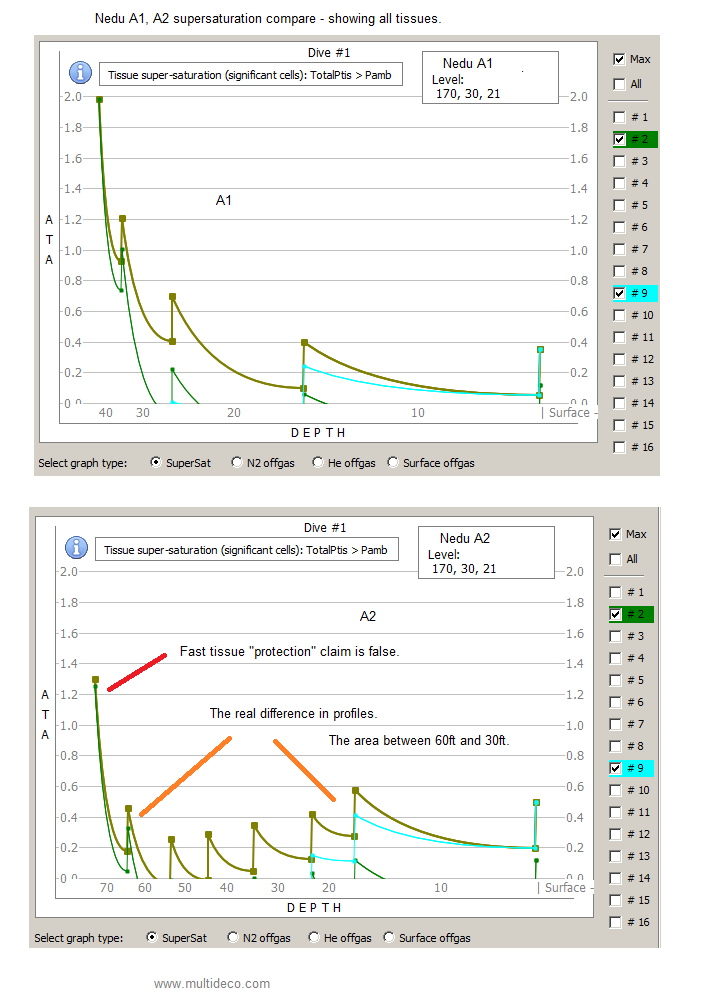
nedu_a1-a2-sscompare.png


These are the Nedu profiles, using real science measures. Two points I want to make.

1/ The claim that A2 protected fast tissues is false. The 1.3 ATA supersaturation the fast tissue experienced, is over double what any bubble model would produce. i.e. not representive of deeper stops. The 1.3 ATA first stop is about equivalent to a GF 60/70 plan for this dive.... i.e. the "new deco" is heading straight for the A2 profile (making hypocrites of the supporters).


2/ Look at the A2 profile in the 60 to 30 ft area. A huge hole and drop in supersaturation, way below normal. i.e. all off gassing rates was reduced and slower tissues were affected. This is where the real difference in the profiles exists, and its how the test generated the different DCS outcomes. The suggestion that the first stop fast tissues somehow changed the last stop slow tissues, is laughable. The last stop slower tissue value difference (sufficiently low enough in both profiles) is dominated by the significant differences in the middle tissues.

Of course the scientists who did this test, knew full well the middle tissue differences were the causative feature. But they completely hid this middle tissue information from the reports, and never mention it anywhere.... so why would they imply some frivolous difference in the first 10 minutes of deco, is responsible for something 3 hours later? It does not add up.

The nedu test was using an extended time multilevel style profile, and testing changes in the middle level stops and mid speed tissues, against a thermal stress. There are no deep stops involved and they were not tested or represented in the test. Those people claiming some relevance to deep stops are wrong.

****************

If we are now finished with this distraction, then lets get back to Don's dive.... the excessive supersaturation it involved and how that led to an in-dive DCS, and the remedy for that (deeper stops).
.
 
Last edited:
1> Nobdy disputed his analysis of saturation.
You are correct - nobody on this forum to date has disputed his analysis. So are we now saying that this means his analysis is fact? To be honest most of us on this forum and others (RBW) have witnessed Ross's contributions on this topic over the years, most of us attempted to politely show him where he erred in his analysis but we were all wrong, the leading scientists in this area e.g. Doolette and Mitchell attempted to explain to him and guess what they were wrong as well. We all were met with his confirmation bias that he was right no matter what. So now most of us sadly have become exasperated and ignore whatever he posts.

1 Simon himself said "Having said all that, I really cannot tell you how to decompress from extremely deep dives like Don’s. We have few relevant data from dives of that depth. I certainly cannot tell you (and nor can Ross) whether adding deeper stops than Don did would add safety, or alternatively create an even greater hazard, "
Maybe you missed that part...

No, I noted that part alright, thats where a leading scientist states that they at the moment do not have sufficient data or evidence that has been independently reviewed by their peers to answer this question. Now if only Ross could adopt the same approach.
 
You are correct - nobody on this forum to date has disputed his analysis. So are we now saying that this means his analysis is fact? To be honest most of us on this forum and others (RBW) have witnessed Ross's contributions on this topic over the years, most of us attempted to politely show him where he erred in his analysis but we were all wrong, the leading scientists in this area e.g. Doolette and Mitchell attempted to explain to him and guess what they were wrong as well. We all were met with his confirmation bias that he was right no matter what. So now most of us sadly have become exasperated and ignore whatever he posts.

No, I noted that part alright, thats where a leading scientist states that they at the moment do not have sufficient data or evidence that has been independently reviewed by their peers to answer this question. Now if only Ross could adopt the same approach.


For the last 5 years.... your group of experts has been pushing for changes based on invalid interpretations and gross distortions of the existing science and papers, plus a number of implied and pretend or made up data points and fake models information, and all of it supported by fabrications in eye candy graphs and junk science, like the things Kevin tried to post above....

In this dive here, you have a clear cut example of your "new deco" theories in practice, and it failed spectacularly. Why? This "new, more efficient (??)" deco method failed, because it tried to ignore the basics of physics of microbubble growth. :rolleyes:..


Now you want a committee or panel to decide this for you (which will never happen), before you will accept the reality....... This looks more like a denial of the truth. And it make hypocrites of your group, given how you lot have stomped all over the successful models of the past without valid justifications.

.
 
Last edited:
For the last 5 years.... your group of experts has been pushing for changes based on invalid interpretations and gross distortions of the existing science and papers

Dr. Neal Pollock:
"The impact of deep stops is … actually quite simple; the extra time spent deep allows more inert gas uptake in the relatively undersaturated intermediate and slow tissues. This is simply a loading problem that subsequently produces a higher degree of decompression stress. If there is less uptake at depth, ascent to a relatively shallow stop has much less risk. The idea that deep stops controlled bubble growth is one of the armchair arguments that has not lived up to human testing ... As with all the protocols we developed and subsequently saw fail, it is time to respect the data over the hand-waving.

Dr. David Doolette:
"The U. S. Navy has some very successful probabilistic models in which the risk of decompression sickness is a function of the time integral supersaturation (ISS) in all compartments. “ This is in contrast to Ross calling ISS “fake science”.
Excellent Doolette presentation. See minute 34:30-38:50.

Dr. Simon Mitchell
Presentation here is excellent.
Clearly Dr. Mitchell does not believe the dive under question can be used as a validation of deep stops. See this post.

...
This is a pretty good group of experts who clearly have a better grasp on science than Ross.
 
Last edited:
As usual, Ross does himself no favors and seems incapable of making any point in a way which actually provokes thought and reasonable discourse. Using terms like "junk science", "fabrications", "made up" in referring to the work of the USN, scientists and medical professionals, who have vastly more experience and resources is sheer folly. It makes me wonder if Ross's main goal is merely to be nuisance enough to keep us talking about him, if so nice work.

To change the subject hopefully not at more of Don's expense, I'm amazed that more people have not mentioned his average (!) PO2 was 1 on a 600'+ dive. This seems to me reason enough for all the tissue trauma/DCS, stop depths and super saturation being the obvious following factors. Is there ANY profile to 600' which could possibly get you out of the water healthy with an average PO2 of 1 in a reasonable amount of time? I mean, it was practically a bounce dive, so the exposure to a higher PO2 at depth would have had the most minimal risk of tox. Isn't the point of constant PO2 diving to minimize our insert gas uptake?
 
Last edited:
Status
Not open for further replies.
Back
Top