Laying line

As others say, lay it on the surface. I would:

1) Uncoil all the rope, flaking into a big builders bucket
2) Drop a shot onto the wreck (with a 60m line to the surface)
3) Motor away to where you want the other end of the line.
4) Chuck the second shot in (again buoyed)
5) Go back, secure the ends of the jackstay on the wreck.

I would also plan on using a lot more line than you think you need.

If you want to do it u/w, then a stick through the spool works, but take your time, and plan to do it in two dives and be pleasantly surprised if it only takes one.

Janos
 
Thank you very much for that DIY spool idea, I will try to modify my existing spool to transform it in to this.

Swimming is fairly difficult because the surface current is really strong.

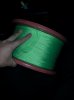
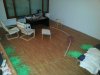
Here are pictures of the spool and the dive site.
 

Attachments

  • Lok Prabha ( BOW ).jpg
    Lok Prabha ( BOW ).jpg
    101.9 KB · Views: 41
  • site.jpg
    site.jpg
    97.3 KB · Views: 27
  • spool1.jpg
    spool1.jpg
    96.8 KB · Views: 24
  • spool2.jpg
    spool2.jpg
    92.9 KB · Views: 23
Rent a canoe?

If you really must swim with it at depth (not for me) then can you not get your mate to pay-out the spool from the shore and just take the end with you? You'd have to sort it out later, just as with the other methods.

Matt.
 
Last edited:
That is not such a bad idea.

I could get some one to unwind the spool at the shallows.
The entry point may not be the best to unwind a spool on land.

I will report back how it goes.

Teoman

BTW: one of my biggest dreams is to cross that bridge from the bottom of the canal.
 
Current is 4-7 knots at the surface.

Hello Teoman

Trying to lay even a weighted 'jackstay' line across the current you are speaking about from the surface will likely not result in the outcome you are seeking (lay with the current yes, across current - doubtful). In addition un-predicable surface traffic adds another layer of failure potential.

Swimming 250m is not far, however swimming 250m in a cross current laying a line whilst trying to accurately navigate to the wreck site is a bit more challenging. I've done exactly what you are trying to do over the same distance and so suggest the following:

1) 3 man team (No 1 Navigator, No 2 Line layer, No 3 Line layer assistant)

2) As is always the case, maximum work at the surface results in minimum work underwater - prepare everything (reel, snoopy loops etc) and rehearse the process on land ('dirt dive' the line laying process with the actual equipment prepared exactly how you intend to use it. Rehearse again once any changes are made to methodology, equipment or technique - leave nothing to chance.

3) Lay a heavy shot line directly onto the wreck from a boat and lower down the shot line everything you intend to use to lay the line.

4) Dive from a boat directly onto the wreck site and secure the line to the wreck at 3 good tie off points.

5) Using a compass (suggest it is on a lanyard and not on the wrist), No 1 moves off in the direction of the shore to the limit of visibility, waits and guides the No 2 in to him.

6) No 2 moves off towards No1 laying then line, No 3 then secures line or if the visibility is poor and each leg therefore short, the process is repeated until a sufficient length of line has been paid out (approx 10m max I suggest) before securing it. Everyone remains within the limit of visibility at all times therefore maintaining good buddy contact and the No1 does not move off until all 3 of the team are together and the intent of the No 1 to start the next leg is clearly understood.

7) If you have muddy bottom (little or no rock) then you may want to think about preparing metal 'tent pegs' of around a 30cm long. These can easily be made from concrete reinforcing bar (rebar) Over 250m you may need approx 25 of them, which will weigh a lot so these will be required to be bundled in small groups of around 5 so they can be managed underwater and the whole lot not spill out everywhere. If too heavy to spread out amongst the 3 man team then secure them to a partially filled lift bag, which is periodically moved along the line by the No 3 (remember to partially deflate the lift bag as the 'tent pegs' are used up and or secure the lift bag to a separate 4kg weight with a 1m strop to acts as an 'anchor' so the lift bag will not inadvertently be dragged away by the current or float away).

Note: as an alternative to 'tent pegs', if on a 'hard bottom' where suitable line secure points (rocks) are in short supply, you may wish to think about using 1kg dive weights. Again these would need to be suitably bundled up and moved en mass using a lift bag described above.

8) If you only partially make it on dive 1 - no problem. Plan for a turn around time to leave everything on the sea-bed (deflate the lift bag if used), swim back to the wreck and ascend on the shot where your safety surface cover is waiting, then continue and hopefully finish the process on the second dive. If you are pushed off course by a cross current, at least you will hit the shore, albeit not exactly where you may have intended to land. However working from the shore to the wreck leaves plenty of scope for navigational errors.

Rgds

Paul

 
I would like to lay down some line to a wreck to speedup access. The wreck is at 50 to 60m and needs a 15 minute swim at 48m. Wreck should be about 200-250m far away. Last time I could not reach it opening my reel.

It is kind of an overhead environment as you have massive cargo ships cruising by.

I bought s spool of 3-4mm line. High vis, polyesther. But is is in a big spool. 40cm R x 25cm width. Guy who fabricated it for me says there is roughly 350m of it on there.

So, how would one go about laying this big spool? Split it up in to smaller spools? Or put a rod through this spool and use it as such? Make s contraption out of pvc pipe so it looks and acts like a reel?


Also what do you say to the idea of leaving a lot of slack on the line and then holding it and swimming at 30m?

There is a bidirectionnal current. One way in the top 20m and the other way deeper down. Current only strong at first 15m.
Teoman

Plenty of people manage with similar sized reels for laying permanent lines in FLA caves. But you need a reel with a handle to allow you to hold with one hand (the other will be putting in tie offs) e.g., an electric fence reel TED WILLIAMS ELECTRIC FENCING REEL WITHOUT CARRY HANDLE on eBay! You should be able to find similar in US. Take your time and work slowly putting ties offs as appropriate and this should be a breeze (much less work than all the boats, smb and weighted line theories put forward).
 
Thank you for the answers Paul.

You know only too well where this site is. It is a few km south and on the opposite side from where you were diving on the bosphorous.

The bottom does not have many significant features. Its a massive field of dead mussels that is covered with a couple of mm of silt. And on the bottom there is little to no current.

I have laid line there before from a smaller reel without incident. But it was a bit slow. So probably multipe dives. After the process is complete it will be an excellent dive site.
 
Thank you for the answers Paul.

You know only too well where this site is. It is a few km south and on the opposite side from where you were diving on the bosphorous.

The bottom does not have many significant features. Its a massive field of dead mussels that is covered with a couple of mm of silt. And on the bottom there is little to no current.

I have laid line there before from a smaller reel without incident. But it was a bit slow. So probably multipe dives. After the process is complete it will be an excellent dive site.

Hi, I thought it might be you. Yes remember the area well. Let us know how you get on and what worked / did not work.

Warm regards Paul
 
There's no surfacing from the wreck - only a surface swim where you can pick your time for cargo-ship dodging!

Towing a line that distance sound arduous to me and I'd not want to be at depth with it. At least of the surface you can add a float to the end to aid the process.

Let us know how you get on.

Matt.

From the sounds of it, it's the Bosphorus if I guess right. He'd be right about the OHC bit, there are so many ships in that piece of water he's right to want to do it from the shore.

Location or not - you'll probably need to do it in stages. Lay the line on the bottom and use small floats to mark where it is. Small plastic milk bottles that weigh nothing in the water and bit of air to float them about 1 or 2 metres above the line. Pre-tie the line to handles and get the team to take a whole load out there attaching them to the line just before viz gets lost. Weigh the line down with rocks if necessarya nd available

Just a thought.
 
Some cracking advise so far.

The securing of the line depends on the bottom type and what sort of 'traffic' you expect.

If theres nothing on the bottom to tie to, you can use blocks/scrap metal (car brake drums work) but these are pretty mobile.

A few years back I was inspecting something across a silt bed, so I tried those spiral dog stakes (they screw into the 'earth'). They let you secure the line and hold it a few inches above the silt if you want (without floats). I was using thin line, so boat anchors break the string but leave the anchor in place.

Dog Pet Metal Steel Spiral Stake Peg Tie In Out Garden Lead Strong Anchor Secure on eBay!

Hope it helps :)
 
Last edited:
Thank you for that advise. Those dog thingies do look good. Wish they wrere cheap over here too.

I do hav a couple of problems. I cannot leave anythig like a buoy on the surface. Will draw too much attention.

The re are a lot of fishers around. And these guys will pull up the line and cut it. They are just ignorant that way.

I completed the reel.will post pics in a wee bit.
 
If the area is frequented by fisherman, their anchors will quickly break your rope. We have a pair of wrecks here that are joined by 16mm thick rope to stop their anchors breaking it... Now we just collect the anchors off the rope.
I think the scooter and drop land marks is the go...
And convince your buddies to do the same.
Benefits are;
1: you're not dumping crap in the ocean
2 : you don't add hazards for others
3: it's easier and safer ( no entanglement risk)
4: uou save gas by moving fast along the bottom and you're not at shallow enough depth to get caught by a trolling lure or net
 
You can make excellent anchor points in sand with 2 foot pieces of PVC pipe ( inch diameter) .. You use the air jet thingy that attaches to a LPI hose ... Use a bit of fuel line to make a quick seal grommit on the air jet... As you swim along you slip a piece of pipe on it.. Push it into the sand whilst hitting the jet... The bubbles dig the pipe into the sane and then it stays there
 
Last edited:
That is a good idea. I willgive it a shot for the fun of it.

I have lots of pvc pipe now from the conversion. But will the constant tug of a float eventually rip the pvc pipe out of place?


Teoman
 
Well,
Here is what i came up with.

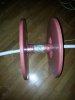
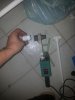
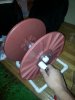
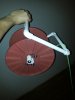
Initially i noticed that the center of the spool had cardboard inside. So i had to unwind it. And indeed it had like a thick toilet paper roll centerpiece in the middle that was taped up. After removing the cardboard pieces i started hunting for pieces. I was inspired a bit by the design another fellow member sent. And i bought some stainless parts and some thermoweldable pvc pipes.

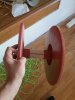
I put a large piece of pvc gutter pipe instead of the cardboard part. Held the two parts together with the stainless parts. I made one of them longer to double as the handle to wind the reel (which i hope i will not have to do :) ) I guesstimated from the other fellows design that the place of the rod was ok.

Then I fabricated a holder from the pvc plumbing parts. I decided to add 2 parts on top, one to hold on to, and the other to act as a guide for the line. Also it acts as a stand when the reel is on land.

If i had to do it again, I would use a bit thicker pvc pipe, as it is slightly flimsy, will not fall apart but will flex a little.

If i were able to get the electric fencing reel for 13ukp as suggested, i would. But checking the local markets, the closest thing i found was a garden hose reel which is too large and costs close to 100usd.


Things left to do:
Increase length of the winding handle by 0.5cm.
Cut off the excess pieces on the rods that hold the spool together (or put piece of hose on it).
Note to self: Cool the rods or the locking rings on the nuts will melt while dremelling.
Wind back the reel before the line gets tangled or significant other has a fit.


Total cost:

35 usd for the spool and 350m line, and 20 usd for the bits and bobs.
 

Attachments

  • 20121210_212604.jpg
    20121210_212604.jpg
    91.9 KB · Views: 11
  • 20121210_213118.jpg
    20121210_213118.jpg
    59.8 KB · Views: 12
  • 20121211_144759.jpg
    20121211_144759.jpg
    58.3 KB · Views: 12
  • 20121211_153735.jpg
    20121211_153735.jpg
    90 KB · Views: 12
  • 20121211_164652.jpg
    20121211_164652.jpg
    53 KB · Views: 13
  • 20121211_192928.jpg
    20121211_192928.jpg
    52.1 KB · Views: 13
@Deltatom80

I like the DIY reel you are using. however if i were to fabricate one for myself, i would disgard the turning lever design and just bend the center shaft 2x 90 degrees and attach the handle (door stopper) at the end. It would make a simpler design. And i would not have to worry about the setscrew falling out.


Teoman
 
Back
Top