
Paul Haynes
CCRX Supporter
Hi All,
After we presented at Oztek last March my good friend and dive buddy Rod Macdonald and I moved on to Chuuk (Truk) Lagoon. As you might imagine we had a fantastic week of diving made all the better by the tremendous support from Truk Stop Hotel / Dive centre who are perfectly geared for CCR / tech diving. Following our return to the UK I drafted up a short dive magazine article but it was never taken up. I'd long since forgotten about this until I started cleaning up my lap top desk top today so instead of filling it away I thought I would post it here.
If I learn how to I'll post the accompanying photographs.
I Hope you enjoy.
Rgds
Paul
Diving The Rio De Janeiro Maru
Dropping out of cloud cover, the Hellcat fighter pilots of US Naval Task Force 58 concentrated on first destroying Japanese aircraft and aerodrome support facilities. Caught mostly on the ground, the vast majority of Japanese planes were destroyed before they had the opportunity to take off. Once control of the air space had been won, following on behind, US Avenger aerial torpedo aircraft and dive-bombers focused on the main objective of the air assault, sinking the Japanese fleet at anchor.
The date was February 17th 1944 and the tide of the Pacific War was eventually turning in favour of Allied, in particular US forces who were shouldering the main burden of the Pacific campaign. Operation Hailstone, the attack on Chuuk (Truk), had been weeks in the planning after high altitude aerial reconnaissance revealed the Japanese fleet at anchor.
Knowing their position had been compromised and anticipating an attack, the main fleet of Japanese warships and submarines had departed Chuuk days earlier, however the auxiliary and support fleet was ordered to remain to offload its essential supplies. The relentless US onslaught launched from 9 aircraft carriers continued for two days and by the end of the 18th, over 40 Japanese naval and auxiliary merchant vessels along with thousands of their crew and passengers were on the bottom of the shallow lagoon where they have since lain.
Surrounded by a protective coral reef broken by a number of deep-water passages, Chuuk is a natural harbour of over 800 square miles within which are numerous mountainous Islands. This made the lagoon an ideal military base from which the Japanese Pacific expansionist programme could be supported.
As an ally of Britain in the early part of the 20th century, Japan seized control of Chuuk from the Germans during the initial phase of World War 1. Following the defeat of Germany, to the dismay of the USA, in 1922 the League of Nations reluctantly gave a mandate to Japan to administer the islands and its people. One of the mandate conditions was not to militarise the region, however with aspirations for a future Pacific empire, this condition was ignored and from 1930 onwards, Japan embarked upon an extensive fortification programme within the lagoon that included partially leveling an island to build one of three military airfields.
From Chuuk Lagoon the attack on Pearl Harbor was launched in December 1941 and so with Allied forces on the ascendancy, it was inevitable that the full horror of war unleashed by Japan would eventually arrive at this remote strategic outpost.
Despite the strategic significance of the US success, with larger advances being made by US forces during this period, Chuuk was largely confined to the history books until the early 1970s when Jacque Cousteau's documentary Lagoon of Lost Ships brought the shipwrecks to wider public attention.
With various casualties of war on the seabed ranging from converted ocean liners to naval destroyers, a submarine and various aircraft, the choice of dive site is extensive encompassing both recreational and technical diving. As a result, today Chuuk offers astounding diving and is frequently cited as the shipwreck capital of the world.
With such an array of diving possibilities, trying to cover even a small number of the wrecks in one article could not do justice to the breadth of what is available, I have therefore focused on a single dive on one shipwreck that typifies the quality diving on offer.
Rio De Janeiro Maru
The 140m (460ft) long, 9,626 ton (gross) ship was built in 1930 and was originally an impressive eight deck ocean liner capable of carrying 1,140 passengers and 150 crew.
Pushed along by her twin propellers and diesel engines, she was capable of 17 knots and spent her early years running the Japan / South America route. However in preparation for war, in 1940 the Rio was requisitioned by the Imperial Japanese Navy (IJN) and converted to a submarine tender. Prior to her sinking she had an active history surviving a torpedo attack off Indo China (Vietnam). Following repair she was put back into service, however on the 17th of February, during the initial phase of Operation Hailstone, she is believed to have been struck by a bomb and following a ferocious fire, subsequently sunk at anchor.
Today the Rio De Janeiro Maru lies complete on her starboard side in a depth of 35m (115ft). With most of the diveable areas and superstructure in the 12m (39ft) to 30m (100ft) zone, this huge shipwreck makes for an incredible dive for all level of diver.
Dropping through the warm 29°C (84°F) water, the 25m (80ft) visibility immediately reveals the portside of this vast shipwreck. To start the tour we swam aft across the huge hull initially at a depth of 12m (39ft). With such good visibility the scale of the ship is readily apparent. Heading down towards the bilge keel, the port propeller shaft and supporting A bracket quickly come into view with the large propeller and rudder just beyond.
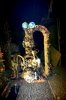
Swimming off the stern and looking back, with divers from the team providing scale to the scene, the view of the two large propellers and rudder is stunning. Moving up to the elegant swept back stern, the ships name is still visible despite decades of corrosion and growth that covers all surfaces. Over the aft gunnel the stern deck lies perpendicular to the seabed upon which is mounted the rear gun platform supporting a large 6 inch gun with its disproportionally long barrel pointing aft. The ship's features and deck machinery remain clearly discernable with the aft mast still in place lying out horizontally. Moving forward, hanging on its chain the aft docking telegraph makes for a great photographic subject.
Into the cavernous aft hold where at the bottom you find thousands of beer bottles still stacked in wooden crates. The name of the original brewer can still be made out on labels and their horizontal orientation looks like a giant wine rack.
Into the other rear hold you ease your way past what appears to be large cylindrical gun mounts / turrets, approximately 4m (13ft) in diameter, which have tumbled from their origin stowage position when the ship rolled onto its starboard side. To exit this second hold we take a passageway forward then out into open water. The pitched roof of the engine skylight is immediately ahead and so one at a time we pass through one of the numerous rectangular window frames into the enormous engine room.
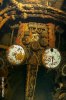
The cylinder heads of an enormous engine are visible ahead as we swim deeper into the room. Snaking our way forward, following stairs and catwalks, now 90° to their original position, we penetrate deeper into the darkness moving forward and around the base of the engine itself. With all ambient light lost, high power primary and backup dive lights are essential. It is now very tight as we squeeze between engine fittings, bulkheads and the hull and all effort is made to avoid silting out the area, which would not only destroy any photographic potential but could cause considerable disorientation when exiting. Our efforts are rewarded as the various engine and electrical control panels come into view, their various dials, gauges and switches again making for another great photographic opportunity.
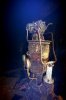
Exiting the engine room via the skylight the team swims forward over the top of the superstructure, the irregular roof stretching away in all directions. We pass the large intact funnel then cross the top of the bridge. Moving towards the foredeck we are presented with an iconic artifact, a katana sword that was recently found by our Chuukese dive guide Nuwa. The sword's exceptional state of preservation is testament to the quality of the steel and the craftsmanship that went into its construction; holding it is a humbling experience and you cannot help but ponder its history, a once family heirloom which likely goes back well beyond WWII. The Federated States of Micronesia have made recovering artifacts illegal and this is rigorously enforced with luggage inspections before you leave the island. However this does not stop unscrupulous divers, both visitors and locals from doing so and the wrecks have been gradually plundered over the years. To find such an artifact is now exceptionally rare and having recently discovered it, Nuwa hides it away determined to prevent it being it illegally recovered.
Down into the forward hold large gun barrels come into view leaning near vertically against bulkheads. Curious as to their length I note the depth at the muzzle then drop down to the breach. At approximately 6m long they likely belong to the gun mounts in the aft hold and were probably destined for Chuuk's shore batteries to reinforce the lagoon's land defences against an anticipated American ground invasion, which never materialised. Swimming under the intact foremast lying out horizontally, on to the forecastle we pass the forward ship's gun and again pause to take in the incredible scene of the slender bow and anchor chain running out from the starboard hawse pipe to the seabed. Again the ship's name is visible on the port side as we swim aft to penetrate the labyrinth of rooms and passageways in the main superstructure. There is plenty of light penetrating most areas with numerous exits points visible. However the typical hazards of wreck penetration remain such as restricted access and hanging wires etc, which are an ever-present entanglement hazard requiring extreme caution within these confined spaces. After 2 hours of diving we eventually emerge out of a superstructure doorway on the portside to begin our decompression. A site of this magnitude warrants multiple dives, however using rebreathers enabled this huge shipwreck to be extensively explored in a single dive. With the Rio being just one of many such magnificent shipwrecks to visit, in the afternoon we move onto a new site to repeat the same incredible dive experience.
Wreck Respect
Regardless of where you allegiance lies, it should not be forgotten that the wonderful sport we love is only possible, at least in part, as a result of the huge sacrifice made by service and merchant shipping personnel from all sides of the conflict. Despite the best efforts of the Japanese government over the last few decades to recover as much of the remains of the personnel that were killed when these vessels were sunk, many of the shipwrecks of Chuuk are still littered with human remains. Diving what is a battleground on the seabed is a privileged glimpse into the past and all respect should be given to any human remains that are encountered, please consider what you are doing before you decide to disturb or publicise images of such remains, all of which causes great distress to the families of those who did not make it home from the battle of Truk Lagoon. I'm sure you would wish your war dead to be afforded the same respect.
Getting There
Chuuk is a remote location and for those who do not live in the region, getting there is a convoluted process requiring multiple flights via Guam or Hawaii. A recommendation is to avoid flying through Manila airport, which is notorious for traveller disruption and luggage 'displacement', both of which was experienced by one of the team.
Dive Support
After researching local options, the most pro-active response to our enquiries and requirements came from the Truk Stop Hotel Dive Centre, leading us to conclude it was likely best placed to support our diving. Run by Cindy Hall and Rob McGann, both with extensive dive centre management experience and local diving knowledge, the centre's support far exceeded our expectations with excellent customer service that included a plentiful supply helium, oxygen and CO2 absorbent. Traveling with a rebreather has the potential to present a number of challenges, however the Truk provided rebreather cylinders and side mount bailout cylinders.
Local laws require that an approved dive guide accompany visiting divers. Again Truk Stop was able to provide our team with Nuwa Paul, an outstanding guide with an intimate knowledge of the shipwrecks. As the only Chuukese dive guide with formal technical diving certification, Nuwa was able to fully support our long duration rebreather dives.
After we presented at Oztek last March my good friend and dive buddy Rod Macdonald and I moved on to Chuuk (Truk) Lagoon. As you might imagine we had a fantastic week of diving made all the better by the tremendous support from Truk Stop Hotel / Dive centre who are perfectly geared for CCR / tech diving. Following our return to the UK I drafted up a short dive magazine article but it was never taken up. I'd long since forgotten about this until I started cleaning up my lap top desk top today so instead of filling it away I thought I would post it here.
If I learn how to I'll post the accompanying photographs.
I Hope you enjoy.
Rgds
Paul
Diving The Rio De Janeiro Maru
Dropping out of cloud cover, the Hellcat fighter pilots of US Naval Task Force 58 concentrated on first destroying Japanese aircraft and aerodrome support facilities. Caught mostly on the ground, the vast majority of Japanese planes were destroyed before they had the opportunity to take off. Once control of the air space had been won, following on behind, US Avenger aerial torpedo aircraft and dive-bombers focused on the main objective of the air assault, sinking the Japanese fleet at anchor.
The date was February 17th 1944 and the tide of the Pacific War was eventually turning in favour of Allied, in particular US forces who were shouldering the main burden of the Pacific campaign. Operation Hailstone, the attack on Chuuk (Truk), had been weeks in the planning after high altitude aerial reconnaissance revealed the Japanese fleet at anchor.
Knowing their position had been compromised and anticipating an attack, the main fleet of Japanese warships and submarines had departed Chuuk days earlier, however the auxiliary and support fleet was ordered to remain to offload its essential supplies. The relentless US onslaught launched from 9 aircraft carriers continued for two days and by the end of the 18th, over 40 Japanese naval and auxiliary merchant vessels along with thousands of their crew and passengers were on the bottom of the shallow lagoon where they have since lain.
Surrounded by a protective coral reef broken by a number of deep-water passages, Chuuk is a natural harbour of over 800 square miles within which are numerous mountainous Islands. This made the lagoon an ideal military base from which the Japanese Pacific expansionist programme could be supported.
As an ally of Britain in the early part of the 20th century, Japan seized control of Chuuk from the Germans during the initial phase of World War 1. Following the defeat of Germany, to the dismay of the USA, in 1922 the League of Nations reluctantly gave a mandate to Japan to administer the islands and its people. One of the mandate conditions was not to militarise the region, however with aspirations for a future Pacific empire, this condition was ignored and from 1930 onwards, Japan embarked upon an extensive fortification programme within the lagoon that included partially leveling an island to build one of three military airfields.
From Chuuk Lagoon the attack on Pearl Harbor was launched in December 1941 and so with Allied forces on the ascendancy, it was inevitable that the full horror of war unleashed by Japan would eventually arrive at this remote strategic outpost.
Despite the strategic significance of the US success, with larger advances being made by US forces during this period, Chuuk was largely confined to the history books until the early 1970s when Jacque Cousteau's documentary Lagoon of Lost Ships brought the shipwrecks to wider public attention.
With various casualties of war on the seabed ranging from converted ocean liners to naval destroyers, a submarine and various aircraft, the choice of dive site is extensive encompassing both recreational and technical diving. As a result, today Chuuk offers astounding diving and is frequently cited as the shipwreck capital of the world.
With such an array of diving possibilities, trying to cover even a small number of the wrecks in one article could not do justice to the breadth of what is available, I have therefore focused on a single dive on one shipwreck that typifies the quality diving on offer.
Rio De Janeiro Maru
The 140m (460ft) long, 9,626 ton (gross) ship was built in 1930 and was originally an impressive eight deck ocean liner capable of carrying 1,140 passengers and 150 crew.
Pushed along by her twin propellers and diesel engines, she was capable of 17 knots and spent her early years running the Japan / South America route. However in preparation for war, in 1940 the Rio was requisitioned by the Imperial Japanese Navy (IJN) and converted to a submarine tender. Prior to her sinking she had an active history surviving a torpedo attack off Indo China (Vietnam). Following repair she was put back into service, however on the 17th of February, during the initial phase of Operation Hailstone, she is believed to have been struck by a bomb and following a ferocious fire, subsequently sunk at anchor.
Today the Rio De Janeiro Maru lies complete on her starboard side in a depth of 35m (115ft). With most of the diveable areas and superstructure in the 12m (39ft) to 30m (100ft) zone, this huge shipwreck makes for an incredible dive for all level of diver.
Dropping through the warm 29°C (84°F) water, the 25m (80ft) visibility immediately reveals the portside of this vast shipwreck. To start the tour we swam aft across the huge hull initially at a depth of 12m (39ft). With such good visibility the scale of the ship is readily apparent. Heading down towards the bilge keel, the port propeller shaft and supporting A bracket quickly come into view with the large propeller and rudder just beyond.
Swimming off the stern and looking back, with divers from the team providing scale to the scene, the view of the two large propellers and rudder is stunning. Moving up to the elegant swept back stern, the ships name is still visible despite decades of corrosion and growth that covers all surfaces. Over the aft gunnel the stern deck lies perpendicular to the seabed upon which is mounted the rear gun platform supporting a large 6 inch gun with its disproportionally long barrel pointing aft. The ship's features and deck machinery remain clearly discernable with the aft mast still in place lying out horizontally. Moving forward, hanging on its chain the aft docking telegraph makes for a great photographic subject.
Into the cavernous aft hold where at the bottom you find thousands of beer bottles still stacked in wooden crates. The name of the original brewer can still be made out on labels and their horizontal orientation looks like a giant wine rack.
Into the other rear hold you ease your way past what appears to be large cylindrical gun mounts / turrets, approximately 4m (13ft) in diameter, which have tumbled from their origin stowage position when the ship rolled onto its starboard side. To exit this second hold we take a passageway forward then out into open water. The pitched roof of the engine skylight is immediately ahead and so one at a time we pass through one of the numerous rectangular window frames into the enormous engine room.
The cylinder heads of an enormous engine are visible ahead as we swim deeper into the room. Snaking our way forward, following stairs and catwalks, now 90° to their original position, we penetrate deeper into the darkness moving forward and around the base of the engine itself. With all ambient light lost, high power primary and backup dive lights are essential. It is now very tight as we squeeze between engine fittings, bulkheads and the hull and all effort is made to avoid silting out the area, which would not only destroy any photographic potential but could cause considerable disorientation when exiting. Our efforts are rewarded as the various engine and electrical control panels come into view, their various dials, gauges and switches again making for another great photographic opportunity.
Exiting the engine room via the skylight the team swims forward over the top of the superstructure, the irregular roof stretching away in all directions. We pass the large intact funnel then cross the top of the bridge. Moving towards the foredeck we are presented with an iconic artifact, a katana sword that was recently found by our Chuukese dive guide Nuwa. The sword's exceptional state of preservation is testament to the quality of the steel and the craftsmanship that went into its construction; holding it is a humbling experience and you cannot help but ponder its history, a once family heirloom which likely goes back well beyond WWII. The Federated States of Micronesia have made recovering artifacts illegal and this is rigorously enforced with luggage inspections before you leave the island. However this does not stop unscrupulous divers, both visitors and locals from doing so and the wrecks have been gradually plundered over the years. To find such an artifact is now exceptionally rare and having recently discovered it, Nuwa hides it away determined to prevent it being it illegally recovered.
Down into the forward hold large gun barrels come into view leaning near vertically against bulkheads. Curious as to their length I note the depth at the muzzle then drop down to the breach. At approximately 6m long they likely belong to the gun mounts in the aft hold and were probably destined for Chuuk's shore batteries to reinforce the lagoon's land defences against an anticipated American ground invasion, which never materialised. Swimming under the intact foremast lying out horizontally, on to the forecastle we pass the forward ship's gun and again pause to take in the incredible scene of the slender bow and anchor chain running out from the starboard hawse pipe to the seabed. Again the ship's name is visible on the port side as we swim aft to penetrate the labyrinth of rooms and passageways in the main superstructure. There is plenty of light penetrating most areas with numerous exits points visible. However the typical hazards of wreck penetration remain such as restricted access and hanging wires etc, which are an ever-present entanglement hazard requiring extreme caution within these confined spaces. After 2 hours of diving we eventually emerge out of a superstructure doorway on the portside to begin our decompression. A site of this magnitude warrants multiple dives, however using rebreathers enabled this huge shipwreck to be extensively explored in a single dive. With the Rio being just one of many such magnificent shipwrecks to visit, in the afternoon we move onto a new site to repeat the same incredible dive experience.
Wreck Respect
Regardless of where you allegiance lies, it should not be forgotten that the wonderful sport we love is only possible, at least in part, as a result of the huge sacrifice made by service and merchant shipping personnel from all sides of the conflict. Despite the best efforts of the Japanese government over the last few decades to recover as much of the remains of the personnel that were killed when these vessels were sunk, many of the shipwrecks of Chuuk are still littered with human remains. Diving what is a battleground on the seabed is a privileged glimpse into the past and all respect should be given to any human remains that are encountered, please consider what you are doing before you decide to disturb or publicise images of such remains, all of which causes great distress to the families of those who did not make it home from the battle of Truk Lagoon. I'm sure you would wish your war dead to be afforded the same respect.
Getting There
Chuuk is a remote location and for those who do not live in the region, getting there is a convoluted process requiring multiple flights via Guam or Hawaii. A recommendation is to avoid flying through Manila airport, which is notorious for traveller disruption and luggage 'displacement', both of which was experienced by one of the team.
Dive Support
After researching local options, the most pro-active response to our enquiries and requirements came from the Truk Stop Hotel Dive Centre, leading us to conclude it was likely best placed to support our diving. Run by Cindy Hall and Rob McGann, both with extensive dive centre management experience and local diving knowledge, the centre's support far exceeded our expectations with excellent customer service that included a plentiful supply helium, oxygen and CO2 absorbent. Traveling with a rebreather has the potential to present a number of challenges, however the Truk provided rebreather cylinders and side mount bailout cylinders.
Local laws require that an approved dive guide accompany visiting divers. Again Truk Stop was able to provide our team with Nuwa Paul, an outstanding guide with an intimate knowledge of the shipwrecks. As the only Chuukese dive guide with formal technical diving certification, Nuwa was able to fully support our long duration rebreather dives.
Last edited: