My DCS Hit

Status
Not open for further replies.
Thanks UWSojourner, and Simon for the video talk.
So, in the interests of keeping this about the science, could I attempt to summarise some expressed points of view?

Ross thinks that integral supersaturation ( as expressed in mb of supersaturation multiplied by minutes of exposure summed for all compartments) is not a valid indicator or predictor of DCS or decompression stress because it is not directly calibrated to measured decompression stress data?
And Simon Mitchell thinks integral supersaturation is the core measure of decompression stress in successful probabilistic models and man tested deco tables and so is validated by incidence of DCS?

A question for Ross: is bubble formation dependent only on degree of supersaturation or is the exposure time relevant to bubble growth/shrinkage? How does this relate to the differing tolerance of fast and slow compartments to supersaturation?

Thanks for your time,

Jason
 
Last edited:
Simon Mitchell thinks integral supersaturation is the core measure of decompression stress in successful probabilistic models and man tested deco tables and so is validated by incidence of DCS?

Those are some of the key points. To summarise:

It passes the biological plausibility test.

I has been incorporated in US Navy probabilistic decompression models meaning that the ISS metric can be correlated against outcome in a predictive way.

As a corollary to the above, professional decompression modelers working for the US Navy have endorsed it as a valid index of decompression stress when used to compare two decompressions from the same dive. Indeed, they used it in this way to interpret the result of the NEDU study.

ISS calculations have correctly predicted the outcome of the human deep stops studies.

Ross doesn't like it because it generally shows that bubble model decompressions have a higher ISS than decompression profiles of the same length with less emphasis on deep stops.

A question for Ross: is bubble formation dependent only on degree of supersaturation or is the exposure time relevant to bubble growth/shrinkage? How does this relate to the differing tolerance of fast and slow compartments to supersaturation?

I could answer this question, but you have directed it at Ross, and I would be interested in his answer so will leave it for now.

Simon M
 
Last edited:
ok, let me state it more clearly VPM gives more bottomtime and less deco than "THE GFs MOST PEOPLE RUN". Hows that.


That's all good I just wanted to challenge that small part of the statement for clarity.

For the record 30mins at 100 on 10/70 gives 220mins on VPMB3 with a first stop at 33 seconds at 78m then a full 2mins at 57 total shallow deco from 12 and up is 105min

and 222mins on my 80/80GF schedule and first stop at 51m for 30 seconds then 2mins at 48 total shallow deco from 12m and up is 125mins
 
Those are some of the key points. To summarise:

It passes the biological plausibility test.

I has been incorporated in US Navy probabilistic decompression models meaning that the ISS metric can be correlated against outcome in a predictive way.

As a corollary to the above, professional decompression modelers working for the US Navy have endorsed it as a valid index of decompression stress when used to compare two decompressions from the same dive. Indeed, they used it in this way to interpret the result of the NEDU study.

ISS calculations have correctly predicted the outcome of the human deep stops studies.

Ross doesn't like it because it generally shows that bubble model decompressions have a higher ISS than decompression profiles of the same length with less emphasis on deep stops.


I could answer this question, but you have directed it at Ross, and I would be interested in his answer so will leave it for now.

Simon M

Lets correct the deliberate mistakes and deceptions in that, before we go any further.

2/

"I(t) has been incorporated in US Navy probabilistic decompression models meaning that the ISS metric can be correlated against outcome in a predictive way."

NO. "It" has NOT been incorporated in the USN work. Your home made version of ISS is not used by NEDU/USN. Your home made version remains untested, un-calibrated, not verified, undocumented, not validated, and a host of other objections, and is too simplistic to represent the risk / stress that you claim it does.
3/

"As a corollary to the above, professional decompression modelers working for the US Navy have endorsed it as a valid index of decompression stress when used to compare two decompressions from the same dive. Indeed, they used it in this way to interpret the result of the NEDU study."

NO. Your friend David (who works for the Nedu), said it had " its utilitiy" but failed to describe what that might be, and he is vague on any other use for it. Further, Your home made version of ISS is NOT what is used in the Nedu test.​


4/

"ISS calculations have correctly predicted the outcome of the human deep stops studies."

The first test you refer (Nedu) was a thermal stress test.. not a decompression gas pressure test. The second test (Spisni) was the result S curve changes, which clearly lowered stress - not deep stops.

Your bold claim that your home made ISS works correctly, is based on two tests that you have falsely interpreted the underlying cause. Your claim of success of your home made ISS, is your own confirmation bias, confirming your own opinions.
5/

"Ross doesn't like it because it generally shows that bubble model decompressions have a higher ISS than decompression profiles of the same length with less emphasis on deep stops"

Thank you for putting words in my mouth....again :rolleyes:

The actual reasons are that I don't like it because its a made up junk numbers measures, it does not show the stress or risk that you claim. Deco is far more complicated than one giant number.

Worst of all, its a sham measure that you will bully the public using the paid marketing people, so you can force through your own opinions, none of which has been through peer review or any kind of proper validations. You are dictating to the world what you want and abusing your privileged position to get it done.


But given how Simon's entire method these last 5 years in the public forums, is to bully the public with junk graphs and marketing people and eye candy distractions and noise, and force any opponent out of the way, then how is this effort to endorse this fake stress measure going to be any different?

Simon does not win through truth or accuracy or better understanding or valid science arguments. No, he just distorts that to suit himself. He wins through attrition.

.

 
Last edited:
Ross - why does your list start at 2?

Also I think simon is waiting for an answer to his question about super saturation.
 
NO. "It" [ISS] has NOT been incorporated in the USN work. Your home made version of ISS is not used by NEDU/USN.
I would think the US Navy would know. Here's what Dr. David Doolette said here:

"The integral supersaturation is the core measure of decompression stress in successful U.S. Navy probabilistic models and man-tested decompression tables that appear in the U.S. Navy Diving Manual."


Your home made version remains untested, un-calibrated, not verified, undocumented, not validated, and a host of other objections, and is too simplistic to represent the risk / stress that you claim it does.

From Dr. Doolette's post here:

"It is true that the raw integral supersaturation is not calibrated, but this does not detract from it's utility for comparing similar profiles, such as Kevin has done here, or I did in NEDU TR 11-06."

Your friend David (who works for the Nedu), said it had "its utilitiy" but failed to describe what that might be, and he is vague on any other use for it.

He wasn't vague AT ALL. He was very clear when he said it has utility "for comparing similar profiles, such as Kevin has done here, or I did in NEDU TR 11-06." As to its other uses, he clearly stated it was used as the "core measure of decompression stress in successful U.S. Navy probabilistic models".


The first test you refer (Nedu) was a thermal stress test.. not a decompression gas pressure test.
Again from Dr. Doolette here:

"I am not aware of anyone involved with the study that has claimed the divers who participated were not cold. I have maintained consistently that the divers were cold. I have simply not bought into your bizarre notion that the cold was so extreme that outcomes observed were thermal injuries. The outcomes observed were clearly DCS."
 
Ross,

Characterising UWSojourner's ISS calculations as "homemade" and therefore somehow invalid is like saying 2+2=4 calculated in someone's home is invalid but 2+2=4 calculated by a mathematician is fine. In the ISS case, as UWSojourner has pointed out above, the mathematician has confirmed the "homemade version" is fine for the purpose it is being put to.

rossh said:
Deco is far more complicated than one giant number.

Of course it is. No one is saying "one giant number" is the answer to everything. But the use of ISS to evaluate and compare different decompressions or phases of decompression (as UWSojourner has done many times) is a potentially useful tool in figuring out how to decompress and in evaluating the decompression stress of different approaches.

Can you please address the issues raised in my post here. Specifically:

Do you still believe that supersaturation at the surface doesn't matter? Has this belief of yours affected the way you have implemented VPM in your software?

I would be interested in your response to my comments about the double standard in your 'blame game'.

Simon M
 
Ross - why does your list start at 2?

Also I think simon is waiting for an answer to his question about super saturation.
Because his point 1 is partially correct - all of DCS is thought to be a result of super saturation somewhere. But finding the right amount at the right time, is a question that has been with us for 100 years, and its still not easily solved today. If we had such a thing as the big handbook of allowable supersaturation pressure for every situation, then we would not need deco models. But it doesn't exist.

Now Simon and Kevin think they are more clever than everyone else, are are going to give us their all in one magic measure of stress and risk. Sadly their home made version is no better than anything else but is in fact worse, because it is be grossly uncoordinated with the current known stress /risk. But they ignore the obvious shortcoming of their assumptions, and go ahead anyway. Such is the privilege of Simon Mitchell being a self appointed king of deco medicine and dictator to public.
.
 
I would think the US Navy would know. Here's what Dr. David Doolette said here:

"The integral supersaturation is the core measure of decompression stress in successful U.S. Navy probabilistic models and man-tested decompression tables that appear in the U.S. Navy Diving Manual."


From Dr. Doolette's post here:

"It is true that the raw integral supersaturation is not calibrated, but this does not detract from it's utility for comparing similar profiles, such as Kevin has done here, or I did in NEDU TR 11-06."


He wasn't vague AT ALL. He was very clear when he said it has utility "for comparing similar profiles, such as Kevin has done here, or I did in NEDU TR 11-06." As to its other uses, he clearly stated it was used as the "core measure of decompression stress in successful U.S. Navy probabilistic models".


Again from Dr. Doolette here:

"I am not aware of anyone involved with the study that has claimed the divers who participated were not cold. I have maintained consistently that the divers were cold. I have simply not bought into your bizarre notion that the cold was so extreme that outcomes observed were thermal injuries. The outcomes observed were clearly DCS."

All you have done is cited a couple of encouraging comments by David. This does not constitute proof of validity of your method, or authenticate your approach in any way. Until you provide some solid and substantial and independent assessment, you are just peddling home made junk.

.
 
All you have done is cited a couple of encouraging comments by David. This does not constitute proof of validity of your method, or authenticate your approach in any way. Until you provide some solid and substantial and independent assessment, you are just peddling home made junk.

.
Hello Ross,
could you please clarify what is UWSojourner's method? What is his home made approach? Or his junk method? How - precisely - does his method differ from that talked about by, for example, David Doolette?

Thanks
Jason
 
Hello Ross,
could you please clarify what is UWSojourner's method? What is his home made approach? Or his junk method? How - precisely - does his method differ from that talked about by, for example, David Doolette?

Thanks
Jason

That's for them to prove the validity for their method relative to the risk and stress claims they make.....

The Nedu pDCS method is something of an enigma, but as I understand its 3 non overlapping cells, that... most importantly, have weighted values applied to ensure it all remains valid. I have to imagine it was well tested and calibrated, and tuned up, long before they started relying on its pDCS prediction value.

The Nedu test 11-06 version of this used two raw cell values, although it was mostly an exercise in geometry, not decompression stress.

Simon's / Kevins method is to take every value from 16 overlapping cells, and add it all into one giant number. No corrections for inherent exponential nature of the underlying data. Just one dumb number, that is validated by Simon claiming its correct based solely of two dives reports that clearly have issues.

If Kevin and Simon want to imagine they have solved all of decompression planning woes, then they need to produce an independent study or analysis, showing the case.

But this thing they are doing now... trying to slide it in the back door, based solely on "my friend said it could be useful", is not science. Why can't you people see through the transparency of Simon's pretend deco measure, and the shortcuts he is trying to take?

.
 
Simon's / Kevins method is to take every value from 16 overlapping cells, and add it all into one giant number.

From Dr. Doolette here:
... adding together the integral supersaturation from each compartment is an essential aspect of the measure. The integral supersaturation is a measure of the risk of injury in that compartment; that risk does not go way just because, for instance, the supersaturation is greater in another compartment.

...

For someone who claims to have science on his side, you sure don't like much of what scientists have to say.
 
Last edited:
The Nedu pDCS method is something of an enigma, but as I understand its 3 non overlapping cells

You have had this explained to you previously, by David and me, but as with most things that don't agree with your strange notions, you have just ignored those explanations. I discussed this with David during a personal meeting in Washington just weeks ago. The NEDU ISS modelling takes account of all the theoretical tissues that UWS's method does, but in their implementations they lump the tissues together in 3 groups corresponding roughly with fast, medium, slow. They are just as "overlapping" (whatever that means) as the approach used by UWS.

The Nedu test 11-06 version of this used two raw cell values, although it was mostly an exercise in geometry, not decompression stress.

This is just meaningless techno-babble. It was without question an exercise in evaluating decompression stress in an attempt to explain the results of their study (which had everything to do with decompression and nothing to do with geometry).

Simon's / Kevins method is to take every value from 16 overlapping cells

What, exactly, do you mean by "overlapping cells". They are just notional tissues with a particular half time. The half times are discrete. They don't overlap.

Just one dumb number
that is validated by Simon claiming its correct based solely of two dives reports that clearly have issues.

Actually, this should read .....that is endorsed for the purpose it is being put to here by the world's leading decompression modeller.

If Kevin and Simon want to imagine they have solved all of decompression planning woes, then they need to produce an independent study or analysis, showing the case.

Where did anyone ever say that?

Why can't you people see through the transparency of Simon's pretend deco measure, and the shortcuts he is trying to take?

Maybe because it is obvious to everyone else that we are talking about a deco measure developed and implemented by the world's most expert decompression modelling team, and that it has nothing to do with me.

Ross, seriously, if you want to keep shovelling dirt on the grave of your credibility and reputation then I will willingly help you do it if the alternative is to stand aside and let you spread misinformation about the science of a field I have dedicated my career to. This is not doing you any good. Why don't you just let it go?

Finally,

Can you please address the issues raised in my post here. Specifically:

Do you still believe that supersaturation at the surface doesn't matter? Has this belief of yours affected the way you have implemented VPM in your software?

I would be interested in your response to my comments about the double standard in your 'blame game' from the same post.

Simon M
 
Last edited:
The Nedu pDCS method is something of an enigma, but as I understand its 3 non overlapping cells, that... most importantly, have weighted values applied to ensure it all remains valid. I have to imagine it was well tested and calibrated, and tuned up, long before they started relying on its pDCS prediction value..
Hi Ross
As a layperson reading this can you explain in lay terms what you mean when you say '3 non overlapping cells', can you give us an example of these and can you give an example of cells that do overlap please.

Cathal
 
You have had this explained to you previously, by David and me, but as with most things that don't agree with your strange notions, you have just ignored those explanations. I discussed this with David during a personal meeting in Washington just weeks ago. The NEDU ISS modelling takes account of all the theoretical tissues that UWS's method does, but in their implementations they lump the tissues together in 3 groups corresponding roughly with fast, medium, slow. They are just as "overlapping" (whatever that means) as the approach used by UWS.


This is just meaningless techno-babble. It was without question an exercise in evaluating decompression stress in an attempt to explain the results of their study (which had everything to do with decompression and nothing to do with geometry).


What, exactly, do you mean by "overlapping cells". They are just notional tissues with a particular half time. The half times are discrete. They don't overlap.


Actually, this should read .....that is endorsed for the purpose it is being put to here by the world's leading decompression modeller.


Where did anyone ever say that?


Maybe because it is obvious to everyone else that we are talking about a deco measure developed and implemented by the world's most expert decompression modelling team, and that it has nothing to do with me.

Ross, seriously, if you want to keep shovelling dirt on the grave of your credibility and reputation then I will willingly help you do it if the alternative is to stand aside and let you spread misinformation about the science of a field I have dedicated my career to. This is not doing you any good. Why don't you just let it go?

Finally,

Can you please address the issues raised in my post here. Specifically:

Do you still believe that supersaturation at the surface doesn't matter? Has this belief of yours affected the way you have implemented VPM in your software?

I would be interested in your response to my comments about the double standard in your 'blame game' from the same post.

Simon M

I see you are trying to wriggle out of the responsible testing and validation process, so you can promote more junk science methods..... to bully another false premise thorough - what a surprise, from the worlds most self appointed deco medicine expert.


You quote me thoughts on surface supersaturation out of context.. again, as usual. Your version of ISS surface supersaturation is junk and it does not matter. Its a big useless number. Surface supersaturation is controlled by dive supersaturation, and the surface amount is secondary, so controlling the dive supersaturation is the only dimension that matters.


There is no double standard...I did not invent the deep stop or VPM-B. There are no such things as Ross stops. But you Simon Mitchell decided that you had to change the world into your new deco ideas, and as Don has demonstrated here, they don't work. Now if you were honest and admitted your deco ideas failed this deep, then I might stop annoying you. But while your only response is denial, then you and the public need to be reminded, before someone else gets seriously hurt following your bad advise.

.
 
Surface supersaturation is controlled by dive supersaturation, and the surface amount is secondary, so controlling the dive supersaturation is the only dimension that matters.
You are at least partially correct here. Whatever you do during the dive controls the surface supersaturation. So in that sense controlling the dive supersaturation is what matters. But that's exactly what we've been discussing for over 5 years.

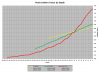
The way bubble models like VPM-B "control dive supersaturation" is through deeper stops. During these deep stops the fast compartment supersaturations are kept low, but this comes at the cost of delaying effective off-gassing of the other compartments and allowing greater continued on-gassing. This causes the higher surface supersaturations commonly seen in VPM-B.

This can be easily seen in the chart below. VPM-B initiates stops very deep, keeps the GF relatively low for quite some time. But the cost of this strategy is the ballooning up of the GF at the surface as seen by a surface GF over 130! It used to be thought, based on theory and no human testing, that this was a good idea. But current research is showing that not to be the case.
GF_byDepth.png


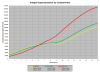
The same thing is easily illustrated in the chart below. The fast compartments toward the left of the chart are those VPM-B is "protecting". The difference in total supersaturation experienced by these compartments is relatively low simply because they're fast compartments. But the cost of VPM-Bs "protection", of executing those deep stops, is the ballooning up of the slower compartments total supersaturation exposure. For GF, there is a "cost" of moving from a low GF of 60 to a low GF of 30, but it is exceedingly small compared to the execution of the bubble-model-style approach.

ISS_Cmpt.png
....

"The impact of deep stops is not that they target some different physical reality. It is actually quite simple; the extra time spent deep allows more inert gas uptake in the relatively undersaturated intermediate and slow tissues. This is simply a loading problem that subsequently produces a higher degree of decompression stress. If there is less uptake at depth, ascent to a relatively shallow stop has much less risk. The idea that deep stops controlled bubble growth is one of the armchair arguments that has not lived up to human testing ... As with all the protocols we developed and subsequently saw fail, it is time to respect the data over the hand-waving." Dr. Pollock
 
That's all good I just wanted to challenge that small part of the statement for clarity.

For the record 30mins at 100 on 10/70 gives 220mins on VPMB3 with a first stop at 33 seconds at 78m then a full 2mins at 57 total shallow deco from 12 and up is 105min

and 222mins on my 80/80GF schedule and first stop at 51m for 30 seconds then 2mins at 48 total shallow deco from 12m and up is 125mins

and how many people run 80/80? Far less than most people. Most run 30/40 70/80.
 
Surface supersaturation is controlled by dive supersaturation, and the surface amount is secondary, so controlling the dive supersaturation is the only dimension that matters.

Ross, I don't claim to be a decompression theorist, but I am having a difficult time understanding your reasoning with this comment. Surely, supersaturation is an issue regardless of whether it is present during the dive or afterwards. Do you not feel that things such as altitude changes, workload, surface O2 use, etc. come into play while on the surface or are you trying to say that anything that impacts decompression happens during the dive? If this is indeed what you are trying to say, it would seem to fly in the face of all decompression training I have ever received.

If I have misunderstood your statement, can you please clarify what you mean by "controlling the dive supersaturation is the only dimension that matters."?
 
I see you are trying to wriggle out of the responsible testing and validation process, so you can promote more junk science methods..... to bully another false premise thorough - what a surprise, from the worlds most self appointed deco medicine expert.

There is nothing "self appointed" about my expertise Ross. I am happy to let people judge that for themselves based on my CV. The only "self appointed deco medicine expert" involved in this discussion is you, and you have demonstrated both here and elsewhere that you do not understand some of the most basic issues (your claims that tissue perfusion doesn't matter, surface supersaturation doesn't matter).

You quote me thoughts on surface supersaturation out of context.. again, as usual. Your version of ISS surface supersaturation is junk and it does not matter. Its a big useless number. Surface supersaturation is controlled by dive supersaturation, and the surface amount is secondary, so controlling the dive supersaturation is the only dimension that matters.

Its not out of context Ross. You have explicitly stated that surface supersaturation does not matter and you have and doubled down on it in this thread in full view of all readers. And the above (which is obviously your first step in trying to cover your tracks and back away from what you said) is precisely why I have asked if you have let your belief that surface supersaturation doesn't matter influence your implementation of VPM. Because if you believe that surface supersaturation doesn't matter you will allow ascents to develop a very high surface supersaturation - which is precisely what we see in UWSojourner's evaluations.

There is no double standard...I did not invent the deep stop or VPM-B. There are no such things as Ross stops.

Wow, you really can't see it? I did not invent anything either and I did not recommend what Don did. But you want to blame me for any shallower stop approach that results in DCS, so why should you not be blamed for any deeper stop approach that results in DCS?

Simon M
 
Status
Not open for further replies.
Back
Top