Time to recover SAC after CO2 hit

From the manufacturer, you can find it using the reference in the table: http://www.ccrexplorers.com/showthread.php?t=13459&page=5&p=126643&viewfull=1#post126643

Which Heliox is it? What was the RMV?

Thanks, I'll add that to the table when I get a moment.

Matt.

Looking at the PDF I assume it is 75lpm and that "heliox" is 10/90.

That makes the table:

WOB-manufacturers4_zpslrertsfv.png


Some of the old links are now broken, if anyone has a copy then please let me have it.

http://www.revo-rebreathers.com/uploads/productenitems/flyer_revoIII_PDF_klein.pdf
http://www.revo-rebreathers.com/flyer rEvo II en 2009.pdf
http://www.dtic.mil/cgi-bin/GetTRDoc?AD=ADA550047
http://www.ccrexplorers.com/showthread.php?t=13459&page=5#post126643
http://jj-ccr.ch/images/stories/downloads/price_list_q1_2012.pdf
http://www.customrebreathers.com/testing/75_RMV_can_testing.pdf
http://www.deeplife.co.uk/or_files/DV_OR_WOB_Respiratory_C1_101111.pdf
http://www.hollis.com/files/ANSTI_Prism2WOB_review.pdf

Edit: Added Hollis.

Cheers
Matt.
 
Last edited:
If you listen to the experts it's all about retained C02. Without end tidal monitoring we are just guessing.


Sent from my iPhone using Tapatalk
If you talk to Simon M. he will not agree with you completely. He is pro inhale CO2 sensors..

Poslano z mojega SM-J500FN z uporabo Tapatalk
 
If you talk to Simon M. he will not agree with you completely. He is pro inhale CO2 sensors..

Poslano z mojega SM-J500FN z uporabo Tapatalk

Talking of Simon that reminded me that I was going to check the Warkander WOB limit for the David Shaw stunt-dive, whilst I had the sheet open.


4/80 at 270m with SP=1.3 is 4.6/79.5. The Warkander limit for that gas at 270m is -0.26176 J/l (negative!). So basically there is no rebreather with low-enough WOB to make that dive within the Warkander limits.


Not sure a BOV would have helped him. Or a CO2 sensor.


Matt.
 
Last edited:
What helium %age is needed to get within the WOB limit(s)?

Pretty sure diving to 270m requires a much lower SP to keep the CNS down - although I supposed someone could use 1.3 on the bottom and lower for deco.
 
What helium %age is needed to get within the WOB limit(s)?

Pretty sure diving to 270m requires a much lower SP to keep the CNS down - although I supposed someone could use 1.3 on the bottom and lower for deco.

If you go for a sexy 1/99 and a SP=1.0 then at 270m you have 3.6/96.4. The Warkander limit is 0.835 J/l. There's nothing tested to this depth, and nothing I see that would be remotely suitable to complete this stunt dive on.

Matt.
 
Talking of Simon that reminded me that I was going to check the Warkander WOB limit for the David Shaw stunt-dive, whilst I had the sheet open.
4/80 at 270m with SP=1.3 is 4.6/83.3. The Warkander limit for that gas at 270m is just 0.082 J/l (~zero!). So basically there is no rebreather with low-enough WOB to make that dive within the Warkander limits.
Matt, What RMV is that limit at?
Apoc at 300m is 1.05-1.15 J/L at 75lpm depending on orientation. http://www.deeplife.co.uk/or_files/DV_OR_WOB_Respiratory_C1_101111.pdf
the 30m extra is irrelevant as its still 0.94J/L at 200m and that is basically the lowest WOB you can physically get at the moment which makes me think either his model breaks down at some point >100m or there is a decimal point misplaced. Check Figure 3 page 6 which for 2/98 appears to visually indicate 0.9ish!

Not sure a BOV would have helped him. Or a CO2 sensor.
A respiratory rate sensor/alarm may have been the most use. Don't know if I have seen the actual workload he got to referenced from the video or any of the presentations SM gave on it.
At 100m a stock Mk16 is 1.85J/L at 75lpm - so Dave's modified one with the felt? scrim and non-stock DSV/BOV? would have been significantly higher than this - haven't IIRC ever seen anyone even estimate just how high it might have been. Would the fatality have occurred if he was diving with the WOB of a stock unit?
 
A respiratory rate sensor/alarm may have been the most use. Don't know if I have seen the actual workload he got to referenced from the video or any of the presentations SM gave on it.
At 100m a stock Mk16 is 1.85J/L at 75lpm - so Dave's modified one with the felt? scrim and non-stock DSV/BOV? would have been significantly higher than this - haven't IIRC ever seen anyone even estimate just how high it might have been. Would the fatality have occurred if he was diving with the WOB of a stock unit?


LMFAO

A electronic device to tell you your breatrhing like a train :D

My unit is manual and it comes with one of those for free. Its inserted directly into the divers head at conception :D

I love the concept that having had a C02 hit or a poo/pants interface event, someone somewhere beleives an alarm going off would be helpfull:D

Mind you I would like one fitted to all holiday diver OC dive kit along with a small volume of semtex. So when naff divers start sucking over 25lpm and cutting my dive short it automaticly blows them up :D

It would need CE aproval to ENwhogivesaf#CK 101 of course

ATB
 
Matt, What RMV is that limit at?
Apoc at 300m is 1.05-1.15 J/L at 75lpm depending on orientation. http://www.deeplife.co.uk/or_files/DV_OR_WOB_Respiratory_C1_101111.pdf
the 30m extra is irrelevant as its still 0.94J/L at 200m and that is basically the lowest WOB you can physically get at the moment which makes me think either his model breaks down at some point >100m or there is a decimal point misplaced. Check Figure 3 page 6 which for 2/98 appears to visually indicate 0.9ish!

Good spot (although not the right one :-) I typed the He ratio not the He fraction in the gas! I fixed the original post you quote also.

SP=1.3 for 4/80 at 270m is 4.6/79.5.

Warkander limit for 4.6/79.5 is negative, so there is no possibility to do that dive with that gas with any kit (-0.26176 j/L). I suppose you could buy a pump :-)

Those limits don't rely on RMV.

And yes, for 2/98 at 270m the limit would be 0.96 j/L. Density of 2/98 is much lower (0.20302) compared to 4.6/79.5 (0.406453571).

Matt.
 
Last edited:
If you go for a sexy 1/99 and a SP=1.0 then at 270m you have 3.6/96.4. The Warkander limit is 0.835 J/l. There's nothing tested to this depth, and nothing I see that would be remotely suitable to complete this stunt dive on.

Matt.

So that is 96.4% of the theoretical limit from the O2 fraction alone? I am pretty sure I heard somewhere that at least one Navy uses pure helium as a diluent. I forget which one and in what unit though.
 
Warkander limit for 4.6/79.5 is negative, so there is no possibility to do that dive with that gas with any kit (-0.26176 j/L). I suppose you could buy a pump :-)

Those limits don't rely on RMV.
The limits might not rely on RMV but the diver operating the kit does and the WOB of it is a direct factor of their RMV (and the gas density). If you knew in advance the maximum safe WOB for the dive based on known safe level of gas mix density (you should already know the WOB of your unit) you could plan the maximum allowable/safe workload. Will however mean that for the same gas mix that different units will have different maximum safe operating depths purely based on their WOB.

Matt, thanks for the Hollis link. Don't believe I have seen that data before; however, I am somewhat surprised that the design of the DiveCAN Shearwater controller allows the diver to breathe 2/98 Heliox at 100m on the Hollis P2 as it gives a rather low PPO2!

DL haven't quoted 2/98 WOB for the Apoc at 100m (it would be quite a bit lower) as it does not allow for a breathable loop so under CE rules is not something that they could use for the measurement of WOB, but as the comparison in your table shows it does make the P2 look better for skin-deep marketing purposes: at least until you think about it.
EN 14143 requires the WOB be measured with the PPO2 controlled by the rebreather typically a PPO2 of 1.3 down to 200m and for saturation 0.7 PPO2 at 300m and deeper, so the Heliox used by DL is what the diver would be breathing at that point. It makes no sense at all to measure WOB for a gas mix that no diver can breathe and that an eCCR controller shouldn't allow.

Matt, If you were to add the JJ-CCR 40m Air WOB from http://www.jj-ccr.com/media/4950/test_report.pdf to your table that gives 1.72J/L compared to the 1.82J/L for the Hollis P2. As the JJ-CCR offers better WOB than the P2 at 40m on Air 75lpm: a more realistic and breathable Heliox mix for 100m in the P2 can probably be gained as a result, likely in the order of 1.8+J/L at 100m 75lpm.
 
The limits might not rely on RMV but the diver operating the kit does and the WOB of it is a direct factor of their RMV (and the gas density). If you knew in advance the maximum safe WOB for the dive based on known safe level of gas mix density (you should already know the WOB of your unit) you could plan the maximum allowable/safe workload. Will however mean that for the same gas mix that different units will have different maximum safe operating depths purely based on their WOB.


Matt, thanks for the Hollis link. Don't believe I have seen that data before; however, I am somewhat surprised that the design of the DiveCAN Shearwater controller allows the diver to breathe 2/98 Heliox at 100m on the Hollis P2 as it gives a rather low PPO2!

DL haven't quoted 2/98 WOB for the Apoc at 100m (it would be quite a bit lower) as it does not allow for a breathable loop so under CE rules is not something that they could use for the measurement of WOB, but as the comparison in your table shows it does make the P2 look better for skin-deep marketing purposes: at least until you think about it.
EN 14143 requires the WOB be measured with the PPO2 controlled by the rebreather typically a PPO2 of 1.3 down to 200m and for saturation 0.7 PPO2 at 300m and deeper, so the Heliox used by DL is what the diver would be breathing at that point. It makes no sense at all to measure WOB for a gas mix that no diver can breathe and that an eCCR controller shouldn't allow.

What ppO2 are you breathing right now? 2% helium is definitely breathable at 100m although far from optimal for deco.

11ata * 0.02 = 0.22 ppO2
 
What ppO2 are you breathing right now? 2% helium is definitely breathable at 100m although far from optimal for deco.

11ata * 0.02 = 0.22 ppO2

lol i dont ever want to see them numbers on my breather s read out ,
think brads trying to say some peps pick numbers to make things look better , some even use the Norsok standards :rolleyes:
 
Last edited:
Apologies Mark, your right but is the 3.44J/L for the KISS Classic with the Paragon BOV (Gordon era) or VR BOV (Kim era) or Hollis BOV (Mike era)?

Inspo Classic WOB couldn't have been 3.44J/L as the limit for CE certification is 2.75J/L at 40m on Air at 75lpm etc etc, in theory! See the NEDU report for pretty graphs of where it crosses over the EN14143 criteria and would theoretically generate a non conformance in the technical file. The loop on the Classic and the Vision is mechanically the same is it not?


[/url]


It would have been the Gorden era as this was done when the Sentinal was launched

Kevin Gurr claimed to have manufacturors figures or did Ansti testing and came up with a chart as seen in the link.

Martin didnt kick off about the figure at the time?
 
What ppO2 are you breathing right now? 2% helium is definitely breathable at 100m although far from optimal for deco. 11ata * 0.02 = 0.22 ppO2
lol i dont ever want to see them numbers on my breather s read out ,
think brads trying to say some peps pick numbers to make things look better , some even use the Norsok standards :rolleyes:
Exactly, am just a little surprised that the DiveCAN controller on the P2 allows you to set a PPO2 of 0.22 when 0.7 is usually considered low... If something fails and your working hard it doesn't leave you very far from clocking out. Noting that after the surface swim cold water issue on the JJ-CCR, the 0.4 set point option was recently removed IIRC. Is 0.22 as a setting the lowest available on the DiveCAN controller or can you set it lower? Conversely how high can you set it?

It would have been the Gorden era as this was done when the Sentinal was launched
Makes sense. The Sentinel does have good WOB and a good duration.

Kevin Gurr claimed to have manufacturors figures or did Ansti testing and came up with a chart as seen in the link.
I believe that was a driver to rEvo doing their own testing and changing the loop connections to be CE compliant, as Paul was a little miffed that KG found he could misassemble the rEvo loop and that KG then had the audacity to publish the resultant rEvo WOB.
Now what is the rEvo 2.17J/L at 40m on Air and 1.45J/L odd at 100m on 10/90, which is still twice what it could be but very respectable none the less. Comparable to the Mk16 (2.1J/L) at 40m on air, but quite a bit better at 100m (1.85J/L at 300ft), which is a neat trick.

Martin didnt kick off about the figure at the time?
Yes, tis only seems he had an issue with open disclosure of the Inspo's WOB once NEDU published their results identifying that it was perhaps a tad higher than allowed with Heliox......
 
Sorry to continue the hijack of this thread but I think it is time to burst this particular bubble
(The mods may wish to move this to a new thread as I'm sure it will provoke some debate)

Yes, tis only seems he had an issue with open disclosure of the Inspo's WOB once NEDU published their results identifying that it was perhaps a tad higher than allowed with Heliox......

There is a not so useful post by MP pointing out that the 2010 NEDU testing on Heliox was done on 2 x 2002 era Inspo's but even looking at http://www.apdiving.com/en/rebreathers/resources/useful-info/ I fail to find any documentation where or how a 2002 Inspo differs in performance from a 2008 Inspo or a 2016 one as far as the WOB is concerned.
The graphs at http://www.apdiving.com/en/wp-content/uploads/Inspiration_WOB_08_06.pdf and http://www.apdiving.com/en/wp-content/uploads/Evolution_WOB_09_05.pdf look pretty but have absolutely no test methodology to go with them and are only on Air and only at 40m. So don't invalidate the NEDU 300ft Heliox Inspo results at all.

I think you should look again critically at the Warkander NEDU TR 10-14 (Work Of Breathing Limits For Heliox Breathing) report that you keep quoting. It is already in the public domain that Warkander did not test the AP Inspiration but used data from prior evaluation (in fact from before he even joined NEDU).

I contacted the author of that report yesterday and he advised that the Inspirations were tested prior to 2002 and couldn’t comment on the technique used for testing as he wasn’t at NEDU then.

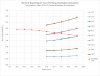
So let's take the data in Table 10 and calculate a regression model for the data presented, a simple task in a statisticsal tool like Minitab.

Code:
X1: RMV   X2: Depth
WOB = 0.873 +*0.00033*X1 -*0.01479*X2 +*0.000247*X1^2 +*0.000082*X2^2 +*0.000202*X1*X2
The relationship between X and Y in the model is statistically significant (p < 0.001)
99.97% of the variation in Y can be explained by the regression model (R-sq > 99.97%)

Now let's calculate using the model and overlay on top of the original measured data to give us some graphical reassurance the model is useful.

Warkander_Regression.jpg

Look! An nice match between the model (r## curves) and measured curves so we have a model that works let's proceed to have some fun.

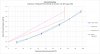
How about we now apply the model to the test condition of the AP published Work of Breathing data for the Inspiration i.e. 40 msw and at the same ventilation rates they used for testing. Plotted graphically here it is...

AP_WOB_AIR_Data_vs_NEDU_Regression.jpg

Blue line AP test result (measurement), green line NEDU data recalculated via a regression model (prediction).

OMG - look at that! The NEDU data presented as Heliox turns out to be for AIR diluent!

It is no surprise that Martin Parker stated the NEDU results were at odds with his Manufacturer's Data and third party QinetiQ data.

Warkander produced an excellent piece work and his limit calculation applied correctly is extremely useful but the test condition for the AP Inspiration data included in the report simply does not appear to be Heliox.

Enough said!
 
Back
Top