Time to recover SAC after CO2 hit

Mr.Dave

New Member
I've been reading the 'bail out' post with interest over the last few weeks mainly because I'm in the market to purchase an ali 80 to increase my BO cylinder collection... I've spent the last year on air dil with a 7L BO plumbed into my BOV and I now want to venture back into normoxic trimix depths.

The process has got me to rethink my SAC calcs and after reading a few posts stating ~50L/min after a CO2 hit it got me thinking, how long does it actually take to recover from a hit?

Now I don't mean full medical recovery, I'm interested to know how long your likely to have a raised SAC or be mentally impaired after switching to BO. In other words after a strong hit how long am I likely to need to get my mental sh!t together before ascending?

So far I've made two assumptions:
1. 5min at max depth with a SAC of 50L/min before making any attempt to move, but as this greatly effects the qty of gas I need to carry i'd like to get it right.
2. After this period my SAC will be back to normal for my ascent and deco, lets say 18L/min and 15L/min respectively.

On RB I found a link to a pdf stating that a physically fit diver can maintain an RMV of 37.5 for 'a few minutes' : http://www.kissrebreathers.com/pdf/scrubberClassic.pdf

This made me scourer the internet for other posts and I came across an article on high intensity exercise and minute ventilation : http://www.hexoskin.com/pages/key-metrics-delivered-by-hexoskin, which seems to confirm a SAC of ~30-70L/min for 'moderate intensity' exercise.

These links kind of confirm 50L/min is realistic for a 'physically fit person' but I've not however been able to find any papers on recovery time after a CO2 hit, can anyone point me in the right direction?


One paper I found interesting but didn't quite give me the answer was:
Gill, M., Natoli, M., Vacchiano, C., Macleod, D., Ikeda, K., Qin, M., . . . Vann, R. (2014). Effects of elevated oxygen and carbon dioxide partial pressures on respiratory function and cognitive performance. Journal of Applied Physiology (Bethesda, Md. : 1985), 117(4), 406-12.


Thanks for your time in reading this...
 
This is the latest report released from the UK HSE. It covers both commercial and sport diving and provides some of the figures you might be looking for

http://www.hse.gov.uk/research/rrhtm/rr1073.htm

In terms of the return to normality, I am not sure you can put 'a' figure on that given all of the physiological variables at play: continued stress & effort, supply of suitable gas with associated density and WOB.

If you cannot recover in a few minutes with sufficient O2 to support life, I am sure the doctors will be along to say that you will collapse through respiratory system failure.

Regards
 
Gareth,

Thanks for the link, makes interesting reading and gives some good insight into breathing rates. Doesn't quite go into effects of CO2 on breathing rate or recovery, so I'll keep digging.

Ta,

Dave.
 
I would look at it in two ways, the lenght of time it would take you physiologically to recover and the lenght of time psycologically it will take to recover.

Your body may be capable of recovering quickly but if the fear has set in it will prolong it...

Deco and distance into a cave might be psychological factors
 
These links kind of confirm 50L/min is realistic for a 'physically fit person' but I've not however been able to find any papers on recovery time after a CO2 hit, can anyone point me in the right direction?
Dave, Based on the link GLOC provided 50L/min is probably the minimum respiratory rate you could expect, if your BOV is capable of providing this flow rate!

AFAIK there is no documentation of trials on recovery time post CO2 hit because first you would have to characterise the respiratory load of the specific CCR in question & any results will vary with the unit/BOV & divers. Also, how high do they let the respiratory rate of the diver get to before the bailout occurs? There is a reason that EN250 calls for flow rates of 62.5L/m on air at 50m as a minimum requirement and they test rebreathers up to ventilation rates of 90L/min.

To start your search you might first want to identify if your unit has an acceptable level of respiratory load, either NATO or USN. see pg 214 https://www.diversalertnetwork.org/files/Tech_Proceedings_Feb2010.pdf

The relative increase in minute ventilation plotted for different levels of inspired CO2, Figure 5, pg210 might also be of interest. https://www.diversalertnetwork.org/files/Tech_Proceedings_Feb2010.pdf

Pages 225-227 might also be of specific interest

Page 246 looking at the CO2 absorption post-accident and the variation on working/resting divers and unit limits might also be a factor for your consideration.
 
Brad,

Thanks for the link :)

P223 does provide a starting point:

'During these tests, a diver will either stop exercising voluntarily, e.g. due to dyspnoea, or
be instructed to stop if the expired end tidal carbon dioxide (P ET CO 2 ) exceeds 8.5 kPa for
five breaths. P ET CO 2 is a direct indicator of arterial carbon dioxide level; 8.5 kPa is
considered as a point beyond which the diver is retaining carbon dioxide rather than
excreting by ventilation and is hypercapnic (11)'


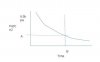
As for recovery a nice graph starting with an elevated PetCO2 of 8.5 dropping in time due to switching to OC would suffice my curiosity. The gas density the subject switches to would probably greatly effect the recovery rate... Kind of like this where A is determined by a point at which the diver feels recovery is adequate or SAC is reduced to an acceptable level. B is the magic number that I could use to calc my BO gas.

Untitled 2.jpg
 
I am going to throw something out there for you to consider. This is something that I personally use in my planning and I will explain why.

15 minutes to an acceptable SAC rate.

My reasoning has absolutely no scientific data to back it up so it is probably completely worthless, but i will explain anyway. A few years back I was forced to thumb a dive due to extreme current. I was already 100 foot from the boat and hanging onto the tag line for dear life. I had a rEvo on my back, 2 AL80's side mounted and a scooter. The drag was incredible and I was using every bit of strength I had to made any headway toward the boat by pulling along the tag line. My buddies were still on the boat and they began to also pull the line in in an effort to assist me. I was working my arse off and never realized how hard I was breathing or how hot the loop gas had become. I never had to bailout, thank goodness for that. When I was finally safe and secure on the boat. I removed the DSV and took a breath of what seemed like ice cold air. I was panting like crazy and could not catch my breathe. It took a full 15 minutes to get my breathing under control and this was on the surface without having to use a regulator.

Hopefully you will never let yourself get this far into the vicious cycle of breathing before you bailout. I have learned that being diligent of paying attention to both your workload and your breathing rate can be an extremely important factor in being able to survive such an issue.
 
I looked into this some time ago, based on the available literature and the outcome is alarming - and in fact I find most people I've quizzed just disregard it as unlikely to be true! More likely they can't carry the gas so they wish it wasn't true, lol.

First I found that the basic time unit for Maximum Voluntary Ventilation (MVV) is 15 seconds and other tests tend to be compared to this. The main other test is the 4 minute test for which there is a fair amount of data, mostly for air, at various depths (one as deep as 1500ft!). It's also pretty clear that gas density plays a big part and that's something else to look at when I have more time. (FYI: We're lucky that 15/50 at 75m has the equivalent air density of about 39m).

I found that the 15 Second MVV averaged 192 L/min BTPS (sea-level Body Temperature & Pressure, Saturated) and that this reduced to 120 L/min BTPS at 40m using air (Fagraeus & Linnarsson, Maximum Voluntary and Exercise Ventilation at High Ambient Air Pressures, 1973). One of the graphs below:

MVV%20Fagraeus_zpsbcfozrvb.png


I also I found in an article by Freedman. He suggest that it is impossible to maintain 100% of the 15 second MVV for any length of time due to fatigue. However he notes that it is possible to sustain, indefinitely, 50% of the 15 second MVV (S.Freedman, Sustained Maximum Ventilation, 1969).

Perhaps more sobering is this from Anesthesia, 5th Edition, Churchill Livingstone, 2000 (my bold):

3.A.24 said:
In healthy male adults, MVV averages 150 to 175 L/min. This extremely high level of ventilatory effort cannot be maintained for much longer than 1 minute. However, approximately 80 percent of the MVV can be maintained by healthy subjects for as long as 15 minutes, and up to 60 percent of MVV can be sustained for even longer periods.[/B] Abnormally low values (<80 percent of those predicted) do not identify specific defects but do indicate gross impairment in respiratory function. The unique value of the test in the surgical candidate may lie in its dependence on intangible variables, such as cooperation, motivation, and stamina.

Cheers,
Matt.
 
Something weird happend with the quote, and it won't edit, so here is it again:

[B said:
3.A.24, Maximal Breathing Capacity[/B]]Dynamic lung function is also routinely evaluated in many pulmonary function laboratories by measuring the maximum breathing capacity or, more specifically, the maximal voluntary ventilation (MVV). This is the largest volume that can be breathed per minute by voluntary effort and reflects an estimate of the peak ventilation available to meet physiologic demands. The patient is instructed to breathe as hard and fast as possible for 12 seconds. The measured volume is extrapolated to 1 minute and is expressed as liters per minute. Because high rates of air flow are required for MVV, the measurement is significantly affected by changes in airway resistance. MVV is usually reduced in patients with obstructive airway disease and correlates reasonably well with FEV1 measured in liters (FEV1 × 35 approximates MVV). Discrepancies between the measured MVV and that predicted by FEV1 often indicate inconsistent or submaximal inspiratory effort. 7 The MVV as a comprehensive test of ventilatory function is altered by factors other than airway obstruction. These include the elastic properties of the lung and chest wall, respiratory muscle strength, learning, coordination, and motivation. In healthy male adults, MVV averages 150 to 175 L/min. This extremely high level of ventilatory effort cannot be maintained for much longer than 1 minute. However, approximately 80 percent of the MVV can be maintained by healthy subjects for as long as 15 minutes, and up to 60 percent of MVV can be sustained for even longer periods. Abnormally low values (<80 percent of those predicted) do not identify specific defects but do indicate gross impairment in respiratory function. The unique value of the test in the surgical candidate may lie in its dependence on intangible variables, such as cooperation, motivation, and stamina.
 
This is the latest report released from the UK HSE. It covers both commercial and sport diving and provides some of the figures you might be looking for

http://www.hse.gov.uk/research/rrhtm/rr1073.htm

In terms of the return to normality, I am not sure you can put 'a' figure on that given all of the physiological variables at play: continued stress & effort, supply of suitable gas with associated density and WOB.

If you cannot recover in a few minutes with sufficient O2 to support life, I am sure the doctors will be along to say that you will collapse through respiratory system failure.

Regards

id take the hse bollox s with a pinch of salt , its prob pushed / funded by someone that will gain a commercial advantage with his type of commercial dive set up ,
 
Matt,

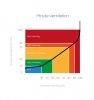
I've come across these alarmingly high MVV figures on the web before, here's one link on a runners website which although not referenced does confirm :

http://www.hexoskin.com/pages/key-metrics-delivered-by-hexoskin

Hexoskin-Metrics-Graphs-MinuteVentilation-V6_large.jpg

I've no idea what my minute ventilation rate is when i'm out running but i'd guess it was +50l/min. Certainly wouldn't like to pull that through a reg let alone my BOV for any length of time!

Thanks,

Dave.
 
id take the hse bollox s with a pinch of salt , its prob pushed / funded by someone that will gain a commercial advantage with his type of commercial dive set up ,
Mr Fish, did you read where the HSL sourced their data from? It wasn't one place but a variety of sources. Who asked for the research? Does it matter if it put all of the information in one place?

Regards
 
15 minutes to an acceptable SAC rate.

.

I've seen some medical docs which suggested 10min for recovery but the context wasn't right so i've kind of dismissed it..

Don't fancy twin 18's for bailout, so I guess we all end up making an educated guess while compromising on what's realistic to carry.

Ta,

D.
 
Mr Fish, did you read where the HSL sourced their data from? It wasn't one place but a variety of sources. Who asked for the research? Does it matter if it put all of the information in one place?

Regards

soursed this info , yes I see that several phds and a few arse licker,s to put that pdf in to the world , fooking ground braking ,:trophy:


PS
HARD HAT divers hose feed , have nothing in common with a free swimmming diver ccr of oc , when it comes to co2 , or sac rates ,
 
Last edited:
My view, which is quite different to the most vehement views you see on the forums, is that if you are carrying bailout to cover all eventualities then you are deluding yourself.

If you start doing your calculations for your deep bailout even with an RMV of 50 you quickly find your whole plan is flawed, if you move the first 5 minutes to 100LPM then you find a full 11L cylinder @ 250 bar is no good deeper than 45m.

If you accept that you cannot in any reasonable way cover this scenario then it becomes manageable, and the whole premise for the need for a BOV seems a bit flawed.

Adding kit and carrying too many OC cylinders is, IMHO, more likely to cause a problem than it is to solve the problem it is perceived to.

For shallow no-stop dives things pan out quite well. But that's not really what we're talking about, is it.

YMMV.

Cheers,
Matt.

I've seen some medical docs which suggested 10min for recovery but the context wasn't right so i've kind of dismissed it..

Don't fancy twin 18's for bailout, so I guess we all end up making an educated guess while compromising on what's realistic to carry.

Ta,

D.

Matt,

I've come across these alarmingly high MVV figures on the web before, here's one link on a runners website which although not referenced does confirm :

http://www.hexoskin.com/pages/key-metrics-delivered-by-hexoskin

View attachment 8519

I've no idea what my minute ventilation rate is when i'm out running but i'd guess it was +50l/min. Certainly wouldn't like to pull that through a reg let alone my BOV for any length of time!

Thanks,

Dave.
 
My view, which is quite different to the most vehement views you see on the forums, is that if you are carrying bailout to cover all eventualities then you are deluding yourself.

If you start doing your calculations for your deep bailout even with an RMV of 50 you quickly find your whole plan is flawed, if you move the first 5 minutes to 100LPM then you find a full 11L cylinder @ 250 bar is no good deeper than 45m.

If you accept that you cannot in any reasonable way cover this scenario then it becomes manageable, and the whole premise for the need for a BOV seems a bit flawed.

Adding kit and carrying too many OC cylinders is, IMHO, more likely to cause a problem than it is to solve the problem it is perceived to.

For shallow no-stop dives things pan out quite well. But that's not really what we're talking about, is it.

YMMV.

Cheers,
Matt.

+1
 
My view, which is quite different to the most vehement views you see on the forums, is that if you are carrying bailout to cover all eventualities then you are deluding yourself.

If you start doing your calculations for your deep bailout even with an RMV of 50 you quickly find your whole plan is flawed, if you move the first 5 minutes to 100LPM then you find a full 11L cylinder @ 250 bar is no good deeper than 45m.

If you accept that you cannot in any reasonable way cover this scenario then it becomes manageable, and the whole premise for the need for a BOV seems a bit flawed.

Adding kit and carrying too many OC cylinders is, IMHO, more likely to cause a problem than it is to solve the problem it is perceived to.

For shallow no-stop dives things pan out quite well. But that's not really what we're talking about, is it.

YMMV.

Cheers,
Matt.


Agree with you on all except the BOV comment. 'My' preference for a solution in a high stress situation is to keep it simple, and flicking a switch on a BOV is about as simple as you can get..

Ta

D
 
Back
Top