Mouthpiece Retaining Head-strap

ADP mouthpiece strap is comfortable

I dived with the (AP Diving) mouthpiece retainer strap yesterday. So comfortable I didn't notice I was wearing one. Fact I forgot until after we surfaced, I switched to OC pulled my mouthpiece out about 2 inches ( I was gonna talk) before I realized bungee was pulling against me. Strap has release and pull tabs to tighten. I wore it over my neoprene mask strap. Comfortable as I said. I'm gonna make it regular part of kit. Thank you brother Paul (Haynes)!
 
At first i resisted the idea of a gag strap. My concern was that the strap is a hit and miss of protecting the airway. Sure better hit and miss then nothing but it just seems it must be awkward using one overweighing the possible advantages.

Now i have been made aware of report from the French navy indicating that out of some 300+ rebreather accidents during the last 20 years 52 resulted in unconsciousness. Only 2 of the 52 unconscious divers actually drowned. And this was thanks to using the Draeger gag strap that is standard issue on military rebreathers in France along with strict team diving and surface support protocols. The top reason for accidents in the report was toxic gas, Hyperoxia topping the list followed by hypoxia. I am now beginning to reconsider my resistance and will actually order one to try it out.

What can we say bout the recreational rebreather diving statistics? Just atrocious. Do we have anything to learn from this? I think we might.
 
At first i resisted the idea of a gag strap. My concern was that the strap is a hit and miss of protecting the airway. Sure better hit and miss then nothing but it just seems it must be awkward using one overweighing the possible advantages.

Now i have been made aware of report from the French navy indicating that out of some 300+ rebreather accidents during the last 20 years 52 resulted in unconsciousness. Only 2 of the 52 unconscious divers actually drowned. And this was thanks to using the Draeger gag strap that is standard issue on military rebreathers in France along with strict team diving and surface support protocols. The top reason for accidents in the report was toxic gas, Hyperoxia topping the list followed by hypoxia. I am now beginning to reconsider my resistance and will actually order one to try it out.

What can we say bout the recreational rebreather diving statistics? Just atrocious. Do we have anything to learn from this? I think we might.

Do you have a link to this report? Rgds Paul

PS Note to the wider community - referring to it as a 'gag strap' potentially discourages its use by giving a false impression. Nobody 'gags' when using a retaining strap.
 
Can not attach it as file so i am just pasting it. Unclear how many of the unconscious divers used retaining straps. From what i have been told the French navy MCD and combat swimmers use retaining straps and not full face masks so that would indicate all of them uses retaining straps. Maybe someone can help with some info on this?

My earlier post has some in correct figures. There where around 150 accidents involving rebreathers not 300. 52 went unconscious and 2 of them drowned though and that is the important figure here. Just read it and make up your own mind if there is any conclusions to draw from this. I am sure there are other factors involved as well.


Descriptive Epidemiology of 153 Diving Injuries With Rebreathers Among French Military Divers From 1979 to 2009
by Gempp, Emmanuel, Louge, Pierre, Blatteau, Jean-Eric, Hugon, Michel


ABSTRACT
Introduction: Rebreathers are routinely used by military divers, which lead to specific diving injuries. At present, there are no published epidemiologic data in this field of study.

Methods: Diving disorders with rebreathers used in the French army were retrospectively analyzed since 1979 using military and medical reports.

Results: One hundred and fifty-three accidents have been reported, with an estimated incidence rate of 1 event per 3,500 to 4,000 dives. Gas toxicities were the main disorders (68%). Loss of consciousness was present in 54 cases, but only 3 lethal drowning were recorded. Decompression sicknesses (13%) were exclusively observed using 30 and 40% nitrox mixtures for depth greater than 35 msw. Eleven cases of immersion pulmonary edema were also noted.

Conclusion: Gas toxicities are frequently encountered by French military divers using rebreathers, but the very low incidence of fatalities over 30 years can be explained by the strict application of safety diving procedures.

This is copyright material, I've removed the body. Igor can you provide hyperlink instead maybe?
NickB

http://findarticles.com/p/articles/mi_qa3912/is_201104/ai_n57428813/
 
Last edited by a moderator:
Can not attach it as file so i am just pasting it. Unclear how many of the unconscious divers used retaining straps. From what i have been told the French navy MCD and combat swimmers use retaining straps and not full face masks so that would indicate all of them uses retaining straps. Maybe someone can help with some info on this?

My earlier post has some in correct figures. There where around 150 accidents involving rebreathers not 300. 52 went unconscious and 2 of them drowned though and that is the important figure here. Just read it and make up your own mind if there is any conclusions to draw from this. I am sure there are other factors involved as well.


Descriptive Epidemiology of 153 Diving Injuries With Rebreathers Among French Military Divers From 1979 to 2009
by Gempp, Emmanuel, Louge, Pierre, Blatteau, Jean-Eric, Hugon, Michel


ABSTRACT
Introduction: Rebreathers are routinely used by military divers, which lead to specific diving injuries. At present, there are no published epidemiologic data in this field of study.

Methods: Diving disorders with rebreathers used in the French army were retrospectively analyzed since 1979 using military and medical reports.

Results: One hundred and fifty-three accidents have been reported, with an estimated incidence rate of 1 event per 3,500 to 4,000 dives. Gas toxicities were the main disorders (68%). Loss of consciousness was present in 54 cases, but only 3 lethal drowning were recorded. Decompression sicknesses (13%) were exclusively observed using 30 and 40% nitrox mixtures for depth greater than 35 msw. Eleven cases of immersion pulmonary edema were also noted.

Conclusion: Gas toxicities are frequently encountered by French military divers using rebreathers, but the very low incidence of fatalities over 30 years can be explained by the strict application of safety diving procedures.

This is copyright material, I've removed the body. Igor can you provide hyperlink instead maybe?
NickB

http://findarticles.com/p/articles/mi_qa3912/is_201104/ai_n57428813/

With regards to your query regarding French military rebreather divers use of retaining straps, I've worked with them in a former career and since run a number of military rebreather cross-over training courses over the years, there are four rebreathers currently in-service, the FROGs oxygen CCR (max depth 7m), the AMPHORA combined oxygen CCR / nitrox SCR (max depth 7m and 24m respectively), the CRABE nitrox / trimix SCR (max depth 55m and 80m respectively) and Stealth CDLSE nitrox / trimix eCCR (max depth 55m and 120m respectively). All these units have an integrated retaining strap and their use is mandated. This combined with the fact that they dive in pairs may have a bearing on the fact that out of 54 loss of conscious incidents, there were only three recorded drownings.

Rgds

Paul
 
At over 16,500 views this thread appears to have generated significant interest amongst the CCRX community and I'm delighted to see, a number of converts to the safety and comfort benefits of a mouthpiece retaining strap. The CCRX membership has grown significantly since I last 'beat this drum' so I thought I would again pick up discussion on the subject.

With nearly 25 years of military, occupational and recreation rebreather diving behind me, including over 15 years involved with rebreather design, test / trials and incident investigation, a consistent theme from sport rebreather fatality reports is "I noticed the mouthpiece had been dropped".

Below is a short extract from the following link previously posted by Rossh, that typifies the accident theme I speak of: (http://www.underwatercouncil.com/dow...nt_reports.pdf).

DAN reports that in over 90% of rebreather fatalities, drowning is the actual Cause of Death (CoD). Hypoxia, hypercapnia and hyperoxia (3H) are frequent disabling agents often leading to Loss of Consciousness (LoC) and dropping of the mouthpiece. Water aspiration immediately follows, recovery from which appears statistically unlikely.

When using a rebreather, the likelihood of LoC compared to Open Circuit (OC) is greater due to the increased potential of encountering the 3H hazard. Rebreather manufacturers, training agencies, instructors and divers work hard at avoiding the 3H hazard. Few however apply equal effort to mitigating the most common rebreather CoD should LoC be encountered.

To provide protection to the airway a mouthpiece retaining strap needs to be adjusted and worn correctly. Even then, as I keep stating, it offers no guarantee of airway protection. However with consideration to the accident theme I speak of and typified below, its use is about buying extra time should LoC occur; time for a rescue to be implemented whilst the airway is wholly or partially protected.

Loose consciousness and you will drop the mouthpiece, within approximately 60 seconds your death is now almost assured. If your airway is protected then you increase the probability of surviving LoC if you are quickly recovered to the surface or switched by a buddy to a safe breathing gas in the case of using a bailout valve (another highly recommended item of life preserving equipment).

Go buy a rebreather retaining strap, wear it correctly and reduce the probability of joining the infamous rebreather fatality list.

Safe diving.

Paul

Accident Report Extract:

Since the victim was on a rebreather, there were no bubbles, so Mr. XXXXX could not tell if he was breathing. They were no more than 10 feet apart for less than 30 seconds. As Mr. XXXXXXX got a better view, he saw that the mouthpiece was out of the victim’s mouth and the victim was unresponsive, appearing to be unconscious, ........................................
 
I read through this thread again recently after Jakub posted about Golem carrying the Draeger strap for the Shrimp BOV
http://www.ccrexplorers.com/showthread.php?t=15888

At first I thought they had developed a separate model of the gag strap for the Shrimp, but now I'm convinced this was just a marketing issue by Jakub and it is the standard gag strap on all rEvos, etc. Am I correct?
 
I read through this thread again recently after Jakub posted about Golem carrying the Draeger strap for the Shrimp BOV
http://www.ccrexplorers.com/showthread.php?t=15888

At first I thought they had developed a separate model of the gag strap for the Shrimp, but now I'm convinced this was just a marketing issue by Jakub and it is the standard gag strap on all rEvos, etc. Am I correct?

Ken, you are correct. Jakub's descriptions aren't always the best. I have one on my Shrimp, it's just a standard Drager item, not unit specific.
 
Not sure how could I have described it any better. It is
Drager mouthpiece with retaining strap - gag strap

But then again, English is my 4th language, so sorry if I was not clear.
:)
 
Not sure how could I have described it any better. It is
Drager mouthpiece with retaining strap - gag strap

But then again, English is my 4th language, so sorry if I was not clear.
:)

Jakub, I think Ken just misunderstood your post about when you put that the Drager gag strap for the Shrimp BOV was available. I don't think he realized that it is just a stock item, not a DSV/BOV specific piece.
 
APD strap, £16:

headstrap_650.jpg

While the APD strap may avoid jaw fatigue, I am not sure this
is so useful for protecting the airway.
The Draeger gag strap as the rubber flap around the bite piece - when I wear it and relax my jaw bite pretending loss of consciousness it keeps everything sealed for me and it accepts some movement of the loop (if used correct way around).
If in fact I put the strap on upside down and relax I quickly get a leak in the loop and water enters through upper lip.
This is the main advantage of the Draeger strap, the rubber flap around the mouth piece goes some way to keep a seal even if you lose consciousness. I am almost certain a simple mask style strap will not do this at all. As you lose consciousness around a normal bite piece your lips will open and flood loop. Less so with flap on Draeger gag strap.
Alex
 
New to CCR and this is my second post on here.

Thank you all for posting your experiences. Read the Hypercapnia thread last night, which led me to this thread.

I ordered the Drager safety mouthpiece with straps today, and will order a BOV for my Prism 2 before class begins.

Thanks,
Tripntx
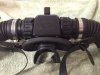
 
GagStrap Purchase

New to CCR and this is my second post on here.
Thank you all for posting your experiences. Read the Hypercapnia thread last night, which led me to this thread.
I ordered the Drager safety mouthpiece with straps today, and will order a BOV for my Prism 2 before class begins.
Thanks, Tripntx
Wisely chosen, Have fun & enjoy the silent world.
 
New to CCR and this is my second post on here.

Thank you all for posting your experiences. Read the Hypercapnia thread last night, which led me to this thread.

I ordered the Drager safety mouthpiece with straps today, and will order a BOV for my Prism 2 before class begins.

Thanks,
Tripntx

Nice one - spread the word.

Safe diving.

Paul
 
Where to buy the Drager mouthpiece and strap?

Great thread, many thanks to all

Water Safety GmbH and Golem Gear both indicate it is no longer available

Suggestions?
 
Back
Top