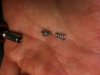
Quick connects for BOV, bailout cylinders etc.

Force = pressure X surface area.

The larger the connector, the more area.

The higher the pressure, the higher the force per area.


Hydraulics run at 1500-3000 PSI, and they usually use fairly large connectors. No doubt they are hard to plug.

We're using 140 PSI and smaller connectors. Basically you'll feel the same push-on pressure from any connector connecting a similar pressure to a similar diameter connection. These then are about the same as plugging in a CEJN.


Empirical observation: No problems noted using these on my CIS Mk-5P for many years.
CIS uses male for dil and female for 02 on the rig, cylinder hoses are reversed.


Dave

.

yes thats what i was thinking the stuff iv use is/was some what bigger that the 1/4 inch in your post ,, thanks for the reply ,
 
What would the cost of the 71 series connectors you listed? And how is the connection achieved to the hose (in other words do you need a few other fittings to make the connection?)

Seems from this link that you'd need the following for a typical BOV to stagebottle connection:

BOV
-> Regulator hose
--> 3/8" F to 1/4" NPT M (Omniswivel NP-UM-ZF, £10 at Miflex UK online)
---> 1/4" NPT F 71 SS Coupler (Snap-Tite S71-3C4-4F, $152.37 at above link)

Stage
-> Regulator hose
--> 9/16" M to 1/4" NPT M (Omniswivel NP-UM-YM, £10 at Miflex UK online)
---> 1/4" NPT F 71 SS Nipple (Snap-Tite S71-3N4-4F, $73.60 at above link)

Total cost for one kit would then be ~$260. Additional stage kits would be ~$90.

(Dave - feel free to correct me if I have misread the parts from Snap-Tite :) )
 
Last edited:
Does anyone know the flow-rate of the Parker 71 fittings? I am really looking at buying a set for my BOV connection.

I know the QC6 have a great flow rate, but as Dave already said, they're crap. I am using the Omni QD's right now and if there is something that is easier and better, I am all for it.
 
Does anyone know the flow-rate of the Parker 71 fittings? I am really looking at buying a set for my BOV connection.

I know the QC6 have a great flow rate, but as Dave already said, they're crap. I am using the Omni QD's right now and if there is something that is easier and better, I am all for it.

Nope but I can tell you how to test if you can be bothered....
AP valves rated their DS4 at 4000LPM by screwing one in to a twinset with a missing port and then timing how long it took to empty the tanks.

Using the same methodology it's easy enough to hook all your gubins together and blow away a few tanks of gas to get some metrics, I am too poor to have twinsets of air kicking around but I would be happy to come play if some one has a club compressor to work with.

I also have QC6's and had Omni and don't like either and am likewise in the market if you can source them.
 
Last edited:
In actual fact... the Swagelok QC-x fittings are some of the worst ones for diving use. The stems get bent, they are finicky, clog with cave-crumbs, etc. They are used because they are familiar, not because they are particularly well suited.

The Cis Lunar Mk-5P used flush faced, no-spill, zero-loss fittings made by Parker-Hannifin. These are the gold standard for a connector: impossible to clog, no exposed stems, etc. They really ought to be the standard for diving. Unsure why the "Industry" went to inferior substitites.


Dave

.

Why the 71's and not the 74's that shuts both ends?

/nils
 
Nope but I can tell you how to test if you can be bothered....
AP valves rated their DS4 at 4000LPM by screwing one in to a twinset with a missing port and then timing how long it took to empty the tanks.

I wonder how big the ice-cube was!

Matt.
 
Nope but I can tell you how to test if you can be bothered....
AP valves rated their DS4 at 4000LPM by screwing one in to a twinset with a missing port and then timing how long it took to empty the tanks.

Using the same methodology it's easy enough to hook all your gubins together and blow away a few tanks of gas to get some metrics, I am too poor to have twinsets of air kicking around but I would be happy to come play if some one has a club compressor to work with.

I also have QC6's and had Omni and don't like either and am likewise in the market if you can source them.

You can order them online from here, Flat Face, No-Spill, Drybreak, Push-to-Connect Hose Coupling - Snap-tite 71 Series on Snap-tite, Inc., Quick Disconnect & Valve Div.
I think I will order a set to try out, problem is if they aren't any better than the flow rates of the Omni QD's, it's a waste of $250.
 
Hi guys I've used AP valves GCS connectors, swagelok and omniswivel QC's on a number of different rigs and BOV's' and can say I didn't notice any real advantages or disadvantages on either of these, and I did test them at depth under normal diving conditions. Although the GCS system does require more maintenance as it's not 316.
I've never had any problems with crud ingress, but then again I don't cave dive either.
In the end I opted for the omniswivel QC'S's as this was what most of my friends that I dive with are using.
The Parker fittings would appear to be $$$$$$ though.

Cheers

Stuey
 
Hi guys I've used AP valves GCS connectors, swagelok and omniswivel QC's on a number of different rigs and BOV's' and can say I didn't notice any real advantages or disadvantages on either of these, and I did test them at depth under normal diving conditions. Although the GCS system does require more maintenance as it's not 316.
I've never had any problems with crud ingress, but then again I don't cave dive either.
In the end I opted for the omniswivel QC'S's as this was what most of my friends that I dive with are using.
The Parker fittings would appear to be $$$$$$ though.

Cheers

Stuey

Same, I hated the Omni, impossible to manipulate in dry gloves, using the QC's now but the stem is annoying and even if you dive with caps on them also difficult to un-cap under water. I like the idea of something entirely robust and easy to connect, I want / tend to like diving with them uncoupled but need to feel that I can get them together if completely out of sorts rather than trying and failing which is what I suspect I would do with caps on the QC's.
 
***304;f anyone is buying the parkers let me know. ***304; would like to piggyback the order :)

For logistics puropses, i live somewhere where the customs is a nightmare.
 
So has anyone actually tested the Parker QC's in the real world yet? Interested to hear what people think as I'm currently thinkin I'll go with a QC-6 setup.
 
I am now using them, they are fairly 'beefy' and their force to couple is not ideal but compared to the QC6 they are low / no maintenance. My bail out / BOV plan is that I spend the first 10 breaths trying to couple them and at worst going for my off-board, in the meantime if I have not slowed breathing I know what's wrong. I don't want to leave them connected by default hence why it was the choice in this instance.

P
 
I was looking for different quick connect options. Most use Swagelok QC6 or CEJN 221.

Has anyone tried CEJN DN6 series?
You can get it in DESO model like Swagelok QC6.
"The Non-Drip design of the Series ensures practically zero spillage and eliminates pollution and air inclusion during connection and disconnection."

QC's are a waste of time, go to M&J's or omni swivels as they are more commonly know.
 
I find the Swagelok, like on the Meg for the O2 connector, too delicate for cave use.

If the little pin protrusion at the front breaks, the connector no longer operates.

I prefer CEJN.

Now the Omniswivel female also works/connects on the CEJN male (for some reason the earlier ones did not for me), so all my male nipples are CEJN.

For O2, I use the Omniswivel female because it is locking (it will not disconnect accidentally once rotated and locked in position) and, for example, and I do not want it to unlock accidentally in use and flood the solenoid (which then will fail and I will need to service...).

For all others, I use the CEJN male from XS-Scuba.

I do try to avoid QCs though wherever practicable.

So far no problem, but they are really hard to connect under pressure.

It works though.
 
I find the Swagelok, like on the Meg for the O2 connector, too delicate for cave use.

If the little pin protrusion at the front breaks, the connector no longer operates.

I prefer CEJN.

Now the Omniswivel female also works/connects on the CEJN male (for some reason the earlier ones did not for me), so all my male nipples are CEJN.

For O2, I use the Omniswivel female because it is locking (it will not disconnect accidentally once rotated and locked in position) and, for example, and I do not want it to unlock accidentally in use and flood the solenoid (which then will fail and I will need to service...).

For all others, I use the CEJN male from XS-Scuba.

I do try to avoid QCs though wherever practicable.

So far no problem, but they are really hard to connect under pressure.

It works though.


Gian can you post some pic's please of these parts ...just so it's clear for us .
Tony
 
Gian can you post some pic's please of these parts ...just so it's clear for us .
Tony

CEJN in particular and many other things I source from NESS because they have a good range of QCs and they are good and quick and fairly priced.

Here is the links to what I use:

CEJN to Regulator Hose - Northeast Scuba Supply

CEJN to Second Stage Adapter - Northeast Scuba Supply

Of the following one I do not use the nipple (only the female bit):

CEJN Quick Disconnect - Northeast Scuba Supply

Pre-dive you must check all your QCs and shared QCs in the team actually fit and work (otherwise you end up finding out when you need it that two QCs although they are the same brand or compatible parts do not work on a particular male to particular female).

Manufacturing process does not always produce the same identical QCs or one manufacturer may have slightly changed the specs. and the QCs are no longer cross-compatible.
 
We are 3 Kiss Classic divers in Linköping Sweden.
All gas tanks are sidemounted and QC6 connected.
We have used them about 1500 hours without problems.

But stay away from QC4!
Earlier we used QC4 as oxygen connection to distinguish them from dil connections.
On the male, the tip (really a nut) unscrewed and parts was lost.
Also the shaft was bent and sometimes broken.
see picture.

4 of 5 (80%!!!!) of the SS-QC4-D-4PF was broken before we gave up and
replaced them with QC6.

To distinguish O2/DIL we use the O2 QC-s in opposite direction.

(O2 MAVS on all O2 tanks - we don't want 10 bar dil to be connected
directly to the loop :wavey: )

The onboard QC-s are mounted in 2 Omniswivel blocks mounted on the
harness. Both hands can be used to overcome the pressure resistance while
connecting.

Regards
Sven
 

Attachments

  • QC4 broken small.JPG
    QC4 broken small.JPG
    20.2 KB · Views: 178
  • QC6 on harness liten.JPG
    QC6 on harness liten.JPG
    88.5 KB · Views: 180
Back
Top