So kind of like switching to an intermediate decompression trimix on OC ? The difficulty for me would be this : from the time you start to add air to the loop until the time you flush with 02 at 6m, you have no way of knowing what fraction of helium and nitrogen is in the loop. To allow for this accurately in your decompression planning is impossible. IMHO if you are going to change the makeup of your diluent it should be a full flush and proper planning.

You are using an out of date browser. It may not display this or other websites correctly.
You should upgrade or use an alternative browser.
You should upgrade or use an alternative browser.
Gas switch using air
- Thread starter JukkaO
- Start date

matt
Well-Known Member
If you were to conduct a deep and long dive on a high helium-content diluent and then on ascent switch to air and do a full loop flush, is it possible that the sudden lack of inspired helium coupled with a high saturation of helium in the tissues would cause the helium to offgas at a rate which might bring on a bend ?
Yes, depending on the mixes.
Matt.
matt
Well-Known Member
I am not writing about complete diluent or air flush.
It is possible to replace let´s say 1...2 liters of the loop volume with air. It will soon be mixed and the result includes less helium than earlier. It could be repeted using small steps avoiding big gradients.
Jukka
I'm still unclear on the benefit, BTW. Perhaps there isn't one and it's just a discussion - which is also fine!
Matt.
I'm still unclear on the benefit, BTW. Perhaps there isn't one and it's just a discussion - which is also fine!
Matt.
Less helium on the ascend would be better. How much less and how to manage it is the challenge. The portion is getting lower on ascend always but not enough without any flush.
Another question: What helium% the planners are using in calculations? It has been said here many times that it is not possible to know what it really is on ascend. But still I guess less is better.
Jukka
matt
Well-Known Member
Less helium on the ascend would be better.
Not sure that's either true or provable.
I'm now of the opinion that helium is my friend and therefore I keep on the mix all the way up for the reasons stated.
Matt.
matt
Well-Known Member
Maybe true from Buhlmann based deco, but not sure it applies to VPM....
Not sure it applies physiologically regardless of the algorithm but absolutely no way to tell for sure!
As an OT, could someone with VPM desktop run the profile side-by-side with Buhlmann with that switch (full flush 60m I guess is the only practical way unless we work out a dozen gas switches breath-by-breath
 ) so we can see that difference?
Matt.
Not sure that's either true or provable.
I'm now of the opinion that helium is my friend and therefore I keep on the mix all the way up for the reasons stated.
Matt.
It is quite impossible that the optimal mix is the one we get just by doing nothing to have it. If less is not good, should we add some He then? If we one day know, we can think how to use that info. Or as many of us have done we just try something and see how it goes. It just does not proof much as the whole deco theory is so inaccurate. I like to discuss first if there is someone already who knows. New ideas might also rise up when discussing. All the comments are very wellcome.
Jukka
matt
Well-Known Member
It is quite impossible that the optimal mix is the one we get just by doing nothing to have it. If less is not good, should we add some He then? If we one day know, we can think how to use that info. Or as many of us have done we just try something and see how it goes. It just does not proof much as the whole deco theory is so inaccurate. I like to discuss first if there is someone already who knows. New ideas might also rise up when discussing. All the comments are very wellcome.
Jukka
Discussion is good, agreed.
Matt.
Approach from a different angle.
When you ascend using OC would you switch to gas with proper END for the depth?
Or would you like to keep He high during the whole ascend?
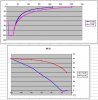
Here we have two OC calculations from V-Planner. 20min at 120m.
One represents how it goes with CCR without any flush. He is decreasing slowly.
Another is with diluents with optimal END for the depths.
Calculations are not exact but you get the idea about the difference. Both are OC to keep it simple and comparable.
One could cut 1,5h from 5h dive.
Off gassing of He is not included.
It is not only about comfort but shorter deco is more safe in many ways if you can do it with the same DCS risk.
Jukka
When you ascend using OC would you switch to gas with proper END for the depth?
Or would you like to keep He high during the whole ascend?
Here we have two OC calculations from V-Planner. 20min at 120m.
One represents how it goes with CCR without any flush. He is decreasing slowly.
Another is with diluents with optimal END for the depths.
Calculations are not exact but you get the idea about the difference. Both are OC to keep it simple and comparable.
One could cut 1,5h from 5h dive.
Off gassing of He is not included.
It is not only about comfort but shorter deco is more safe in many ways if you can do it with the same DCS risk.
Jukka
Attachments
matt
Well-Known Member
Approach from a different angle.
When you ascend using OC would you switch to gas with proper END for the depth?
Or would you like to keep He high during the whole ascend?
Yes - but that's not due to choice it is due to necessity & practicality. My carried choices OC are limited.
Here we have two OC calculations from V-Planner. 20min at 120m.
One represents how it goes with CCR without any flush. He is decreasing slowly.
Another is with diluents with optimal END for the depths.
Calculations are not exact but you get the idea about the difference. Both are OC to keep it simple and comparable.
One could cut 1,5h from 5h dive.
Off gassing of He is not included.
Dil=6/72, SP=1.3, GF=15/85, 120m, 20 mins:
Ascent
#1 SP=1.3, Dil=6/72, Total Time=210
#2 SP=1.5, Dil=6/72, Total Time=178
#3 SP=1.3, Dil=Air@63m, Total Time=153
#4 SP=1.5, Dil=Air@63m, Total Time=141
So we could save 69 mins by flush and higher SP. But I personally don't feel good after that, so I do not take those flushes anymore and settle for 32 minutes saving.
If I wanted more then I would shave without flush, perhaps as much as half the 37 minutes extra suggested saving.
It is not only about comfort but shorter deco is more safe in many ways if you can do it with the same DCS risk.
Jukka
I'm not sure you can, I feel quite bent on #3 & #4. YMMV.
Matt.
matt
Well-Known Member
Matt: You make comparisons with quite high PPO2 and very dramatic flush. I do not understand your comment?
Is your 120m 20min run time or time spent at 120m as it is in my example?
How do you explain the huge difference what you might accept on OC but not when using CCR?
Jukka
Personally I have not dived OC to 120m, my deepest OC is around 80m due to the gas carried.
Do you consider 1.3 and 1.5 high ppO2? I use those all the time.
You say the move to air is dramatic; what would you use - we used to move first to 50% at 21m, is that more or less dramatic?
My only point is that I don't think moving off the gas onto N2 in CCR diving gives a decent result when diving deep.
Matt.
I try to find out the difference with different He contents in the mix. 1.1 and 1.3 that I used in calculations are conservative for most divers and good when comparing different He%. I also took off air brakes. O2 dosage is quite high already with 1.1 and 1.3. Air brakes had just made the calculations more complex to compare.
In the picture attached below I describe He% changes starting from 100m and the difference what happens in CCR just by tuning PPO2 and what could be done within the limits of reasonable END. Switch to air at 63m is out of space compared to what I am writing.
I am not trying to discuss what divers did on dives in the past but what might be the future.
Jukka
In the picture attached below I describe He% changes starting from 100m and the difference what happens in CCR just by tuning PPO2 and what could be done within the limits of reasonable END. Switch to air at 63m is out of space compared to what I am writing.
I am not trying to discuss what divers did on dives in the past but what might be the future.
Jukka
matt
Well-Known Member
I am not trying to discuss what divers did on dives in the past but what might be the future.
Jukka
I admit I did not fully follow your chart...what's the gas list?
I've also tried 20/30 flush at 63m, with the same result (I also tried air at 42m).
Matt.

Clare
Retired - going diving
Years ago Proplanner used to wipe out tons of deco if you put a couple of minutes in with a deep switch to air. I used to do it all the time, always felt absolutely shagged afterwards.
There have been a few deaths where deep air switches have been suggested as contributing to the accident. Rob Parker's accident is one that springs to mind, IIRC it was suggested that a deep air switch had caused some deco problems.
Talked to some old wkpp guys about this. Jarrod spoke of switching to air deep as being like being hit between the eyes with a sledgehammer.
I don't really care that much about what I can get a theoretical model to do if I twist it. One benefit of CCR is the gradual changes it makes on ascent. Same reason my deep deco gases have helium in.
Thanks for all the comments received through different channels.
Comments about switching to air are misleading the discussion in this forum. There has been no suggestions or support to do that.
The drawings earlier are describing gradual change in He content. The idea was just to add small amounts or air to the loop but the whole method of changing the mix is not important in this phase. The big question is is it the best method to have more than 50% He in the loop still at 20m. I do not mean that the blue line is the way to go but it just gives the idea that it is a question about a big difference in the calculations.
I recognize two different views. Some think that planners are right and having less He in the loop during ascend allows less deco. Some others think that planners do not understand how He is leaving the body and it does not make the deco shorter if the He starts to off gas deeper. Some divers just cut the shallow deco alhtough planners does not.
Jukka
Comments about switching to air are misleading the discussion in this forum. There has been no suggestions or support to do that.
The drawings earlier are describing gradual change in He content. The idea was just to add small amounts or air to the loop but the whole method of changing the mix is not important in this phase. The big question is is it the best method to have more than 50% He in the loop still at 20m. I do not mean that the blue line is the way to go but it just gives the idea that it is a question about a big difference in the calculations.
I recognize two different views. Some think that planners are right and having less He in the loop during ascend allows less deco. Some others think that planners do not understand how He is leaving the body and it does not make the deco shorter if the He starts to off gas deeper. Some divers just cut the shallow deco alhtough planners does not.
Jukka

divetheworld
New Member
Matthew mentioned twice the risk of gas shifts on the compartments, ok it was subtle but no one seemed to pick up on it.
Making significant gas shifts close to your compartment limit runs a high risk of ICD. The anecdotal posts above give credence.
As a side note;
What can be surprising is the effect on computed deco when working with gases in some older computers. If you were running a 10/52 for example, at the last stop at 3m (sp 1.3) - some older computers would show different TTS if you changed to OC 100%.
Interesting how they handle inerts in the calcs. I bring this up in light of Matts post above with the loop mixes. Ponder away.
Making significant gas shifts close to your compartment limit runs a high risk of ICD. The anecdotal posts above give credence.
As a side note;
What can be surprising is the effect on computed deco when working with gases in some older computers. If you were running a 10/52 for example, at the last stop at 3m (sp 1.3) - some older computers would show different TTS if you changed to OC 100%.
Interesting how they handle inerts in the calcs. I bring this up in light of Matts post above with the loop mixes. Ponder away.
Matthew mentioned twice the risk of gas shifts on the compartments, ok it was subtle but no one seemed to pick up on it.
Making significant gas shifts close to your compartment limit runs a high risk of ICD. The anecdotal posts above give credence.
As a side note;
What can be surprising is the effect on computed deco when working with gases in some older computers. If you were running a 10/52 for example, at the last stop at 3m (sp 1.3) - some older computers would show different TTS if you changed to OC 100%.
Interesting how they handle inerts in the calcs. I bring this up in light of Matts post above with the loop mixes. Ponder away.
What do you mean with "significant gas shifts"? The blue line indicates such as from 70% to 60% at 100m and I think even smaller step is still very usefull. The curves are made with current V-Planner.
Jukka
divetheworld
New Member
What do you mean with "significant gas shifts"? The blue line indicates such as from 70% to 60% at 100m and I think even smaller step is still very usefull. The curves are made with current V-Planner.
Jukka
Now we are talking inner ear ICD. Significant is not defined, its more of a sliding scale of risk.
However, a change of gas at a compartment limit will result in transient increases in total inert gas pressure. How much increase? Dunno, I've seem little empirical data or studies to comment.