In loop gas change calculation

Hi Ross

I remember you had taken a couple pages of notes and we discussed a figure - one from NEDU TR 12-04 I think - but I don't remember this last part, your thoughts on the deco mechanism behind what you are calling deep water IE DCS. Perhaps you could explain them here?

David

Hi David, thanks for confirming that.


One day soon, I will update the IBCD topic is my DecoMyths page with diagrams using the current info and so on. I will ask you to review it when thats done.


But I don't think we need to go through the gory details here, as that might just upset the narcasist beyond his boiling point.
 
I'd like to see it too, please. Why not post it up now?

Matt.

No sorry matt.

David does the in-depth deco science, but not even he tackles this issue in public discussion forums.

I do the software programming, to avoid the problems identified by the deco science above. What's important here from my end, is the program does the right thing at the right place (which happens now).


The issue needs diagrams, and a plain text conversation is just going to end up in another sh1t fight.
 
Last edited:
So, to recap:
The person about whom a claim was made... one of a handful of people on the planet who knows enough to validate/invalidate some science says, "I don't think you know what you're talking about."

The response:
"Yes I do. You totally said I'm right, but I'm not going to tell you the specifics about what you said I'm right about."
 
David and Simon,

Can you clarify something for me?

Based on my understanding of the gas kinetics research published the half times for helium and nitrogen can be assumed to be the same. As such, switching from helium to nitrogen based gases during decompression to speed up the rate of ascent is not going to be effective as suggested by some decompression programs. Is this a correct assumption?

My other question is this - Is there any reason why we should switch from high helium to nitrogen dominant gases on ascent assuming we do the decompression originally prescribed by the helium schedule?


Sent from my iPhone using Tapatalk
 
David and Simon,

Can you clarify something for me?

Based on my understanding of the gas kinetics research published the half times for helium and nitrogen can be assumed to be the same. As such, switching from helium to nitrogen based gases during decompression to speed up the rate of ascent is not going to be effective as suggested by some decompression programs. Is this a correct assumption?

My other question is this - Is there any reason why we should switch from high helium to nitrogen dominant gases on ascent assuming we do the decompression originally prescribed by the helium schedule?


Sent from my iPhone using Tapatalk

Hi Gareth

Yes, correct to the first question, helium and nitrogen half times are probably the same except for slow exchanging tissues. As a result typical length decompressions probably cannot be accelerated with a helium-to-nitrogen switch. There is only a little data and the data is a bit conflicting but is more heavily in support of no acceleration.

As to the second question. For very long decompressions, say 10 hours or more, a switch to nitrox might accelerate the decompression (or make the longer, heliox-prescribed decompression safer), because you will be washing gas out of the very slow exchanging tissues where nitrogen exchange is slower than that of helium. For more typical length decompressions, there is some very soft data suggesting the overall risk of DCS is similar with or without the heliox-to-nitrogen switch, but that staying on heliox throughout decompression results in more of the DCS being Type II. Neither of these potential advantages have been confirmed with direct experiments. I think I have your email, but if you pm me with it I can send you a review paper that gives a bit more detail.

David
 
Last edited:
Thanks David.

Makes an interesting dilemma for computer manufacturers and software engineers who follow previous assumptions about helium and nitrogen half times.

On the one hand we don't know what we don't know and they are merely representing the current model. On the other hand do they now have a responsibility to highlight this specific flaw in the models based on emerging research. Not a question directed at you but would be interesting to hear the perspective from Shearwater, V Planner etc. Same could be said for training agencies and how they position this topic with students.


Sent from my iPhone using Tapatalk
 
Thanks David.

Makes an interesting dilemma for computer manufacturers and software engineers who follow previous assumptions about helium and nitrogen half times.

On the one hand we don't know what we don't know and they are merely representing the current model. On the other hand do they now have a responsibility to highlight this specific flaw in the models based on emerging research. Not a question directed at you but would be interesting to hear the perspective from Shearwater, V Planner etc. Same could be said for training agencies and how they position this topic with students.

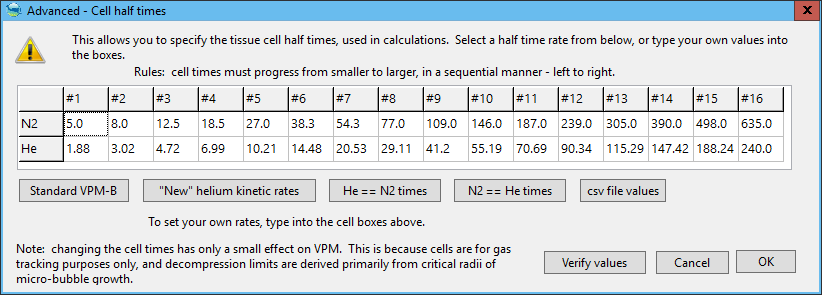
V-Planner already has the ability to apply and test these different theories. Under the advanced configuration, you can set the cell half times to suit yourself. It includes a set of times based on presentations and conversations with David. Go ahead and experiment all you like.

vp_adjusthalf.png
 
Ross,

Does the default setting still differentiate helium and nitrogen parameters. Guess that was my point. Do you as a software company have a responsibility to represent the gas kinetics as we understand them today based on improved knowledge?


Sent from my iPhone using Tapatalk
 
Ross,

Does the default setting still differentiate helium and nitrogen parameters. Guess that was my point. Do you as a software company have a responsibility to represent the gas kinetics as we understand them today based on improved knowledge?


Default settings will remain unchanged. We have provided advanced settings for you to set your own gas kinetics values. Monkey with it all you want.

If one day there is enough peer reviewed, tested, validated information to make a model with, then we will add a new model and new designation.

But Gareth, I think you are getting way ahead of the situation. One set of observations, and review paper, do not make for a model. Your asking for changes, that you have no idea where they take you.
 
Last edited:

David -

Out of curiosity, did you agree to have your name directly associated with the function of a product that allows people to monkey with the theoretical half-times of tissues when they have no idea what they're doing (considering even the best minds in the world on this topic barely know what they're doing)?

And, if so, are you covered by the manufacturer's insurance when some knucklehead changes every number to 42 (because it's their lucky number), dives according to that plan, gets horribly bent, and their family sues the bejeezus out of everyone even remotely affiliated with the planning software used?
 
David -

Out of curiosity, did you agree to have your name directly associated with the function of a product that allows people to monkey with the theoretical half-times of tissues when they have no idea what they're doing (considering even the best minds in the world on this topic barely know what they're doing)?

And, if so, are you covered by the manufacturer's insurance when some knucklehead changes every number to 42 (because it's their lucky number), dives according to that plan, gets horribly bent, and their family sues the bejeezus out of everyone even remotely affiliated with the planning software used?

No I did not agree to have my name associated with this or any commercial product. Indeed I am not aware of having provided any "helium rates" (my published work describes multi-exponential helium kinetics, not mono-exponential half-times, and not identified with particular compartments in existing decompression algorithms). Ross did describe the half-time scheme illustrated in the [previous, now replaced] figure, and I told him that they look a bit like half-times that I believe have been used in DCAP / Tonawanda II, and declined to review any specific changes to, or output from, the software.

No, I do not endorse making random changes to a decompression algorithm.

I do not endorse any particular piece of commercial decompression software.

David Doolette
 
Last edited:
V-Planner already has the ability to apply and test these different theories. Under the advanced configuration, you can set the cell half times to suit yourself. It includes a set of times based on presentations and conversations with David. Go ahead and experiment all you like.

vp_adjusthalf.png

Ross,

Please remove my name from your software. Whereas we have had brief conversation and correspondence about half-times, I have never endorsed a particular set of half-times for use in existing decompression algorithms.

Assignment of half-times should only occur in conjunction with man-dive validation of an algorithm.

David Doolette
 
Ross,

Please remove my name from your software. Whereas we have had brief conversation and correspondence about half-times, I have never endorsed a particular set of half-times for use in existing decompression algorithms.

Assignment of half-times should only occur in conjunction with man-dive validation of an algorithm.

David Doolette

HI, OK I will take your name off the button - no problem. There is also an info panel of references behind this which gives details of the study - Sheep gas kinetics, and the presentations at TekDiveUSA. These are public with your name on them, so no avoiding these.
 
HI, OK I will take your name off the button - no problem. There is also an info panel of references behind this which gives details of the study - Sheep gas kinetics, and the presentations at TekDiveUSA. These are public with your name on them, so no avoiding these.

Thank you for making that correction Ross. I hope no one has downloaded a version of the software with my name on that button.
 
Last edited:
Just put my name on the darned button. That should scare the crap out of everyone.

I gotta say, I love the idea of a Don Six button.

Press it and EVERYONE gets pissed off about something.
 
Last edited:
Default settings will remain unchanged. We have provided advanced settings for you to set your own gas kinetics values. Monkey with it all you want.

If one day there is enough peer reviewed, tested, validated information to make a model with, then we will add a new model and new designation.

But Gareth, I think you are getting way ahead of the situation. One set of observations, and review paper, do not make for a model. Your asking for changes, that you have no idea where they take you.

To be fair Ross, the gas kinetics research was controlled animal testing. Isn't VPM based on lab testing and computer simulation?

Not sure how one view is considered too much of an edge case to be incorporated into a model but the other is not.


Sent from my iPhone using Tapatalk
 
the presentations at TekDiveUSA. These are public with your name on them, so no avoiding these.

Ross, are you basing this comment on some form of enduring material that people can review, because there is clear evidence from earlier in this thread that your interpretation and/or recollection of things that get said in conversations (and by inference presentations) can be substantially inaccurate.

Simon M
 
Last edited:
Back
Top